
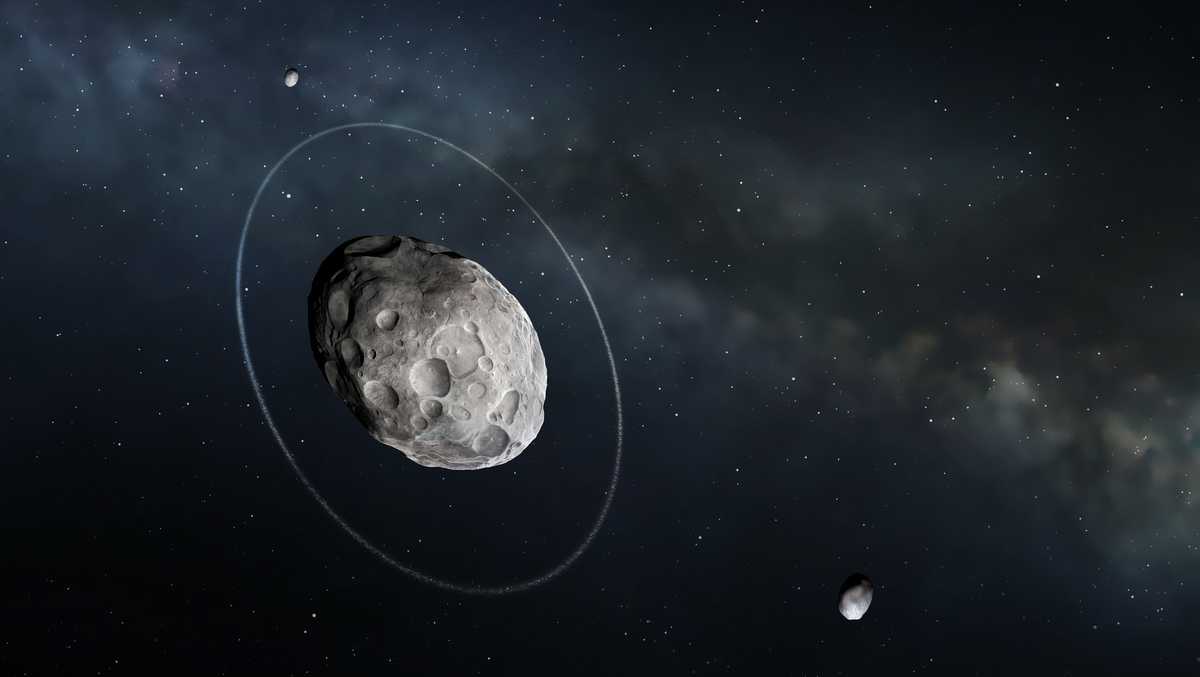

Astronomers have spotted a new dwarf planet candidate in the solar system, beyond the orbit of Pluto, which they provisionally named ED138.
See the orbital path of the new dwarf candidate in the video above
If future observations confirm the discovery, ED138 will join a group currently made up of five dwarf planets that have been recognized by the International Astronomical Union, or IAU: Ceres, Pluto, Haumea, Makemake and Eris.
The finding is the result of detections made by the Vera C. Rubin Observatory, a new telescope that sits atop a 2,682-meter-tall (8,800-foot-tall) mountain in Chile and houses the world’s largest digital camera. The telescope started operating in 2025 and is capable of imaging the entire sky every three days.
Matthew Holman, a Smithsonian senior astrophysicist and lecturer in astronomy at Harvard University, ran a computer program he co-developed to comb through data collected by Rubin earlier in 2026, scanning billions of detections of moving objects. When ED138 popped up, Holman said he first reacted with “excited disbelief” and immediately checked for a false positive or an error with the computer program.
To confirm the observation, Holman, who is also a Rubin Operations team member, worked with his colleague Mario Jurić, the Rubin Solar System lead scientist and a professor in the department of astronomy at the University of Washington. Jurić looked for more observations of ED138 in Rubin’s catalog and found 20 additional ones dating back to March 2026. Eventually, using other sources, the researchers were able to plot the orbit of the object as far back as 10 years.
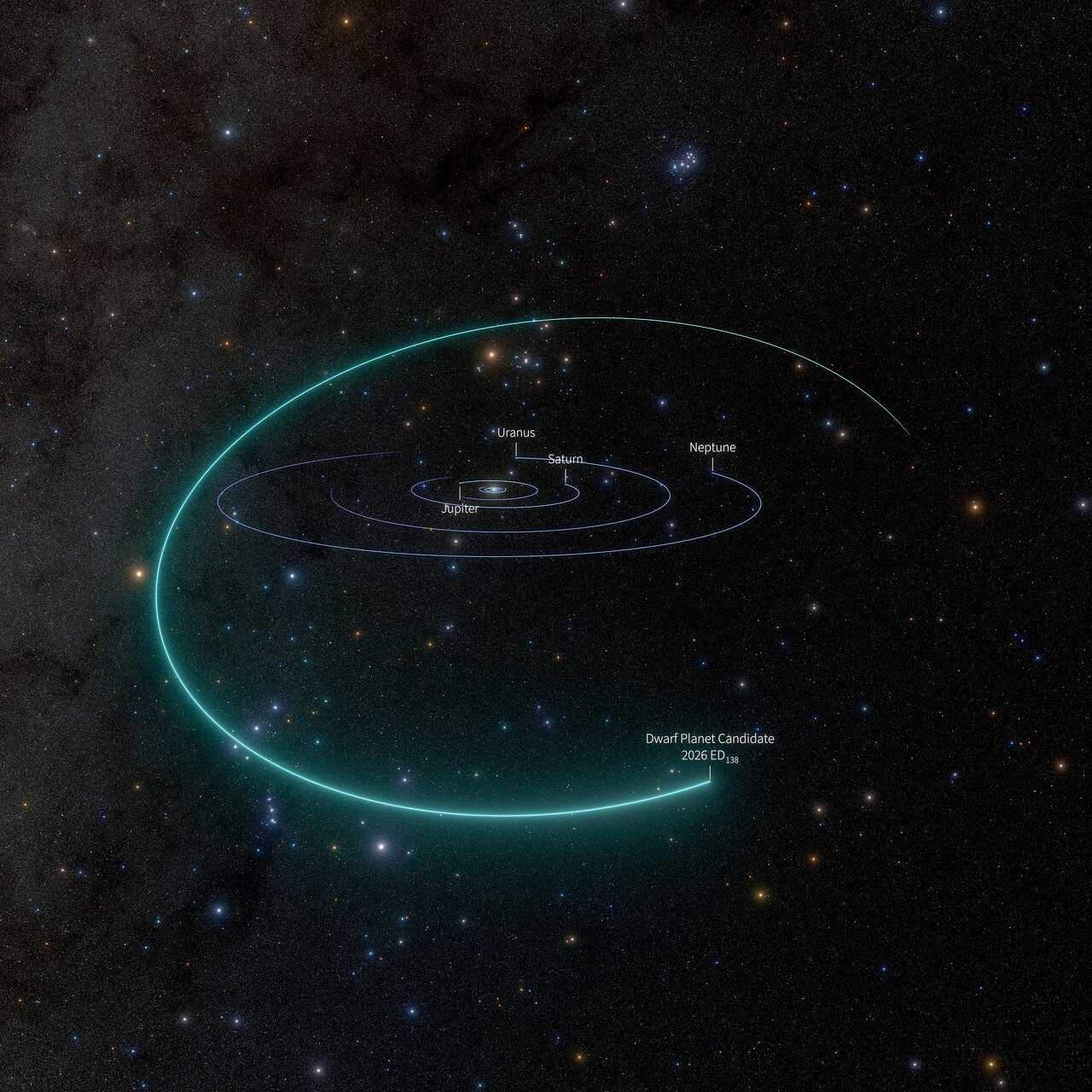
NSF–DOE Vera C. Rubin Observatory/NOIRLab/SLAC/AURA/R. Proctor
A view of the Solar System showing the orbital pathway of newly discovered dwarf planet candidate 2026 ED138.
However, Holman warns, ED138 isn’t officially a dwarf planet yet: “At this point, it’s still a candidate. We really need to know how physically big it is, and that will take a few months, probably.”
ED138 unveiled
ED138’s diameter is estimated to be between 600 and 1,500 kilometers (370 and 930 miles), which would make it bigger than the smallest of the recognized dwarf planets, Ceres. It currently orbits the sun at a distance of about 46 astronomical units — with each unit representing the average distance between Earth and the sun. That means ED138 is farther away than Pluto and also a trans-Neptunian object, or TNO — a class of objects that orbit the sun at a distance greater than Neptune’s.
In the night sky, ED138 is not visible with the naked eye but “is bright enough that really capable amateurs can see it if they know where to look,” according to Holman.
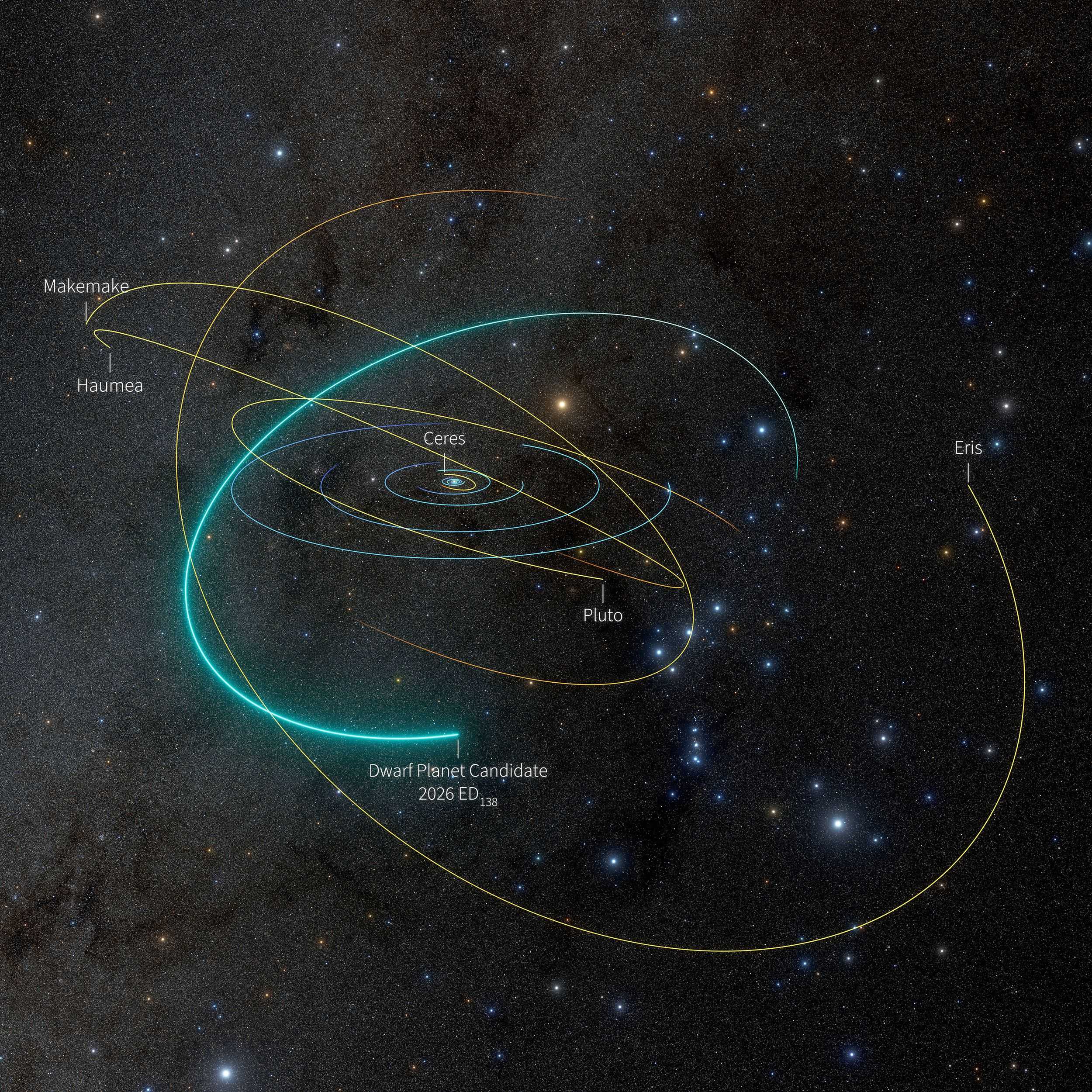
NSF–DOE Vera C. Rubin Observatory/NOIRLab/SLAC/AURA/R. Proctor
A view of the solar system showing the orbital pathway of ED138 and those of the five dwarf planets.
Part of the reason scientists hadn’t discovered ED138 before is that it’s in the southern hemisphere, and therefore very difficult to observe from the northern hemisphere, Holman noted.
“That already rules out whole sets of telescopes that might have found this, and there aren’t as many telescopes searching the sky in the southern hemisphere,” he said.
Another factor that kept ED138 hidden is that it is on the same plane as our galaxy. “For the last 20 years, the object has kind of been looping its way across the Milky Way, from our point of view,” Holman explained. “People don’t typically search for things in the Milky Way, because there’s so many stars that it’s really hard to find moving objects.”
The new dwarf planet candidate joins the Rubin telescope’s growing list of detected objects — largely asteroids and much smaller TNOs. According to Holman, there might be “a handful” more objects the size of ED138, and Rubin should eventually find those, too.
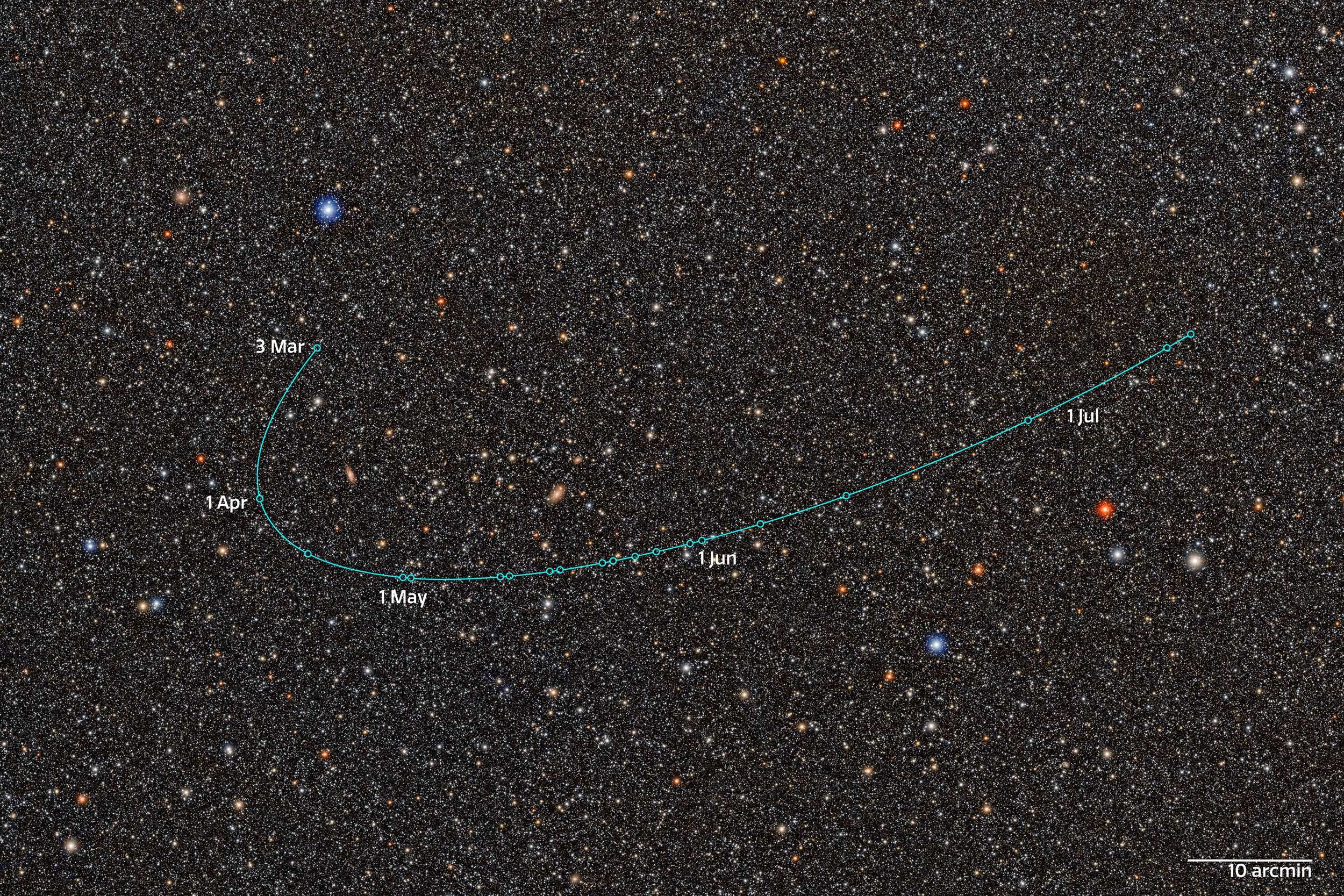
NSF–DOE Vera C. Rubin Observatory/NOIRLab/SLAC/AURA
The orbital path of a newly discovered dwarf planet candidate, ED138, observed by the Vera C. Rubin Observatory.
“Rubin Observatory is just doing its job really well, inventorying the Solar System to new depths,” said Megan Schwamb, a reader in astrophysics at Queen’s University Belfast and a member of the Rubin Solar System Operations team, in an email.
“I was surprised that it found such an object so early in the commissioning observations. This was not on my bingo card for this year,” Schwamb added. “It shows how Rubin’s combination of speed, depth, and sky coverage is going to transform our view of the Solar System over the next decade and especially in the next few years.”
‘Think of it as a world’
In 2006, the IAU adopted a new definition of a planet, describing it as an object that orbits the sun, is mostly round, and is big enough that it has cleared its orbit of objects of similar size. Scientists made the controversial decision to demote Pluto because it didn’t satisfy the last requirement, and our solar system went from nine to eight planets.
At the same time, Pluto and its ilk became known as dwarf planets — nearly round objects that orbit the sun but aren’t large enough to have cleared their own orbits of debris.
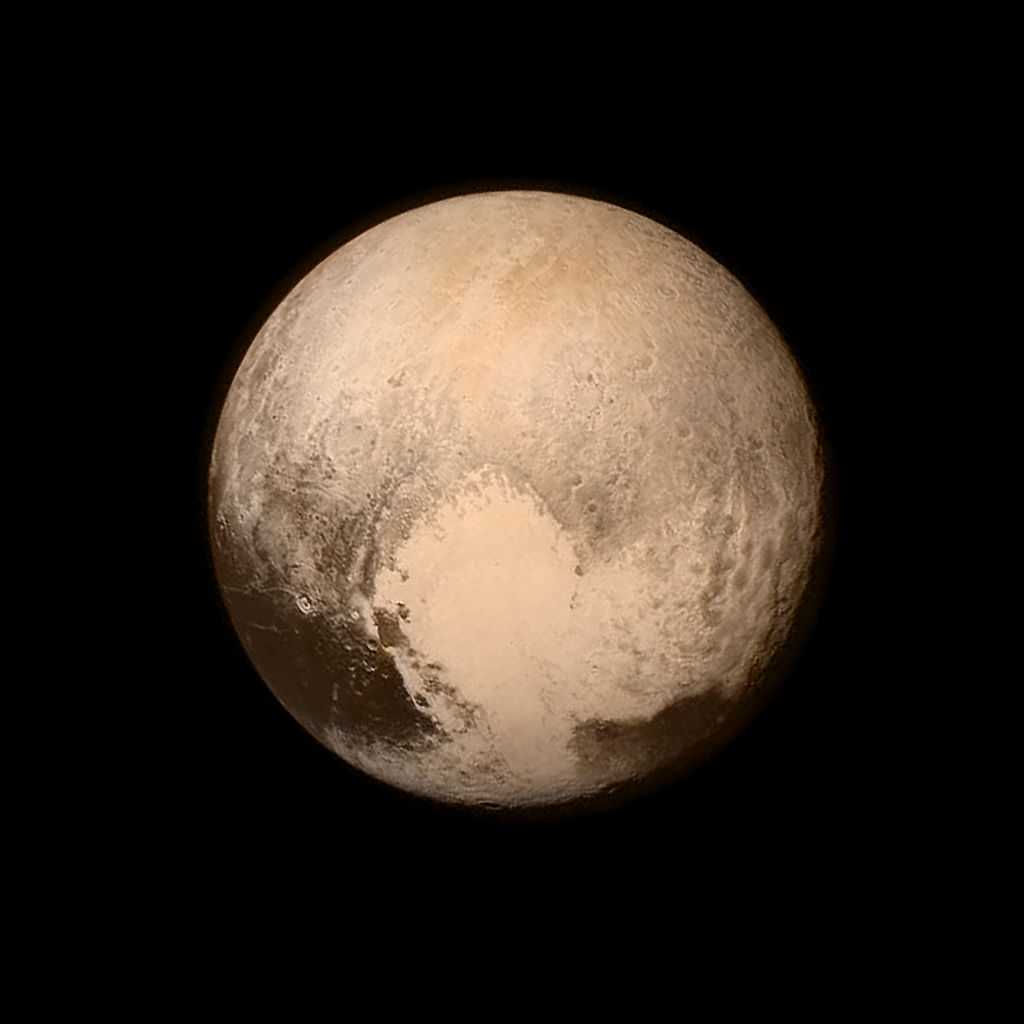
NASA
Pluto nearly fills the frame in this image from the Long Range Reconnaissance Imager aboard NASA’s New Horizons spacecraft, taken on July 13, 2015, when the spacecraft was 476,000 miles from the surface.
If ED138 is confirmed as a new dwarf planet, astronomers will first give it a permanent number and then an actual name, although the process could take time, and the details of who exactly will get to choose the name are still unclear.
“People have already emailed me some suggestions, and some of them are already taken by other objects,” Holman said. “I don’t know. It’ll be fun. Maybe I’ll get to suggest something, but I’m not going to hold my breath, because this is a big, big project.”
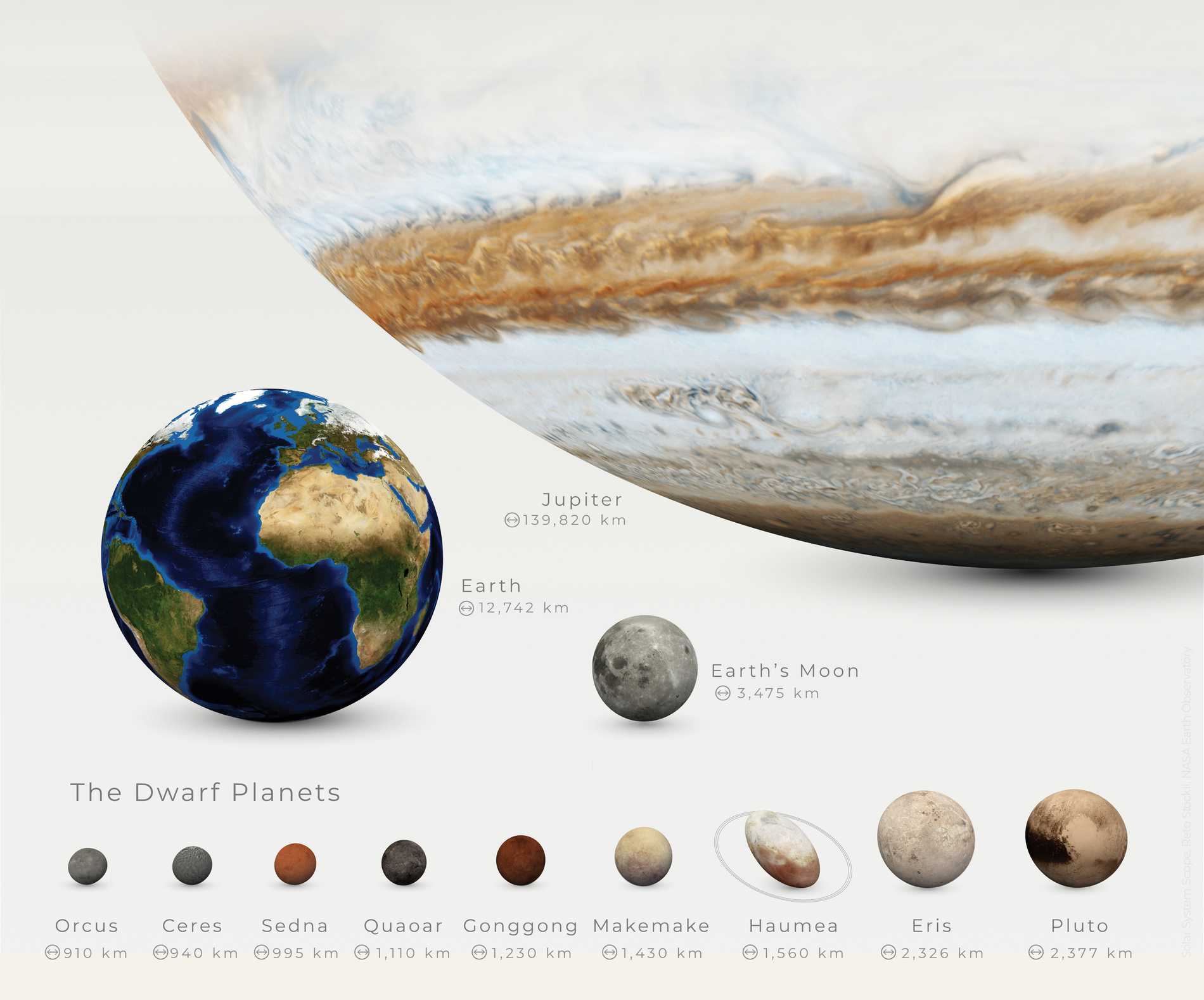
VISUAL CAPITALIST/SCIENCE PHOTO LIBRARY
Illustration depicting the solar system’s five dwarf planets and a few smaller natural satellites.
The finding is significant for the field, said Michele Bannister, an associate professor at the University of Canterbury in New Zealand, who was not involved with the discovery of ED138.
The object is “scientifically really cool because it’s a trans-Neptunian object and it’s also physically quite large, but still a lot fainter than you can see with the naked eye,” said Bannister, who studies the small worlds of the solar system.

NSF–DOE Vera C. Rubin Observatory/NOIRLab/SLAC/AURA
A mosaic of images captured by the Vera C. Rubin Observatory of the newly discovered dwarf planet candidate.
The size of the object is just within the range where we can start to think of it as a world, she added, and other telescopes will now pick up the baton to find out more about it.
“Maybe if we ever fly a spacecraft there, we’ll find it has a nitrogen glacier like Pluto,” Bannister said. “That would be great to see. But at the moment, all we know is that it’s big, and the rest is going to be speculation for a little bit, about what its physical characteristics really are.”