
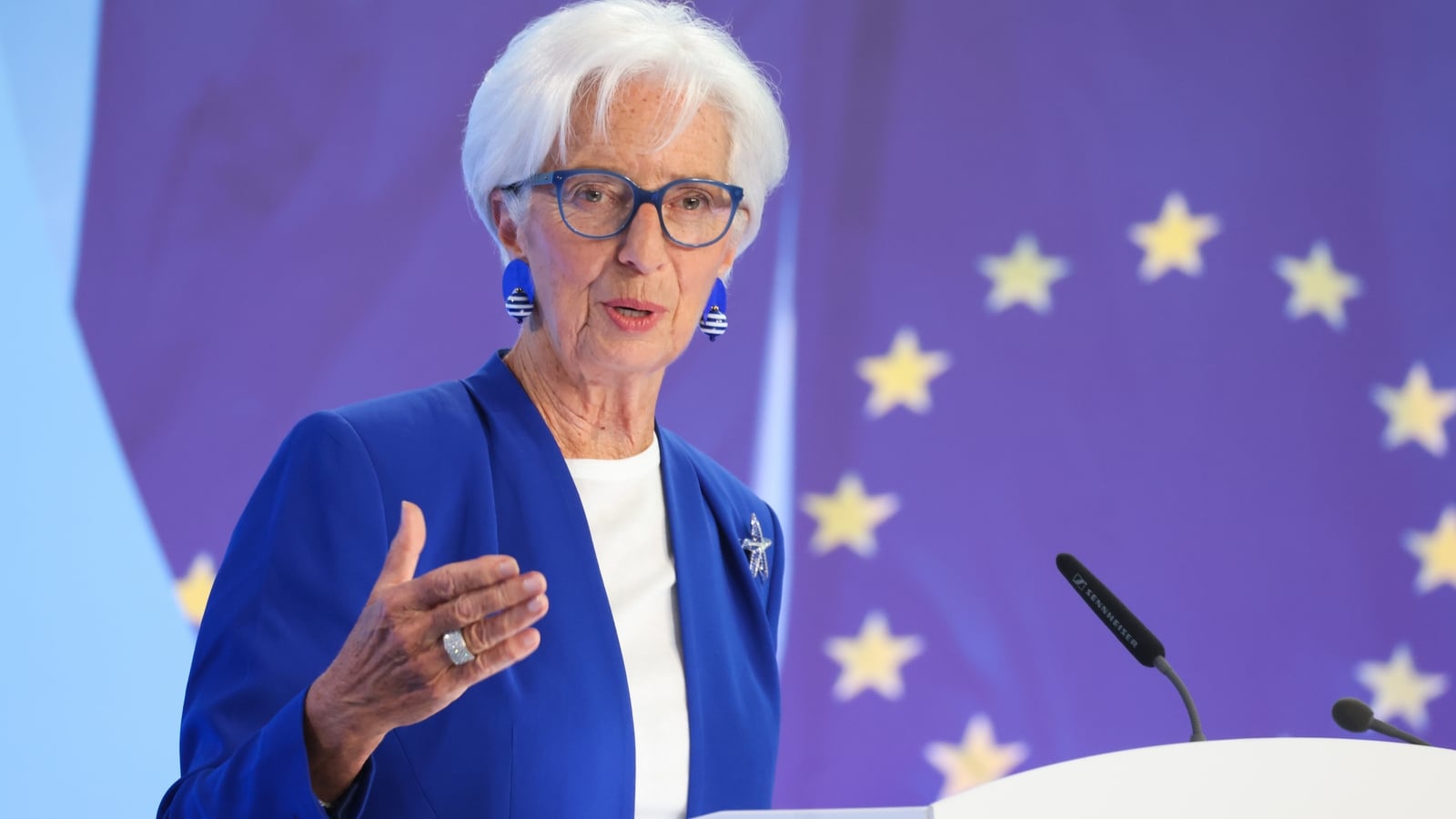
European Central Bank (ECB) President Christine Lagarde has announced her resignation, ending months of speculation about her future at a complex juncture for Europe and the ECB.
Ms Lagarde will step down on 7 February, giving current EU leaders time to pick a successor well before a French presidential election that polls show far-right candidate Marine Le Pen is favourite to win.
“European Central Bank President Christine Lagarde today informed the Governing Council and the President of the European Council António Costa that she will step down from her position on 7 February 2027,” the ECB said in a press release.
The former central bank governors of the Netherlands and Spain, Klaas Knot and Pablo Hernandez de Cos, are seen as frontrunners to replace Ms Lagarde.
Ms Lagarde’s term was scheduled to run until the end of October 2027 but speculation about an early departure had been mounting for months, with the World Economic Forum seen as a likely destination.
EU chief Antonio Costa praised Ms Lagarde’s “leadership” after she stepped down, and said the process to name a successor begins right away.
I have been informed by Christine Lagarde, President of the European Central Bank, of her intention to step down from her role on 7 February 2027. I respectfully acknowledge her decision. I would like to thank Madame @Lagarde for her dedication as President of the @ecb since November 2019. Throughout her mandate, she has led the European Central Bank with a strong sense of duty and responsibility. Europe has been well served by her leadership in uncertain times and her unwavering commitment to the European project. Through a global pandemic, a war in Europe, energy crises and inflation shocks, she has provided a steady and determined stewardship, helping to safeguard stability and the resilience of the euro area. To ensure a smooth transition to the next leadership of the ECB, the process for the appointment of her successor will be initiated today and will proceed without delay, with a view to a timely decision by the European Council acting in its euro area composition, in accordance with the procedure set out in Article 283 (2) of the Treaty on the Functioning of the European Union.
— António Costa (@eucopresident) October 29, 2026
“Through a global pandemic, a war in Europe, energy crises and inflation shocks, she has provided a steady and determined stewardship, helping to safeguard stability and the resilience of the euro area,” Mr Costa, who leads the European Council representing EU states, said.
“To ensure a smooth transition to the next leadership of the ECB, the process for the appointment of her successor will be initiated today and will proceed without delay, with a view to a timely decision,” Mr Costa said on social media.
The move comes as the ECB is in the middle of a rate-hiking cycle, seeking to prevent an oil-price shock linked to the Iran war from feeding into other prices and wages.
But it must also contend with a surge in government bond yields – especially in debt-laden France – that has pushed up borrowing costs for households and businesses and which Lagarde has said will curb growth and inflation.
Caught between persistent inflation fuelled by a renewed surge in energy costs and deteriorating financing conditions, the ECB kept its deposit rate at 2.5% today while signalling that another increase, potentially as soon as December, remains likely.