
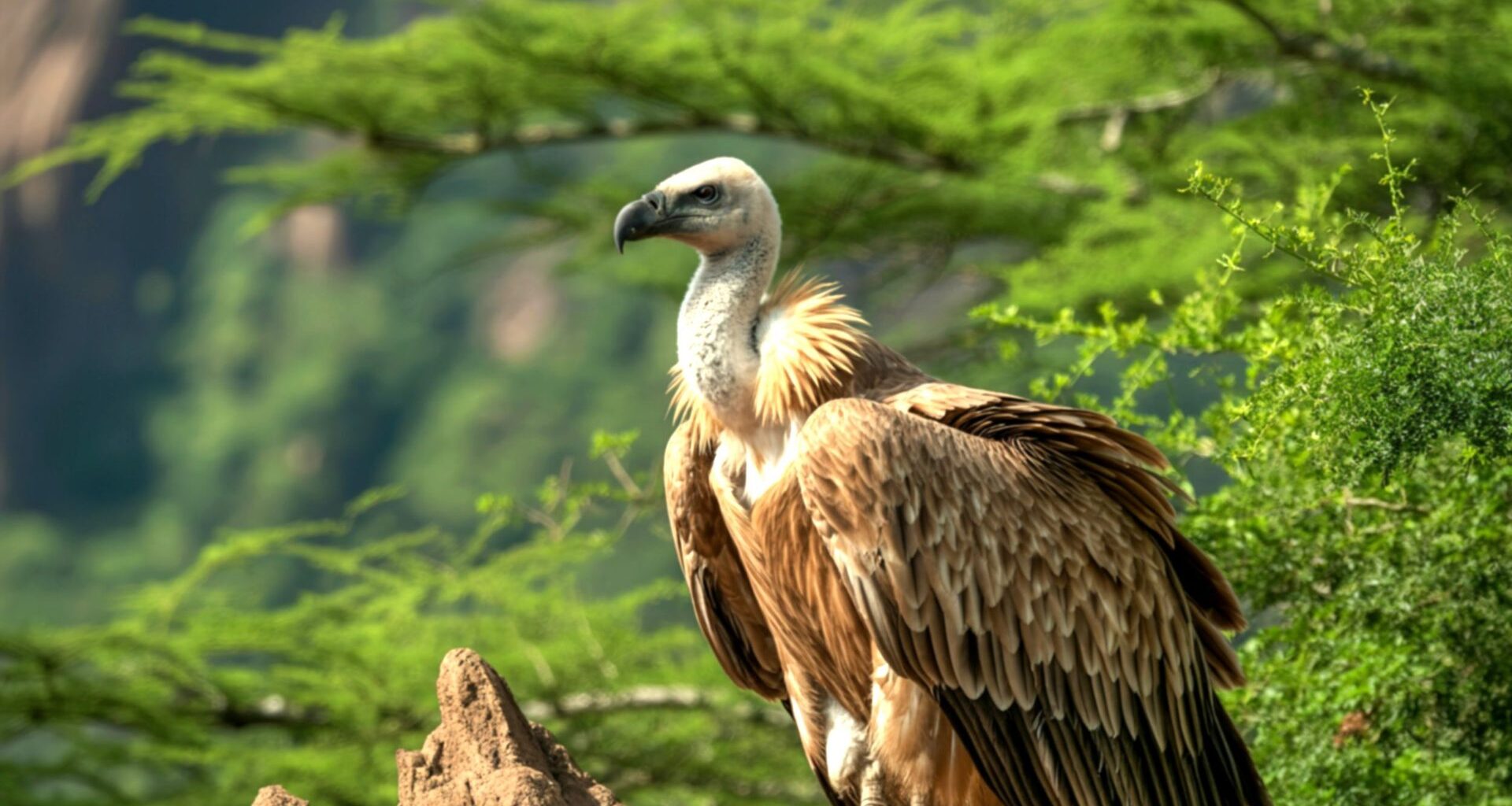
A deadly strain of bird flu is threatening vulnerable vulture populations worldwide, raising concerns about disease spread and ecosystem health.
Vultures do something nobody else will. They eat what is already dead, often rotten, often crawling with pathogens that would kill most other animals.
Their remarkable ability to survive exposure to many dangerous pathogens makes them indispensable to healthy ecosystems.
Without vultures, carcasses accumulate, bacteria spread, disease moves up the food chain.
They are, in a real sense, the biological sanitation system of the terrestrial world.
Now the world’s vultures are facing something their natural defenses cannot reliably protect them against.
A recently published letter warns that the H5N1 avian influenza virus poses a catastrophic threat to vulture populations already thinned by poisoning, habitat loss, and persecution.
Vultures were already in trouble
At least 16 of the world’s 23 vulture species are already of conservation concern. The California condor has fewer than 600 individuals alive, including those in captivity.
The Andean condor ranges across a continent but in decreasing numbers. Griffon vultures in southern Europe were considered a conservation success story.
None of this provides any buffer against H5N1.
The scale of what has already happened is sobering. Thousands of American black vultures and turkey vultures have died across the United States and South America.
In southern Europe, the 2022 H5N1 outbreak killed at least 16 adult Griffon vultures across Spain and France and left hundreds of chicks dead at breeding sites.
California condors, whose total population had fallen to just 27 birds in 1987, lost roughly 6 percent of their wild population in just six weeks.
Bearded vultures in Europe have been affected too.
Documentation from Africa and Asia remains sparse, partly because surveillance is limited and partly because vulture numbers there have already declined so severely that detecting further losses is harder.
A dangerous feedback loop
The letter identifies a feedback loop that makes the situation especially dangerous. Vultures are social and congregate at carcasses – the same places where H5N1-infected animals are most likely to have died.
As scavengers, they are resistant to many bacterial pathogens, but H5N1 is different. The virus kills with high efficiency across domestic and wild birds alike. It has now been confirmed in over 48 mammal species worldwide.
The loop works like this. More infected animals die in the landscape, producing more contaminated carcasses.
Vultures gather at these carcasses and contract the virus. As more vultures die, there are fewer birds to remove the carrion.
“The greater the number of infected carcasses, the greater the risk of contagion for the vultures,” Morant said.
“Since these carcasses can become sources of infection, a paradox arises: as more vultures die, the capacity to eliminate the carrion reduces, the pathogens spread and contagion increases.”
What makes this particularly alarming is that many vulture species are already living close to the edge.
A virus that kills 6 percent of a California condor population in six weeks is not a manageable mortality event for a species with a few hundred wild individuals.
Such losses could undo decades of conservation progress.
Tracking outbreaks before they spread
The letter proposes five coordinated responses. These are framed explicitly as a guide for conservation managers and policymakers across the diverse range of countries where vultures survive.
The first and most urgent is population monitoring.
Without knowing where birds are dying and at what rate, it is impossible to calibrate any other response. Migratory species – which cross national borders and carry the virus with them – need particular attention.
“In the Basque Country, the Griffon vulture population is in a healthy condition, but the Egyptian vulture is more sensitive. We need to pay particular attention to migratory species,” Morant said.
The second is vaccination, where logistical conditions allow. In response to the acute threat to California condors, researchers have already implemented a vaccination program.
The letter advocates continuous evaluation of vaccination as populations come under serious risk.
Third, feeding stations – a conservation tool widely used for vultures across Europe and parts of Africa – need to be managed so that the carcasses provided are verified free of H5N1.
These stations are, by design, places where large numbers of birds aggregate.
In the context of a highly contagious pathogen, that aggregation becomes a liability unless the food supply is controlled.
Biosecurity protocols and context-specific actions
Fourth, researchers working with vultures must follow strict biosecurity protocols since the virus can persist in feathers and tissue after death.
Fifth, the letter calls for context-specific national action plans embedded in shared cross-border governance frameworks.
The countries that host significant vulture populations range across vastly different socioeconomic contexts and regulatory environments.
A one-size approach will not work. But the absence of coordination across borders will not work either, given that the birds themselves do not recognize frontiers.
Why vultures cannot recover quickly
Vulture populations once collapsed can take decades to recover, if they recover at all. The birds are long-lived and slow to reproduce – most species raise only one chick per year.
A sustained mortality event can hollow out a population without any dramatic visible collapse, simply by preventing the replacement of birds that die. H5N1 adds rapid, acute mortality on top of that slow demographic pressure.
“We wanted to alert the research community and those responsible for conservation so that they could establish coordinated actions,” Morant said.
“To tackle this dangerous epidemiological situation, it is urgent to develop coordinated cross-border plans and to integrate these actions into shared governance structures.”
The birds that clean up after everything else now need someone to look after them.
The study is published in the journal Conservation Biology.
—
Like what you read? Subscribe to our newsletter for engaging articles, exclusive content, and the latest updates.
Check us out on EarthSnap, a free app brought to you by Eric Ralls and Earth.com.
——-