
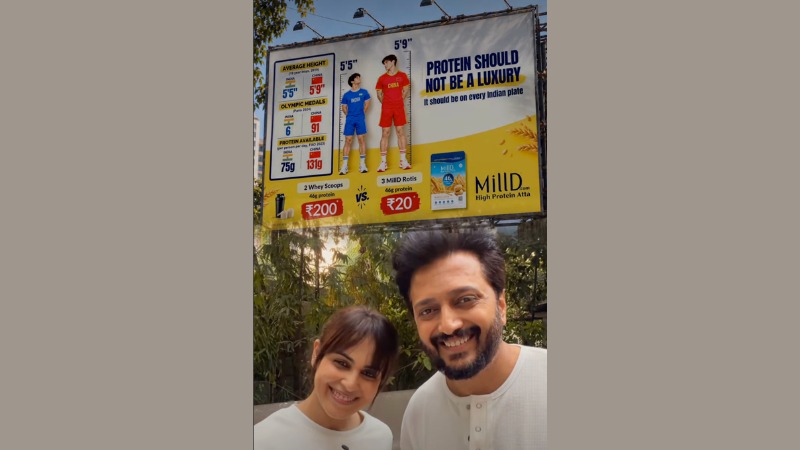
Does eating more protein require adding a new product to your diet, or can it start with food already on your plate? High-protein atta brand MillD is taking that question outdoors with a new out-of-home (OOH) campaign that focuses on protein consumption, affordability and everyday nutrition.
The campaign draws comparisons between India and China on protein availability, average height and sporting performance, using the message, “Protein should not be a luxury. It should be on every Indian plate.” MillD’s proposition centres on providing approximately 15g of protein per roti at ₹7, positioning everyday staples as a way to make protein more accessible.
According to a 2020 study published in The Lancet, the average height of 19-year-old males in China was 175.7 cm in 2019, compared with 166.5 cm in India. FAO-attributed data for 2023 puts daily protein availability at approximately 131g per person in China, against 75g in India. At the 2026 Asian Games, China won 169 gold medals, compared with India’s 21. While these outcomes are influenced by several factors beyond nutrition, MillD uses the comparisons to bring everyday nutrition into the conversation around India’s long-term health and development.
The campaign will run across five outdoor sites in two cities, alongside digital platforms. Actors Riteish Deshmukh and Genelia D’Souza are supporting the initiative through social media content.
For MillD, the campaign reflects its focus on making protein consumption part of familiar eating habits. While protein supplements, shakes and bars have become more visible in the market, the brand is betting on the potential of everyday staples to reach consumers who may not want to adopt a separate nutrition routine.
Prashant Pitti, Investor, MillD, said, “If India wants to become a stronger and healthier nation, we need to pay more attention to what people eat every day. The progress countries like China have made over the decades shows why nutrition deserves to be part of that conversation. But in a country as large and diverse as ours, we cannot expect everyone to depend on expensive protein supplements or change their eating habits. We need affordable solutions built around foods Indian families already consume. With MillD, our aim is to make protein accessible through something as familiar as a roti, at approximately ₹7 per roti.”
The campaign uses the comparisons to raise questions about the role of nutrition in long-term development, without suggesting that protein alone determines outcomes such as height or sporting performance. Genetics, overall nutrition, health, socioeconomic conditions, training and sporting infrastructure also influence these measures.
Sivaram Briyas, Co-founder, MillD, said, “The opportunity we see is much larger than building another protein product. We are looking at whether high-protein staples can become part of regular household consumption. Atta gives us that opportunity because the behaviour already exists. Consumers do not need to create a separate nutrition routine or fundamentally change the way they eat. If the everyday meal itself can deliver more, that is where we believe the category can become significantly larger.”
MillD’s product development began with Co-founder Prashant Pitti’s effort to increase his protein intake without giving up rotis. After 281 trials over six months, the founders developed an atta containing 46g of protein per 100g, designed to retain the taste, softness and cooking experience of regular atta.
Since launching in November 2025, the company says it has reached approximately six lakh homes across more than 1,700 cities, with repeat transactions accounting for 47% of purchases. MillD currently sells around 12,000 kg of atta daily and reports an annualised revenue run rate of approximately ₹100 crore. The company has also reported demand from cities including Mohali, Nagpur, Dehradun and Bhopal.
The campaign will extend across social media through creators working in nutrition, fitness, food, parenting and lifestyle, with the aim of encouraging discussion around making protein a more accessible part of everyday Indian diets.