
Analysis: Did the incident on William Horatio Crawford’s Lakelands estate have anything to do with the owner’s liberal leanings and radical interests?
By Matt Ryan, Newcastle University
On the afternoon of Sunday 18 July 1886, three police investigators arrived at the gates of Lakelands, one of several sprawling estates that occupied the townlands just east of Cork city. Gradually, they worked their way through the woods to the north of the property, and before long, arrived at the scene of an explosion.
Trees, blackened and splintered, had been thrown across the path, great chunks of limestone were scattered far and wide, and at the centre of the blast crater was a ruined icehouse, shattered and still-smouldering. The bodies of two men and a dog were visible beneath the debris.
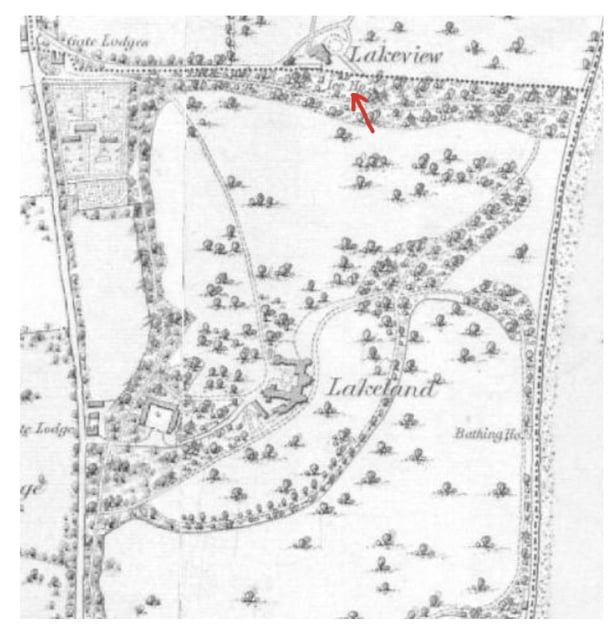
Ordnance Survey of Ireland, 1842. Extract from the First Edition Six-Inch Map of County Cork, showing Lakeland demesne, and the location of the icehouse. Visitors entered the estate through the gate lodge in the top left corner of the map.
Tailte Éireann Historic Mapping.
What happened? Those who lived and worked on the estate were reluctant to answer this question. The Cork Examiner reported that ‘no one in the demesne of Lakelands’ or anyone ‘in the local vicinity’ had seen or heard anything. An explosion of that size would have been audible for several miles around, and the silence of those interviewed suggests that they were unwilling to betray confidences.
Before long, word emerged that the blast was an accident caused by a stash of dynamite stowed in the disused icehouse. It is likely that the explosives were concealed by local associates of the Irish Republican Brotherhood (IRB), whose bombing campaign targeted British institutions in the UK and Ireland throughout the 1880s.
It is easy to see why a cavernous, partly subterranean structure on the edge of a vast estate would have been the perfect hiding spot for a cache of explosives. But an investigation into the landowner and his background might help us further unravel why a pile of IRB dynamite ended up on his property.
It is likely that the explosives were concealed by local associates of the Irish Republican Brotherhood
Lakelands was owned by William Horatio Crawford (1815-1888), a philanthropist, collector and heir to one half of the Beamish & Crawford brewing dynasty. An important figure in the cultural landscape of 19th century Cork, his name still adorns several of the city’s cultural institutions. Crawford’s politics have long been overlooked, but the mystery of the exploding icehouse offers us a tantalising glimpse into his complex affiliations.
Crawford’s social and professional networks were stuffed with prominent Protestant landowners, wealthy merchants, and Anglo-Irish gentry. A member of the prestigious Cork County Club, he regularly appears in its records alongside knights, brons, and Members of Parliament. Given these connections, we would expect Crawford to have leant toward the conservative end of the political spectrum, but his opinions were apparently less straightforward than those held by many of his peers.
But despite rubbing shoulders with Cork’s conservative elite, Crawford’s social and professional network also resonated with dissenting voices. Such voices shaped his early experiences, and his extensive book collection reflects a long-held interest in radical politics. His library at Lakelands was stocked with the work of 17th century dissenters like William Prynne and George Wither, both of whom were imprisoned for their stance against the tyranny of King Charles I.
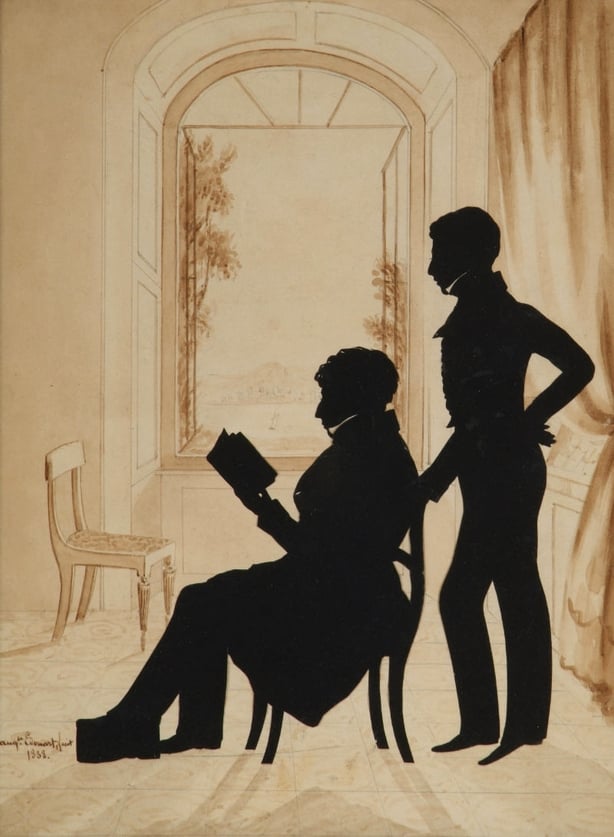
Members of the Crawford Family (1838) by Augustin Amant Edouart is believed to show father and son, William Crawford Jr. (1788-1840) and William Horatio Crawford (1812-1888), at their Lakelands home. Image: Crawford Art Gallery (CAG.0907)
These more radical bibliographical interests extended into Crawford’s philanthropy. He owned several titles by political theorist Jean-Jacques Rousseau, and donated his own 20-volume set of Rousseau’s writings to the library at the newly-established Queen’s College, Cork (QCC) in 1879. Cited by figures like Wolfe Tone and William Drennan, Rousseau’s ideas were important to the early leaders of the Irish Republican movement, a connection no doubt appreciated by Crawford’s associate William Kirby Sullivan, then-president of QCC and lifelong Nationalist.
Crawford’s political sensibilities ran deep. He was distantly related to both William Sharman Crawford, an outspoken supporter of tenant rights, and his daughter Mabel, pioneering feminist and member of the women’s suffrage movement. While at Trinity College, he was tutored by prominent mathematician and physicist James MacCullagh, himself a passionate supporter of Irish Nationalism.
Several of MacCullagh’s students echoed his liberal-nationalist views, and his classroom was likely a place of intense discussion. Crawford shared this classroom with several students who went on to make political contributions in the name of a united Ireland. For instance, John Hewitt Jellett, one of Crawford’s peers at Trinity, was later appointed Commissioner of National Education and helped draft a tranche of reforms aimed at improving primary education for working-class children across the country.
There is plenty of evidence to suggest that Crawford’s political affiliations were not as clear-cut as they might first appear.
But was the explosion on his estate motivated by more than the opportunism of a group of local activists? The revolutionary movement had well-established connections in Cork, and the fishing and boatbuilding communities of nearby Blackrock had historically been targeted by the Royal Irish Constabulary in its clampdowns on republican activity. Indeed, in the early 2000s, an archaeological report found several pipe bowls stamped with nationalistic slogans scattered across the site of the old Lakelands demesne.
In an area with clear links to the republican cause, it is hardly far-fetched to imagine that several of the staff who worked on Crawford’s estate had at least tangential connections to nationalist networks. While it is unlikely that Crawford himself was personally involved with the activities of such groups, there is plenty of evidence to suggest that his political affiliations were not as clear-cut as they might first appear. With his liberal leanings and radical interests in mind, the mystery of the exploding icehouse prompts us to reconsider the long-overlooked complexity of his ideological position.
Follow RTÉ Brainstorm on WhatsApp and Instagram for more stories and updates
Matt Ryan is an AHRC-funded PhD candidate at Newcastle University and a Mary Robertson Fellow at the Huntington Library, California.
The views expressed here are those of the author and do not represent or reflect the views of RTÉ