
Spacex.com
A SpaceX Falcon 9 lifted off from California’s central coast in the pre-dawn darkness of Halloween morning carrying 27 satellites that most of the Starlink constellation cannot replace: the batch adds capacity to the high-inclination shell that extends reliable broadband to Arctic and polar communities that receive no signal from SpaceX’s lower-orbiting fleets. The Group 15-18 mission lifted off from Space Launch Complex 4 East (SLC-4E) at Vandenberg Space Force Base at 04:04:34 UTC — 12:04 a.m. ET — on October 31, 2026, with tracking data from SpaceNexus and Launch Library 2 confirming the rocket was in flight. The launch was the 18th in the Group 15 series, a set of missions targeting an orbital shell that sits above 70 degrees of inclination and covers latitudes that mid-latitude shells structurally miss — regions including Alaska, northern Canada, Greenland, Iceland, and Scandinavia.
Launch Details: Three Days Late, Then Clean
The Group 15-18 mission did not arrive on schedule. SpaceNexus tracking records show the flight was originally targeted for October 28, then slipped one day at a time to October 29, October 30, and finally to October 31. SpaceX did not publicly report any technical anomaly behind the slips; single-day adjustments of this kind are standard practice for Falcon 9, whose narrow daily launch windows frequently require day-of refinements based on weather, airspace, or range scheduling.
When the rocket flew, it performed cleanly. The Falcon 9’s first stage completed its propulsive return and landed on SpaceX’s Pacific-stationed droneship Of Course I Still Love You, stationed downrange in the Pacific Ocean to catch boosters launched southward from Vandenberg. The recovered booster will be transported to Port Hueneme for inspection and turnaround before its next flight, continuing a reuse cycle that is central to SpaceX’s launch economics.
Why Only Vandenberg Can Do This
The most significant fact about the Group 15-18 mission has nothing to do with the launch itself: it is the trajectory. Vandenberg Space Force Base, positioned at 34.74°N on California’s central coast, launches rockets southward over the open Pacific with no land downrange for thousands of kilometers — a clear corridor that allows rockets to reach orbital inclinations as steep as sun-synchronous orbits (roughly 97 to 98 degrees) and, critically, the 70-degree inclination of the Group 15 shell.
Cape Canaveral cannot match this. At 28.6°N on Florida’s Atlantic coast, the East Coast launch corridor is oriented eastward toward the Atlantic. A rocket from Cape Canaveral that needed to reach 70 degrees of inclination would have to fly southward — directly over the Caribbean and populated regions of South America. US range safety requirements prohibit that trajectory. As a result, Cape Canaveral cannot reach polar inclinations within normal US launch constraints.
This is the structural reason SpaceX has concentrated Starlink’s Group 15 deployments at Vandenberg, not a strategic preference. SLC-4E has accordingly become SpaceX’s dedicated gateway to every polar-region shell, while Cape Canaveral handles the constellation’s lower-inclination mid-latitude traffic — and increasingly shifts its infrastructure toward Starship. Spaceflight Now reported that SpaceX had concentrated Starlink launch operations on the West Coast while directing Cape Canaveral resources toward Starship’s East Coast debut.
Who Does Group 15 Actually Serve?
The 70-degree inclination of the Group 15 orbital shell is not an arbitrary configuration number. It defines exactly which communities receive signal. At 70 degrees of inclination, satellites trace ground tracks reaching up to 70 degrees north and south latitude — a coverage band that sweeps across virtually every populated Arctic region. Communities in Alaska’s North Slope, in Greenland’s coastal settlements, in Iceland, in Norway’s Svalbard archipelago, in northern Finland and Sweden, and in Canada’s Northwest Territories all fall within the latitudinal band that Group 15 satellites pass over on every orbit.
For those communities, Group 15 is not supplementary coverage — it is often the only broadband option. Starlink’s lower-inclination shells, including the heavily populated Group 6 series at 53 to 55 degrees of inclination, provide service to the majority of the world’s mid-latitude population but offer thinning or absent coverage above roughly 55 to 60 degrees north. Alaska alone has approximately 740,000 residents spread across communities with limited or no terrestrial broadband infrastructure, according to U.S. Census Bureau estimates.
The capacity picture has moved rapidly. On July 9, 2026, Starlink demonstrated 10 Gbps symmetric throughput at Utqiagvik — a community of roughly 5,000 people about 320 miles north of the Arctic Circle with no road connection to the continental US. Alaska’s GCI telecommunications company is deploying bonded gateway hardware in Alaska communities — hardware combining multiple Starlink antennas — as middle-mile links in Bethel, Sitka, Kotzebue, and Dillingham, carrying community internet traffic on the satellite backbone where fiber does not reach. Each Group 15 mission that adds operational satellites to the shell increases capacity and improves the consistency of that throughput for existing users across the Arctic band.
What Happens After Deployment: Krypton Thrusters and the Long Climb
Deployment from the Falcon 9 upper stage is not the end of each satellite’s journey — it is barely the beginning. The 27 satellites released during Group 15-18 are initially dropped at an insertion altitude of roughly 300 kilometers (186 miles), well below their intended operational station. From there, each satellite fires its onboard Hall-effect ion thruster continuously — at low thrust, over a period of days to weeks — gradually spiraling upward to the Group 15 operational altitude of 570 to 574 kilometers (354 to 357 miles).
Hall-effect thrusters work by trapping electrons in crossed electric and magnetic fields, then accelerating ionized propellant through ring-shaped channel with an axial electric potential of 150 to 800 volts. The design’s roots trace to Soviet spacecraft engineering: the first Hall thruster flew December 1971 aboard a Meteor satellite, with Soviet-developed technology entering Western aerospace in 1992. SpaceX’s Starlink satellites use krypton as their propellant rather than the traditionally preferred xenon. Krypton is cheaper and more abundant than xenon, though it delivers somewhat lower efficiency — a tradeoff SpaceX accepted to make the economics of deploying thousands of satellites viable.
The key performance metric is specific impulse (Isp), the propellant-efficiency figure that measures how much thrust a propulsion system extracts from each kilogram of fuel. Hall thrusters achieve specific impulses of roughly 1,500 to 3,000 seconds, compared with roughly 450 seconds for the best chemical rocket engines. That efficiency advantage means each satellite can carry substantially less propellant mass than a chemical-propulsion equivalent, freeing mass for payload and reducing launch costs. The tradeoff is thrust: where a chemical thruster produces kilonewtons of force, a Hall thruster produces tens to hundreds of millinewtons — roughly the weight of a US quarter. The orbit-raising burn is not a sprint; it is a month-long slow spiral.
Once at operational altitude, the same thrusters handle collision avoidance maneuvers, routine station-keeping, and the eventual end-of-life controlled deorbit that removes satellites from the shell after their service lives end.
A Constellation Measured in the Thousands
Group 15-18 adds 27 satellites to a constellation that, as of late October 2026, counts more than 11,190 satellites in orbit — a figure that makes Starlink the largest satellite constellation in history by a substantial margin. SpaceX passed the 11,000-satellite mark on August 19, 2026, per tracking data from N2YO. The company has launched more than 13,069 Starlink satellites in total since the program began in May 2019, with the difference between that total and the current in-orbit count reflecting satellites that have naturally decayed or been deliberately deorbited at end of life.
At 11,190-plus active satellites, Starlink accounts for roughly 65 percent of every active spacecraft currently tracked in Earth orbit — a density of operational hardware that would have seemed implausible at the program’s first launch seven years ago.
SpaceX has FCC regulatory approval to grow the constellation to 12,000 satellites under its initial license, with filings extending potential authorization to more than 42,000 spacecraft. At the deployment pace SpaceX has sustained through 2026 — more than 2,000 satellites launched in the first eight months of the year alone, per financial analysis published by SmallSatNews — the 12,000-satellite initial tranche will be completed well ahead of any pace milestone SpaceX publicly forecast at program launch.
Booster Reuse: What Makes This Cadence Possible
The pace of Group 15 missions — Group 15-15 flew October 20, Group 15-16 flew October 27, Group 15-18 launched October 31, with Group 15-21 tentatively scheduled for November — is only possible because the Falcon 9’s first stage costs a fraction of what an expendable rocket would cost per flight.
Financial analysis published in August 2026 modeled Falcon 9 economics based on SpaceX’s operational data. After amortizing the estimated $30 million build cost of a Block 5 first stage over 25 flights and adding approximately $7.2 million per flight in refurbishment, the estimated marginal cost of a Falcon 9 mission runs to roughly $13.7 million — against a commercial list price of $74 million. The resulting margin funds Starlink development, satellite hardware, and Starship — SpaceX’s next-generation fully reusable rocket that remains in development for commercial service.
SpaceX’s Block 5 boosters now routinely exceed the vehicle’s original 10-flight design target. The most-flown Falcon 9 booster, B1067, completed its 37th orbital mission on August 25, 2026, per SmallSatNews. Each additional reuse reduces the amortized cost per mission. It is the economic engine behind a deployment cadence — 50 West Coast launches before the end of the first week of August 2026, per Spaceflight Now — that no expendable launch program could sustain at comparable scale.
What Comes Next for Group 15
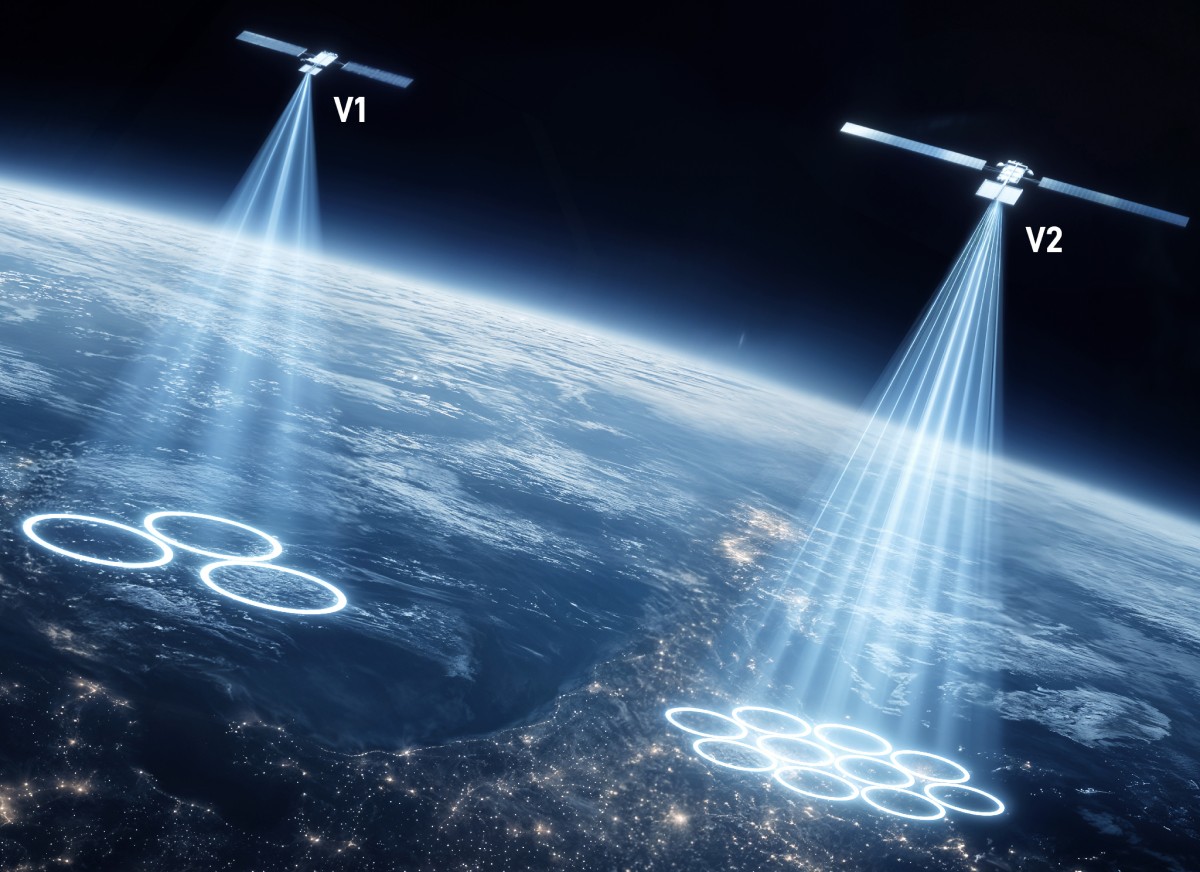
The Group 15 series has more missions ahead. Tracking databases already list a Group 15-21 mission as tentatively scheduled for November 2026, with booster B1103 slated for what would be its seventh flight. The V2 Mini optimized satellite variant carried on recent Group 15 missions is a lighter revision of the V2 Mini platform that SpaceX introduced to maximize payload count on Falcon 9 — packing more capability per kilogram without the mass penalties of the full-size V2 design, which is reserved for the much larger Starship vehicle that has not yet entered commercial Starlink service.
The continued expansion of the Group 15 shell is less about adding users in mid-latitude markets and more about raising the density and throughput quality in the Arctic band — more satellites in the shell mean more passes over any given point at high latitudes, which translates directly into higher aggregate throughput and more consistent service for communities in Alaska, Greenland, and analogous regions across the northern hemisphere.
Frequently Asked QuestionsWhat is Starlink Group 15, and how is it different from other Starlink satellites?
Starlink Group 15 is one of the orbital shells that makes up the Starlink constellation. What makes it distinct is its inclination: Group 15 satellites orbit at 70 degrees of inclination and at altitudes of 570 to 574 kilometers (354 to 357 miles), which allows them to cover latitudes up to 70 degrees north and south. Most of the Starlink constellation operates in lower-inclination shells (53 to 55 degrees) that cover mid-latitude regions efficiently but provide thinning or absent coverage above roughly 60 degrees north. Group 15 fills that gap, serving Alaska, Greenland, Iceland, Scandinavia, and analogous high-latitude regions in the Southern Hemisphere.
Why does SpaceX only launch polar Starlink satellites from Vandenberg, not Cape Canaveral?
Cape Canaveral’s eastward launch corridor cannot safely reach high inclinations like 70 degrees — a southward trajectory from Florida would pass over the Caribbean and South America, violating US range safety requirements. Vandenberg’s southward Pacific launch corridor faces thousands of kilometers of open ocean with no populated land, allowing Falcon 9 to reach inclinations from 70 degrees all the way up to sun-synchronous orbits of roughly 97 degrees. This geometric constraint, not strategic preference, is why all Group 15 missions launch from California.
Does Starlink’s polar shell actually work in Alaska and Arctic communities?
Yes. On July 9, 2026, Starlink demonstrated 10 Gbps symmetric throughput at Utqiagvik — a community of about 5,000 people north of the Arctic Circle that has no road connection to the continental US. Alaska’s GCI telecommunications provider is deploying Starlink bonded gateway hardware as middle-mile backhaul in communities including Bethel, Sitka, Kotzebue, and Dillingham. Each Group 15 mission that adds operational satellites to the shell increases capacity and coverage density for those communities and others across the Arctic band.
How do Starlink satellites get from their launch orbit to their operational position?
After deployment from the Falcon 9 upper stage at roughly 300 kilometers (186 miles), each satellite fires its Hall-effect ion thruster — fueled by krypton gas — in a continuous low-thrust burn that spirals the satellite upward to the Group 15 operational altitude of 570 to 574 kilometers (354 to 357 miles). The process takes days to weeks. Hall thrusters achieve specific impulse of 1,500 to 3,000 seconds — far higher than chemical engines — but produce only millinewtons of thrust, which is why the climb is gradual rather than a quick burn.