
Exploring the forest of ecologicstudio
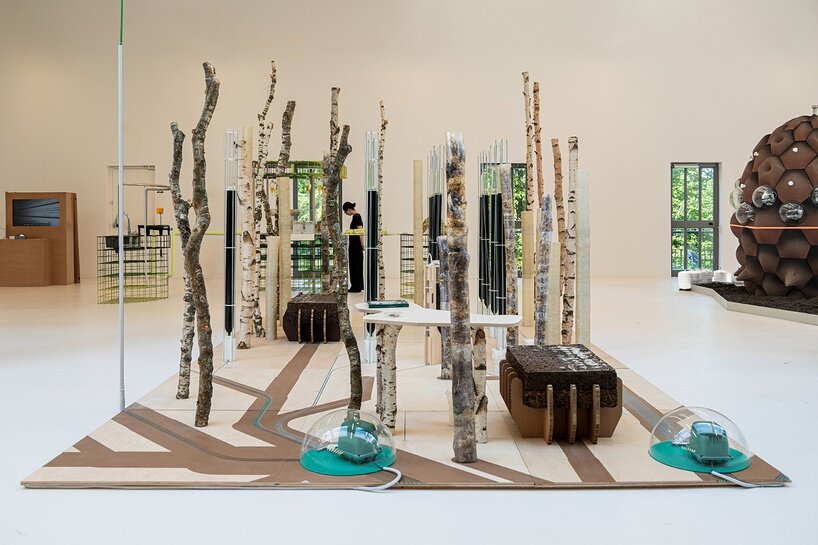
In 2025, a forest emerged in the Triennale Design Museum in Milan. It was DeepForest³, a project by the London-based design studio ecoLogicStudio, co-founded by Claudia Pasquero and Marco Poletto. It was presented as part of the exhibition We the Bacteria: Notes Toward Biotic Architecture, curated by Beatriz Colomina and Mark Wigley, who authored the book of the same title. While the installation looked as though a few saplings had risen from the shiny museum floors, what was on display was, in fact, a hypothesis about how domestic space could be transformed by processes inherent to nature, with Poletto describing it as a system constructed with a ‘fully functional and tangible biotechnological living system, grounded in the metabolic cycles of algae and fungi.’
Seeing the deep green cyanobacteria and the lichen growing from a cork bench felt like following a fungi-covered path back through the London-based studio’s projects. Since its inception in 2005 , the duo has proposed a built world that leverages the powers of nature – algae air-purifying mechanisms, waste-digesting mushrooms, and insulation that grows itself – to develop a style of architecture that grows with the environment instead of against it.
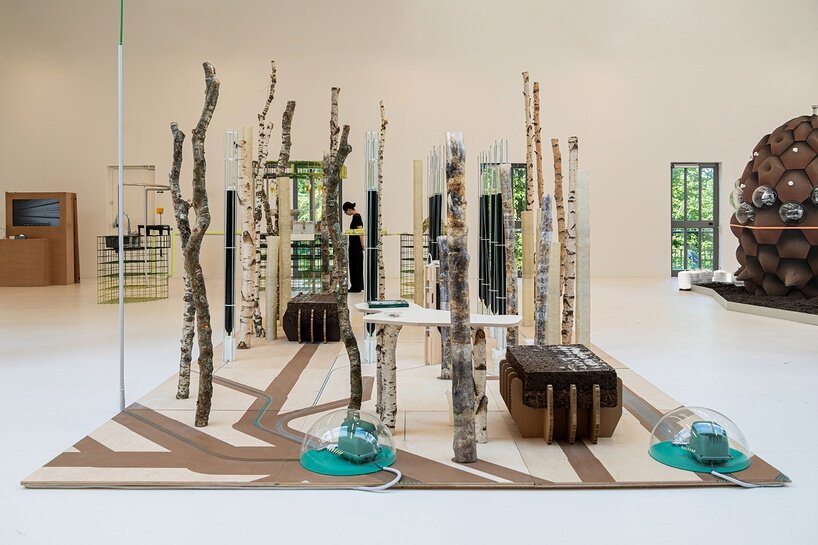 DeepForest³, a project by the London-based design studio ecoLogicStudio, presented as part of the exhibition We the Bacteria: Notes Toward Biotic Architecture, curated by Beatriz Colomina and Mark Wigley | image © Synthetic Landscape Lab
The Urban Algae Folly
Nearly ten years earlier, at EXPO Milano 2015 Future Food District, a pavilion of triangular panels glowing with a flow of green algae was erected in the event’s central square. Called The Urban Algae Folly, the canopy provided shade through the growth of Spirulina, a type of microalgae that is highly nutritious for people while also being an effective CO₂-capturing organism. Here, ecoLogicStudio created a symbiosis between the sun, the algae, and humans. On sunny days, more algae grows in the membrane of the canopy. When a person stands under it to take advantage of its shade, the CO₂ they release continues to feed the system. The project is born from the idea that architecture should work with microbial life rather than attempt to exclude it. Here, algae become active collaborators in shaping the environment, turning a pavilion into a living, carbon-consuming system.
EXPO Milan 2015 – Urban Algae Folly
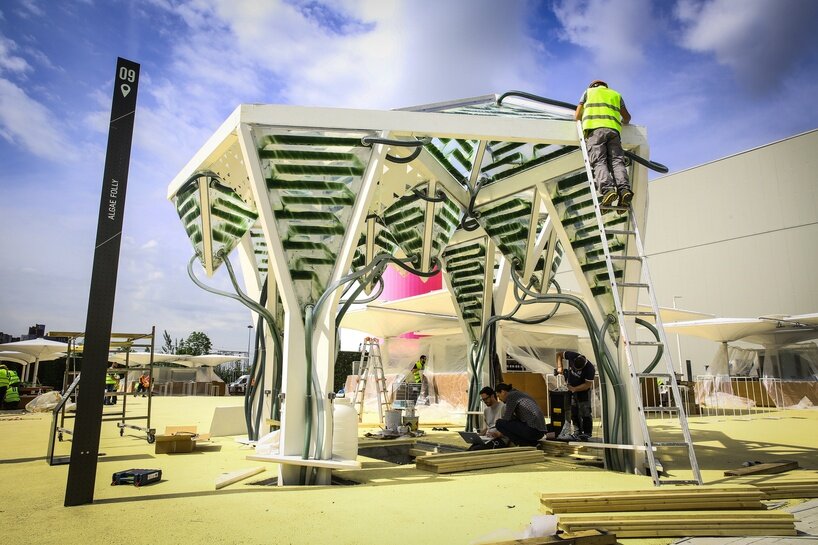 at EXPO Milano 2015 Future Food District, the pavilion of triangular panels was erected in the event’s central square | image courtesy of ecoLogicStudio
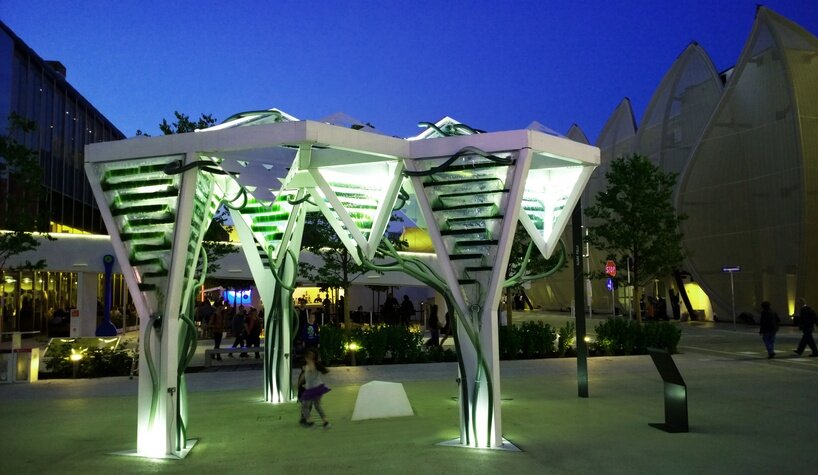 when a person stands under it to take advantage of its shade, the CO₂ they release continues to feed the system | image courtesy of ecoLogicStudio
The AirBubble in Nyon
In Nyon, Switzerland, the studio developed what they call ‘the world’s first biotechnological healthcare garden that combines air-purifying algae cultures with medicinal plants.’ Here, an outdoor space, a kind of circular, tent-like structure made of semi-transparent fabric, provides a respite for its inhabitants. Inside, the circumference is lined with ‘36 large bioreactors in borosilicate glass which contain 350 litres of living green Chlorella algae cultures that can filter a flow of polluted air of 150 litres/minute.’ The project challenges the assumption that healthy spaces must be sterile. Instead, it positions living organisms as essential infrastructure, using algae and plants to create an environment where ecological and human health are interconnected.
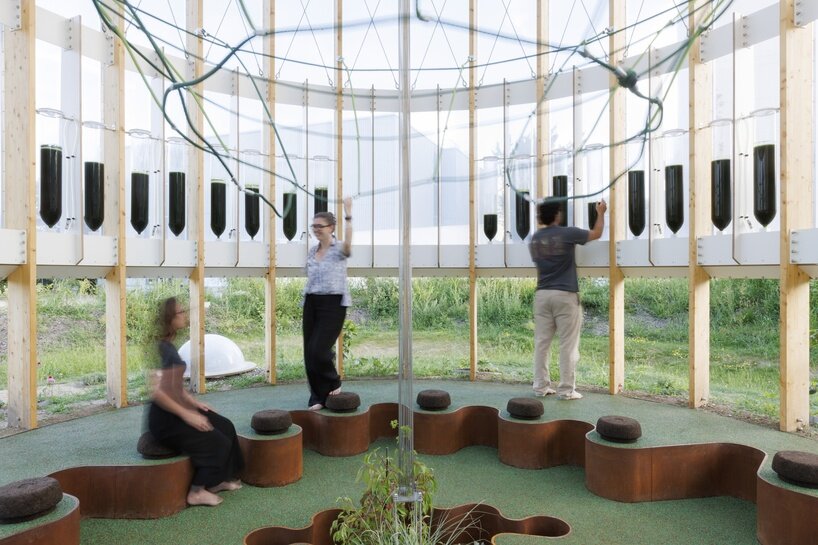 an outdoor, circular, tent-like structure made of semi-transparent fabric, provides a respite for its inhabitants | image © Pepe Fotografia
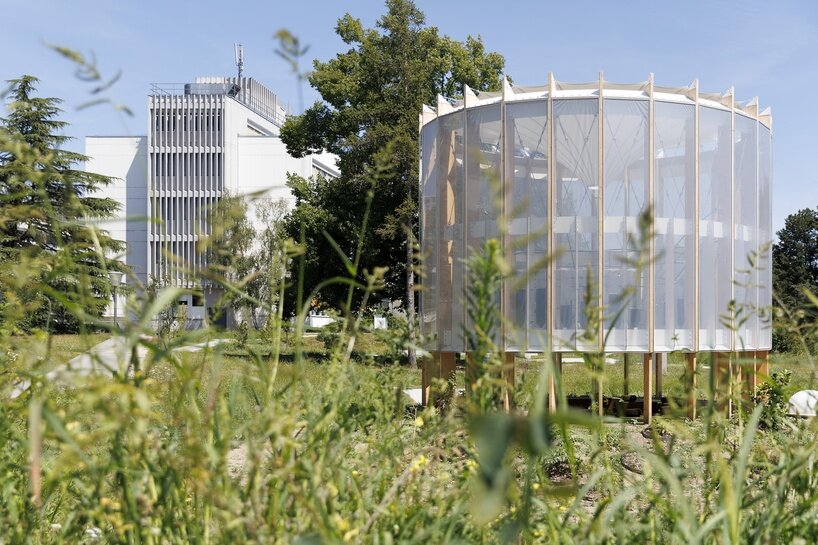 bioreactors in borosilicate glass purifies the air with algae cultures | image © Pepe Fotografia
CryoflorE at MUDAC’s Solar Biennale
In collaboration with the Synthetic Landscape Lab at the University of Innsbruck, the studio also produced CryoflorE: a model for cyber gardening the city, which expanded this thinking beyond a singular structure and into the urban realm. As part of the MUDAC’s 2025 Solar Biennial, Soleil·s, the project takes the form of a near-hexagonal model resembling a miniature cityscape of high-rises filled with cyanobacteria.
Here, they ‘capture and channel electrons generated through photosynthesis into electrical currents flowing along the copper wires embedded in the streetscape.’ Using the energy-producing and CO₂-capturing potential of cyanobacteria, the studio takes initial steps towards developing a simulation of a city powered by bio-solar energy networks.