
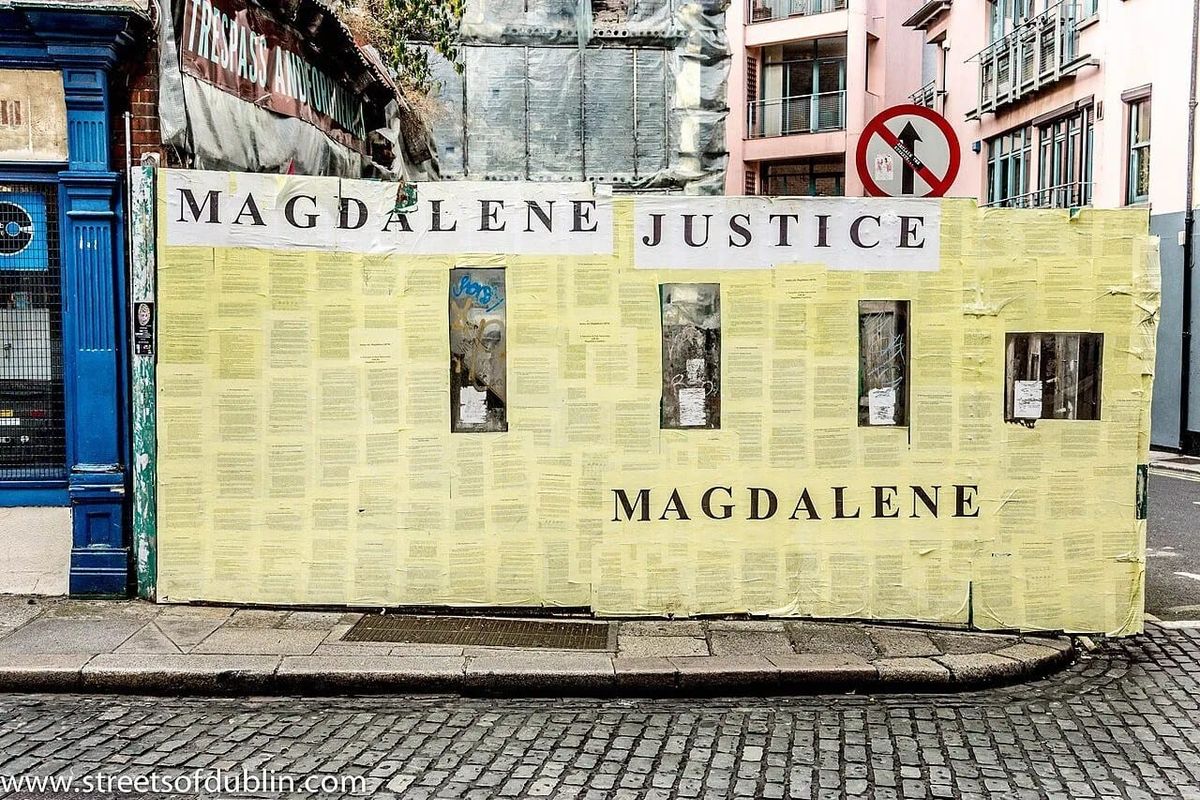
‘The Fallen’ by Louise Brangan, an Irish academic based in Edinburgh, was published earlier this year. In her introduction, the author tells us that she “wanted to write the history of the Magdalene Laundries from the perspective of the women and girls who had been subjected to it,” but she was “equally curious about the nuns who oversaw the laundries.”
Every reminder of the horror that was the Magdalene Laundries is to be welcomed, lest we forget, and allow Church/State abuse to go unchallenged. Brangan’s book is a well-told tale of that abuse, but her account of how and why the laundries ‘succeeded’ in the way that they did, is not always convincing.
Brangan’s book is based on the research which she completed for Strathclyde University. She summarises well what happened: “Thousands of women and girls were sent to Ireland’s ten Laundries – the homeless, sex workers, the disabled, girls from care homes, those who were abandoned and abused. Each of them was perceived to have fallen in some way, and at the Laundries it was believed they would make their ascension.
Once they were locked inside, their names were taken, and they were forced to maintain a strict rule of silence. Then they were put to work: they washed, they scrubbed and they prayed, laboring in often indefinite captivity in an attempt to salvage their souls”.
Across Ireland, 10 laundries run by four orders of nuns, processed more than 10,000 women from 1922 to 1996, when the last one in the heart of Dublin on Sean McDermott Street, finally closed.
Brangan’s book is compassionate and written in a vivid prose style. She interviewed six survivors for the book and also draws on the testimonies gathered by other researchers who also ‘gave voice’ to the survivors, of the religious run, for-profit, laundries.
Coercive confinement
The Magdalene laundries were not the only religious-run, punitive institutions in post-independence Ireland. In his review of Brangan’s book, Fintan O’Toole explains “the laundries were part of a vast archipelago of coercive confinement: by the 1950s, one in 100 Irish citizens was locked up in some form of institution, including the industrial schools, the psychiatric asylums that held a bigger proportion of the population than anywhere else in the world, and the Mother and Baby homes where single mothers gave birth before their babies were whisked away for adoption”.
The author herself states that “In a regime distinguished by its excessive inhumanity, the Magdalene Laundries were its deep end. They were not peripheral, they were Ireland’s main carceral institutions… employed for those women and girls considered to be beyond the help of the Mother and Baby Home, beyond the industrial school, beyond the prison and beyond the pale of ordinary life. The Laundries are the end of the line; the termini.”
Women in the laundries were not just unfairly treated. They disappeared into ‘an abyss of devoid of dignity, belonging, citizenship, human rights, personhood’ as Fintan O’Toole highlights.
They were beyond the reach of the law and many of the children were unlawfully transferred from industrial schools, also under the control of Catholic religious orders. These were children whose parents were deemed incapable of caring for them and were effectively trafficked to these institutions to be set to work as slaves.
There is a wealth of very good research, much of it available through Justice For Magdalens Research (JFMR). However, in Brangan’s commitment to ensure the ‘women’s voices are heard’, the hard facts, the statistics, the sheer scale and criminality of what was done to them, including the injustices built into their ‘redress’, become muted.
The full picture
Also, some of Brangan’s presentations of facts do not give the full picture. On page 245 she states “Each of the four religious congregations [who ran the laundries.
MS] cooperated with the inquiry. McAleese and his team were given full and unfettered access to an array of material in their archives.”
The Irish president of the day – Mary McAleese – whose husband Martin McAleese, who chaired the Committee of Investigation into the Magdalen Laundries produced a 1000-page report. As critics —including survivors, Justice for Magdalene’s Research, and several legal scholars—have argued, this type of voluntary process with which the nuns were invited to cooperate, was inadequate because it depended on the willingness of the very institutions whose conduct was under scrutiny. Only a statutory inquiry could investigate the laundries fully.
The Irish State has never compelled the religious orders to provide records and information about the laundries. Questions about the sums of money made from this slavery and trafficking have never been answered.
Some of the orders even refused access to records that might show where women who died within their walls were buried, as they sold on this ‘property’, the graveyard, to developers.
To add insult to injury, the nuns also “declined” to make a financial contribution to the Magdalene Laundries Restorative Justice Ex Gratia Scheme. This was set up by the State and which, eventually, after unconscionable delays, paid out to survivors – or those who lived long enough to receive them.
‘Zeal’ or imposition?
Brangan rightly castigates the State for their role in colluding with the abuse meted out by the religious orders, and she criticizes the social ‘acceptance’ of that abuse. But her explanation as to how this state of affairs came about and was maintained for 70 years, is not adequate.
She writes: “After the establishment of the new Irish Free State in 1922, many people – ordinary citizens, political parties and public figures alike – became gripped by a fanatical right-wing zeal about how society should be organised and how citizens should behave ….. Fear of the unknown, economic despair and suspicion of foreign influences gave way to a desire for control”. (p 24)
Marxists look to material conditions to explain prevailing attitudes in society. The material conditions at the foundation of the State in 1922 were a culmination of an historical dynamic that had been at work.
The previous two decades had begun to see a real push-back against colonial power. National liberation, workers’ liberation, women’s liberation, were clearly on the agenda and the prospect of revolutionary change terrified the establishment.
The role played by women in this process was profound, as Goretti Horgan highlights. A key fact of 1922 and the foundation of the state was that reaction triumphed. The revolutionary period, in particular the War of Independence had seen the rise of hope and potential, where workers and a landless peasantry challenged the power of the colonial state and the native bourgeoisie.
But the deal done in 1922 partitioned Ireland, restored the ‘property’ of the Irish bourgeoisie, and with British guns and money broke the resistance. But how to make sure this movement for change was put permanently ‘back in its box’?
The Catholic Church proved the staunchest ally of the fledgling State. It damned resistance (quite literally: even church going rebels were excommunicated) and helped roll back the social gains made by women with a series of Acts passed by the new government, which dove-tailed with church teaching.
These restricted women’s access to work, removed them from civic roles (jury duty), pilloried unmarried mothers and created a framework for punishing them. These were the Mother and Baby Homes, the ‘Mental Asylum’ system, and the Magdalene Laundries.
The Free State completely banned divorce by closing off all loopholes that might have made dissolution of unhappy unions possible. They introduced rigid censorship laws.
The 1937 constitution not only conferred a special place to the church; its designated women’s special place as the home. This fitted well for a state that had neither the means nor the political will to invest in social services.
These were material and political factors that lay behind what Brangan refers to as “…a fanatical right-wing zeal about how society should be organised and how citizens should behave” (p 24). It was not ‘zeal’ for Catholic conservatism which explained this turn; rather it was the defeat in 1922, of the progressive movement for change that had radically challenged – and terrified – the existing order.
Bullying the population
Church and State combined to bully the population into acceptance of their rule.
You could easily lose your job, or fail to ‘qualify’ for one, on the say-so of the local clergy, whose influence was everywhere; you could be denounced and publicly shamed from the pulpit at Mass. You could be refused a loan or mortgage by the very holy bank manager!
It is very useful to a capitalist state not to have ‘bolshie’ workers who will stand up and fight for their rights. And what better way to cower people than to shame them as guilty sinners.
Guilt diminishes us, makes it easier for a boss or a priest to push us around. So enslaved women in the Magdalenes were not prisoners! They were ‘penitents’ expunging their guilt!
This is not an exclusively Irish phenomenon. In her review of Brangan’s book, Catriona Crowe reminds us that: “400 Spanish Catholic congregations, many of which had run centres for the incarceration of girls and young women, guilty of no crimes, from 1941 to 1985.
At their height, under the fascist dictatorship of Francisco Franco, they held 41,000 people. Their patron was Franco’s wife, Carmen Polo”
The Catholic church always has the back of reactionaries even when that reaction turns to fascism. So, our watchword today must be ‘Never Again’, particularly in these days where the far-right are mobilizing around transphobia, islamophobia, racism, misogyny and anti-refugee propaganda.
Indeed, those revolutionary socialists who challenged the Catholic Church in Spain for their abuses, called on people to “Neither forget, nor forgive”. Brangan’s book serves us well in reminding us of the horror of reaction; but a more radical, revolutionary standpoint is needed to fully recognize both its source and the means to triumph over it.
Mary Smith is a former midwife and an activist with Dublin South Central People Before Profit
Image: William Murphy from Dublin, Ireland, Protest Art – Magdalene Justice, Dublin, via Wikimedia Commons (CC BY-SA 2.0).