
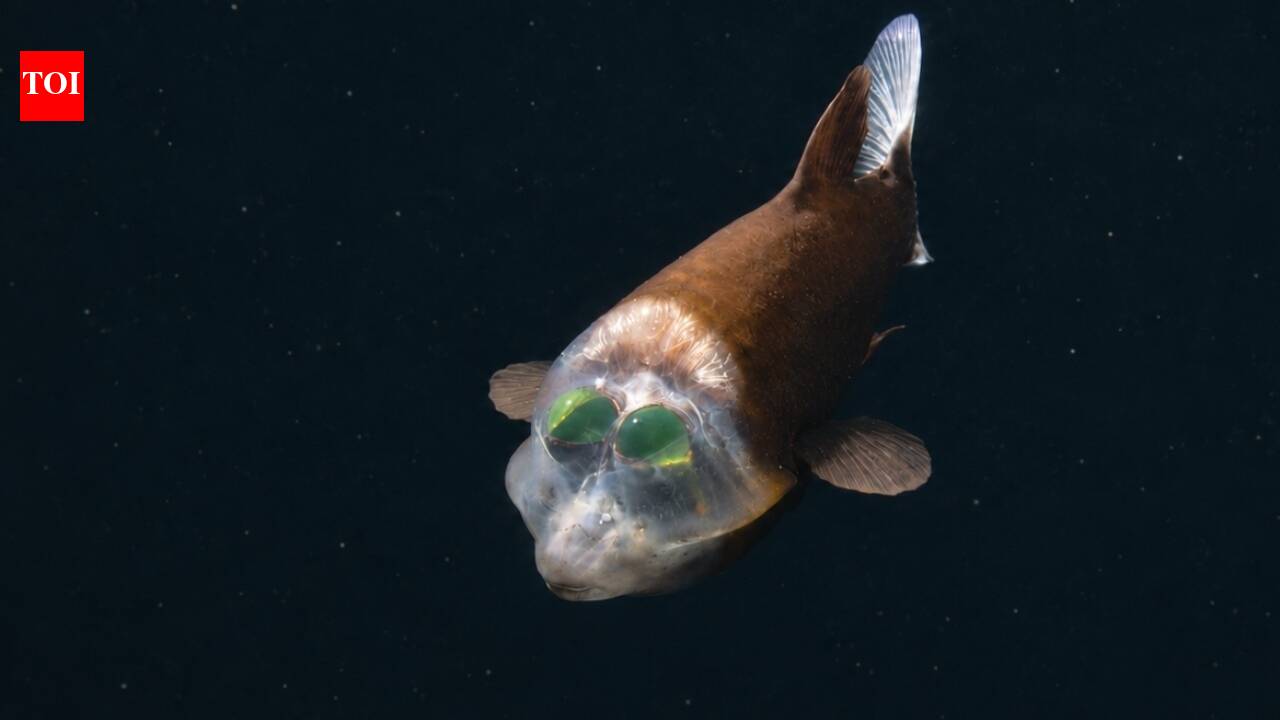
 A fish with a transparent head? Meet the rare deep-sea barreleye with glowing green eyes, filmed in 4K A fish with a see-through head? That too, with glowing green eyes? That sounds like science fiction, but it’s real, and it’s called the barreleye! This odd-looking creature usually hides out hundreds of meters beneath the surface, where sunlight barely exists, and strange animals thrive. Even after decades of exploration, much of the deep sea is still shrouded in mystery. So when researchers spot something unusual, it’s not just exciting; it’s a window into a world most people never get to see.Recently, scientists at the Monterey Bay Aquarium Research Institute (MBARI) managed to capture jaw-dropping 4K video of this rarely seen barreleye fish. It happened during one of their research expeditions off the coast of California, nearly 600 meters down. The barreleye isn’t just rare; it’s downright bizarre. Imagine a fish with a clear, dome-shaped skull, glowing green tubular eyes inside, and a look that belongs in a sci-fi movie. Over almost forty years and thousands of deep dives, MBARI researchers have encountered this species just 11 times. This time, they got it on the brand-new 4K camera, allowing them to observe the fish in more detail than ever before.
Rare sighting during deep-sea research expedition
The story of the encounter is fun in itself. Per IFLScience, the team was wrapping up the day’s work aboard the R/V David Packard, having spent the week checking out jellyfish and other gelatinous drifters. The remotely operated vehicle, Doc Ricketts, was coming up from the depths when MBARI’s Shannon Johnson caught sight of the barreleye on a screen. The mood shifted instantly: everybody crowded into the control room just to watch. They observed the fish for about 20 minutes, which is much longer than their usual fleeting glimpses, experimenting with lights to capture high-definition shots of its transparent head and unique body structure. They even filmed it in virtual reality to get three-dimensional images. In almost four decades, this was MBARI’s 11th sighting of Macropinna microstoma. Their last was in 2021, so this was big news.
What makes the barreleye fish so unusual?
Now, why is this fish so special? The barreleye belongs to a family known for weird, tube-shaped eyes, but Macropinna microstoma takes it further. Its transparent dome is filled with liquid, and inside you see those greenish tubes, which look like floating eyes inside a glass helmet. As if that isn’t strange enough, those eyes can actually rotate. Early studies by MBARI scientists Bruce Robison and Kim Reisenbichler showed that the fish’s eyes usually point straight up as it searches for food drifting above. When it spots something tempting, the eyes swivel forward, tracking prey. The clear head isn’t just for show; it protects those delicate eyes from the stinging tentacles of creatures like siphonophores, which the barreleye hunts for snacks.
How does the barreleye fish survive in the ocean’s twilight zone?
The barreleye’s home is the mesopelagic zone, or twilight zone of the ocean, which is about 200 to 1,000 meters down. Down here, sunlight is a dim memory, so most creatures have evolved all kinds of tricks to survive. Many produce their own light. Others have specialized senses or unusual camouflage. The barreleye’s tubular eyes, packed with green pigments, help it filter out sunlight and zero in on prey against the faint backdrop above. It’s pretty clever. Some scientists say the pigment works like that found in strawberry squid eyes, which is another deep-sea oddball. The fish doesn’t just swim constantly, either; with its big, flat fins, it can hover almost motionless, watching for food drifting by and saving energy.Steven Haddock, MBARI’s senior scientist, explains that in the deep ocean, predators use tiny clues, like shadows above, to find meals. Every creature is trying to get better vision, while others use tricks like bioluminescence or camouflage to hide.
What’s the big deal about the new 4K footage?
Well, for marine scientists, it could be a goldmine. MBARI’s done over 7,000 remotely operated vehicle dives, recording more than 41,000 hours of video, but seeing the barreleye fish remains a rare treat. This time, they didn’t disturb the fish, letting it go on its way. High-resolution images should help scientists study its head, eyes, and visual tricks up close. Plus, the virtual-reality shots could be useful for education: imagine students or museum visitors experiencing the barreleye as if they were right next to it!There’s more. Earlier in 2026, MBARI researchers joined another expedition and filmed the binocular fish (Winteria telescopa), a different species with equally odd eyes. That just underscores how much we still don’t know about life in the ocean’s twilight zone. Every glimpse brings new questions: what else is out there? How have these creatures adapted to live where almost nothing else can?For now, that 4K footage isn’t just stunning; it reminds us that Earth’s deep seas remain mostly unexplored, packed with weird and wonderful animals that push the boundaries of biology. The barreleye, with its glass head and floating green eyes, is proof that nature’s imagination hasn’t run out yet.