
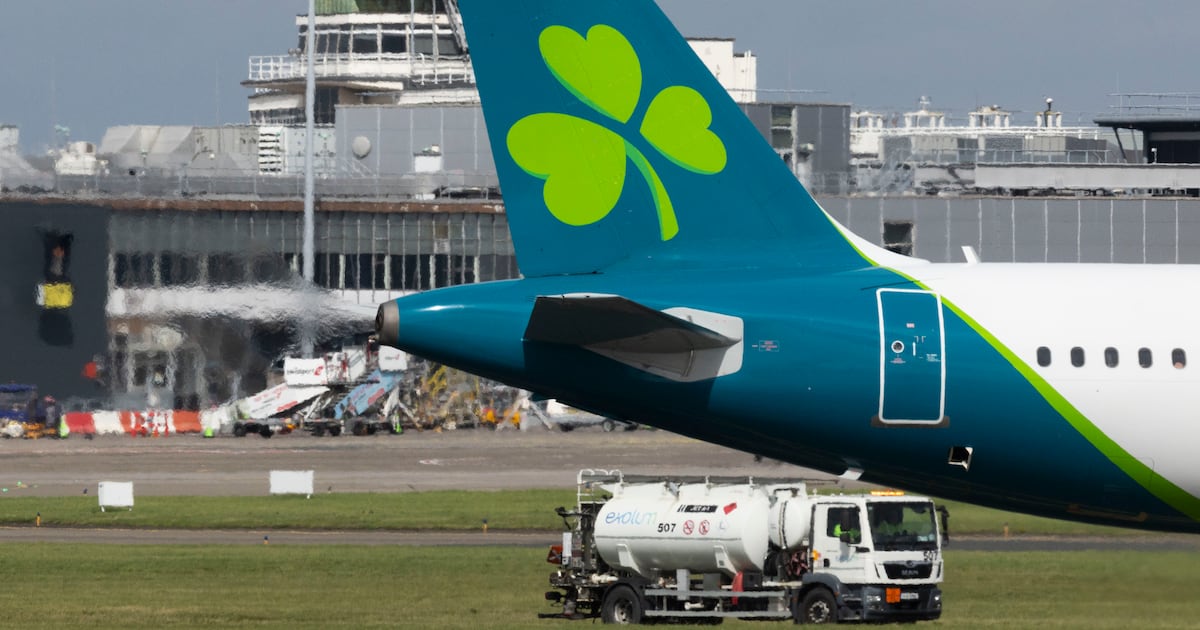
An Aer Lingus plane flying from Dublin to Rome has been diverted to France’s Évreux airbase following a bomb alert.
The Airbus A320 has landed safely at the airbase in the Normandy region.
The situation is being monitored, the office of French prime minister Sébastien Lecornu said on Thursday.
Lecornu’s office said the 151 passengers and six crew on board were moved to a safe place when the plane landed.
“Aer Lingus flight EI402 from Dublin to Rome diverted to Normandy this morning as a security precaution,” Aer Lingus said in a statment. “The flight landed safely and Aer Lingus will work to reaccommodate customers to their final destination as soon as possible.”
The plane crossed the English Channel on a normal flight path to Rome before veering southwest of Paris and circling Chartres airport and diverting towards Évreux.
Le Figaro reported that the plane was escorted on approach by a French Rafale fighter jet. The original bomb threat alert reportedly came from the Italian authorities.
A number of other flights were disrupted across Europe on Thursday.
Belgian media reported that an airliner forced to land at Brussels’ Zaventem airport belonged to the Polish airline Lot.
A Finnair plane from Helsinki was safely escorted to its scheduled landing in Rome by the Italian air force, a source close to the matter said.
Bulgarian officials reported three aircraft making emergency landings because of bomb threats. Airplanes flying from Copenhagen and Madrid landed in Sofia, the interior minister said, according to broadcaster bTV. A third aircraft, from London, landed in Plovdiv, local media said.
Flightradar24, one of the largest flight tracker websites in the world, also said that “no aircraft have departed from Rome Fiumicino Airport (FCO) in the past 30 minutes”.
The incident comes just two days after seven planes across Europe were searched or diverted after malicious hoax bomb alerts, including two Ryanair flights that originated in Dublin.
While no country has attributed blame for the threats, they come at a time when European officials have been blaming both Russia and Iran for what they describe as “hybrid attacks” and acts of sabotage. Moscow and Tehran both deny any such campaign.
This week, unidentified hackers shut down fridges in supermarkets in several European countries. Some experts said hoax bomb threats could be part of a similar pattern of low-cost, deniable disruption efforts.