
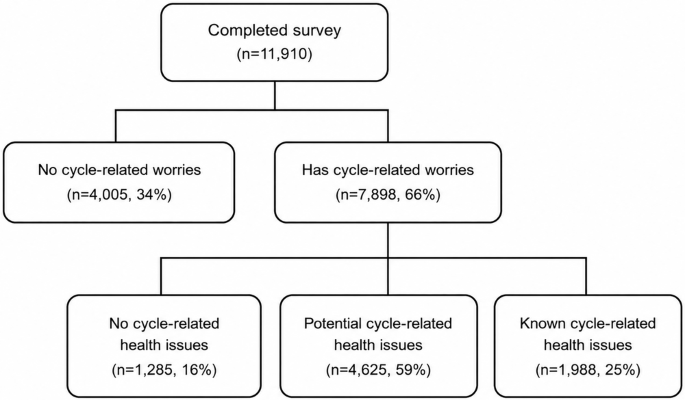
This study provides new insight into how individuals navigate menstrual health concerns and the role menstrual tracking may play in supporting this process. Two-thirds of respondents reported worries about their menstrual cycle or related symptoms, highlighting how common these concerns are even among MTA users already actively engaged in tracking and understanding their menstrual health20,21,22. Among those with worries, symptoms were frequently severe or disruptive, reflecting the substantial menstrual symptom burden and impacts on daily life also documented in broader populations. More than half of these respondents were managing their symptoms primarily on their own, and few felt they were managing well with their current treatments or strategies. Within this context, tracking was reported to support several aspects of navigating menstrual health, most notably by helping respondents better understand and prepare for their experiences, but also by helping them recognize and interpret symptoms and engage with healthcare. Together, these findings highlight the potential of menstrual tracking as a practical tool for supporting greater agency in navigating ongoing menstrual health concerns.
The substantial symptom burden observed among respondents with cycle-related worries was accompanied by considerable uncertainty about how to make sense of and respond to these experiences. Fifty-nine percent reported a potential cycle-related health issue, meaning they suspected that a health issue might affect or be affected by their menstrual cycle, but this had not yet been confirmed. More than 40% reported difficulty determining whether they had a health issue or not, and approximately one-quarter had not yet consulted an HCP because they were still trying to determine whether their symptoms indicated a problem. Notably, even among respondents who reported no cycle-related worries, 15% rated their symptoms as severe and 10% reported substantial impacts on daily life. This apparent disconnect between symptom burden and concern about those symptoms further highlights the potential difficulty of determining when additional support or medical care may be needed.
The persistent normalization of menstrual symptoms likely contributes to how these experiences are interpreted and whether support is sought. Previous research has documented the normalization of even substantially disruptive symptoms and the role of stigma and menstrual norms in delayed recognition and care-seeking2,10,23,24,25. This has been described as a paradox in which menstrual pain and discomfort are treated as an expected part of “womanhood”, while at the same time, individuals who raise concerns often still struggle to be believed5. Illustrative comments from optional free-text survey responses reflected this tension. As one respondent wrote: “There’s nothing wrong with me, my symptoms are 100% normal and within the typical range, but it still hurts too much to go on about my day like nothing’s wrong. I feel stuck…” More broadly, beliefs about the availability or effectiveness of treatment may also influence care-seeking. Previous research has found that perceived lack of effective treatment is common among those who do not seek care for menstrual symptoms and may be even more prevalent among those with more severe symptoms23,26.
Such concerns may be reinforced by difficult or unsuccessful experiences with healthcare. More than half of respondents with cycle-related worries had consulted an HCP, but only 40% of those respondents were satisfied with their healthcare experience. Nearly half reported difficulty getting their concerns taken seriously, one-third reported that HCPs did not know how to help, and one-third had been told that their symptoms were normal or not medically concerning. These experiences are consistent with previous research documenting frequent dismissal, the need for repeated self-advocacy and multiple healthcare consultations, and long diagnostic delays among people seeking care for menstrual health concerns9,10,27,28,29.
Receiving a diagnosis also did not necessarily resolve respondents’ management needs. Among respondents with a known cycle-related health issue, only 15% indicated they were managing well with their current treatments or strategies. This aligns with previous research describing persistent symptoms after diagnosis of menstrual or reproductive health-related conditions because of limited or ineffective treatment options, difficulties accessing specialist care, comorbidities, or complex symptom profiles28,30,31,32,33. Ongoing management and efforts to find effective solutions may therefore remain important even after a health condition has been identified.
Across this range of symptom experiences and levels of engagement with healthcare, self-directed management was common. Nearly 60% of those with cycle-related worries reported that they were just dealing with their symptoms as best they could on their own, including half of those with a known cycle-related health condition. Importantly, self-directed management can be an appropriate and positive component of menstrual health care and does not necessarily indicate an unmet need for medical support. However, when there are severe or unresolved symptoms, exclusive reliance on self-directed approaches may also reflect limited alternatives or a sense of resignation instead of empowerment10. One respondent described this experience: “I’ve had hellish periods for what feels like forever. I’ve tried talking to my GP, nurse, gynaecologist, but I feel like they think it’s nonsense…I’ve kind of given up and just try and manage as best as I can”.
Importantly, for those living with recurring symptoms, management is not only about reducing the symptoms themselves. Managing daily life and the emotional burden of symptoms were more commonly reported as challenges than trying to improve the symptoms themselves. For recurring symptoms that cannot be easily resolved, preparation and adaptation can be important components of management. The reported benefits of menstrual tracking aligned closely with these management needs. While only 13% of respondents with a specified symptom of concern agreed that tracking helped decrease their symptoms, much larger proportions reported benefits related to understanding and preparedness: 96% agreed that tracking helped them feel more prepared for upcoming periods, 90% that it helped them better understand their body and cycle patterns, and 81% that it helped them feel more prepared for symptoms. Comparable benefits were observed across the broader study cohort, suggesting that the value of greater understanding and preparedness is not limited to those experiencing active menstrual health concerns.
These benefits also aligned with respondents’ reported reasons for tracking, which commonly included predicting periods, understanding symptom patterns, monitoring changes, and preparing for recurring experiences. This greater understanding and predictability may also contribute to a greater sense of agency: 72% agreed that tracking made them feel more in control of their health and 64% indicated that they would have more health-related stress without Clue. As one respondent wrote, “Tracking my period with Clue makes me feel more in control of what’s happening although it can’t change my condition…” Together, these findings suggest that tracking may support meaningful aspects of menstrual health management beyond symptom reduction, consistent with benefits described in qualitative research on MTA use for premenstrual syndrome (PMS) management34.
For some respondents, tracking was also reported to support engagement with healthcare. Half of those with a specified symptom of concern agreed that tracking validated their feeling that something might be wrong and nearly one-third reported that it helped them uncover a potential health issue, suggesting that longitudinal tracking may help users recognize when their symptoms could warrant further medical evaluation. Tracking was also reported to support the transition from recognizing a concern to discussing it with healthcare providers: 60% of respondents with cycle-related worries agreed that tracking helped them feel more confident speaking with an HCP about their symptoms, 59% of those who had consulted an HCP agreed that it helped them decide to initiate a conversation, and 21% of those who reported a diagnosed health condition agreed that tracking helped them obtain a diagnosis or treatment for their symptoms or condition. These findings align with previous research suggesting that both app users and HCPs may view MTAs as useful tools for symptom tracking and clinical conversations18. One respondent illustrated how these functions may connect: “I was misdiagnosed with IBS as a teenager and only through tracking my cycle with Clue over the past year did I realize it was likely a gynecological issue… I was diagnosed with stage IV endometriosis.” MTAs may therefore complement clinical care by supporting individuals in bringing structured information about their experiences into healthcare conversations.
This study has several strengths, including its large international sample and detailed assessment of menstrual health concerns, menstrual health management practices, healthcare experiences, and MTA use. This allowed the reported role of menstrual tracking to be examined in the context of respondents’ symptoms, management approaches, and experiences with healthcare.
Several limitations should also be considered. Because the sample comprised current Clue users, findings characterize the experiences of people actively using an MTA. Additionally, although demographically diverse, the sample was disproportionately from North America and Europe and had relatively high educational attainment. Together, these factors may limit generalizability across populations and healthcare contexts.
The survey design introduced additional constraints. Participants were asked to focus on a primary symptom of concern, which may not fully capture the complexity or co-occurrence of menstrual health experiences. Although some respondents reported known or suspected cycle-related health issues, the survey did not establish whether the selected symptom was attributable to those conditions. The study also did not assess the clinical appropriateness or effectiveness of respondents’ self-management strategies or whether particular symptoms warranted medical assessment, limiting conclusions about whether self-directed management represented appropriate self-care or unmet healthcare need.
The study was designed to characterize respondents’ experiences and the perceived contributions of menstrual tracking rather than to evaluate MTA effectiveness as an intervention. Although causal effects of tracking cannot be determined from these data, the findings highlight potential mechanisms for further investigation. Finally, optional free-text responses provided useful contextual illustrations but were not systematically analyzed and should not be interpreted as representative qualitative findings.
Overall, the findings suggest several ways in which menstrual tracking may help individuals navigate ongoing menstrual health concerns. Many respondents were experiencing severe or disruptive symptoms, managing largely on their own, and/or encountering difficulties obtaining effective healthcare support. These experiences occurred within a broader context in which menstrual symptoms remain widely normalized and stigmatized, contributing to uncertainty about how to interpret and respond to them. Monitoring experiences over time may help reduce some of this uncertainty by making recurring symptoms and patterns more understandable and predictable. In turn, greater understanding and predictability may support preparedness, adaptation, and a greater sense of agency, while also helping individuals recognize and communicate concerns when healthcare is needed.
Future research can build on these findings by further investigating the mechanisms underlying the reported benefits of menstrual tracking, the extent to which these benefits can be attributed to tracking itself, and how tracking can most effectively support menstrual health management and healthcare engagement. At the same time, the substantial unmet needs identified in this study underscore the urgency of improving access to timely diagnosis, effective treatments, and ongoing healthcare support. Alongside these improvements, further developing the role of MTAs as accessible, complementary tools could help people better manage their menstrual health in daily life, while also supporting more informed and effective interactions with healthcare when needed.