
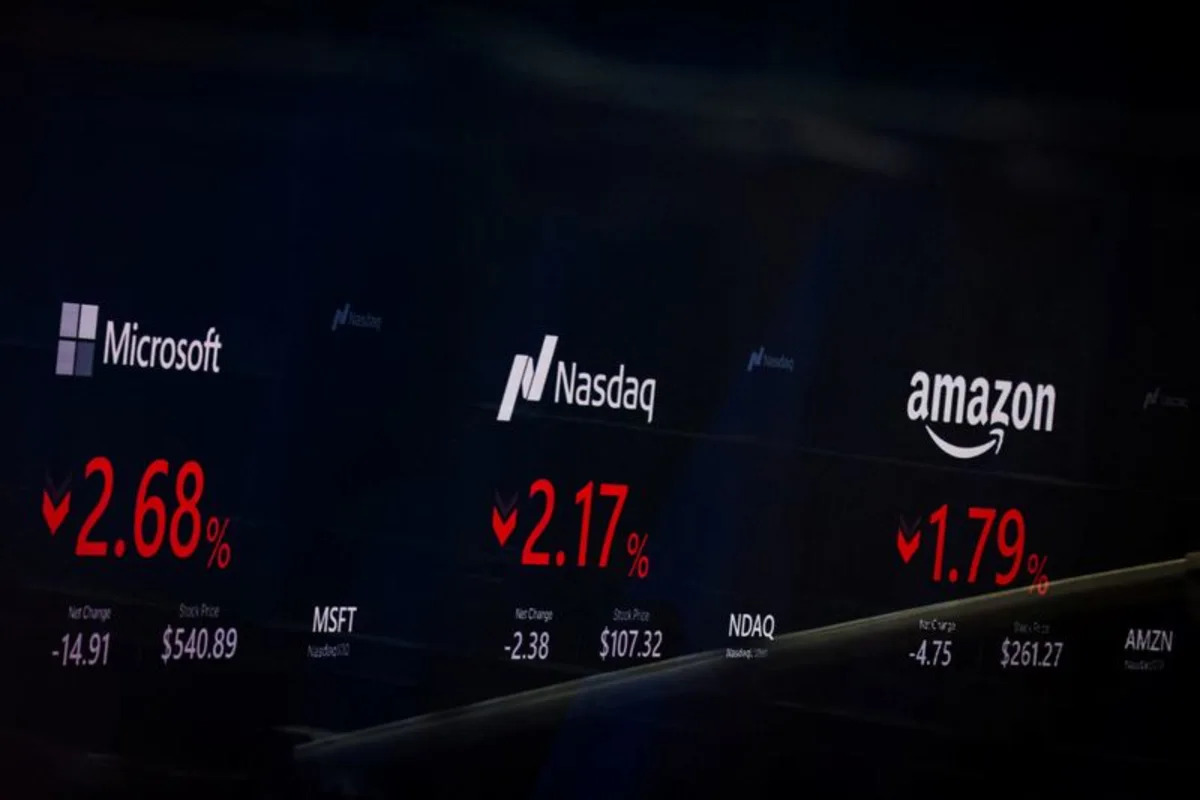
Nov 6 (Reuters) – Stock markets were tumbling as fear gripped investors that the Democratic sweep at the midterm elections would lead to regulation and a slowdown of the AI boom that has been propelling US growth and computer component supply chain stocks all over the world.
The Nasdaq fell 5.5% on Thursday in the biggest drop since the tariff-triggered “Liberation Day” rout in 2025.
On Friday in Asia trade in Seoul was halted after the open when stocks plunged 8%, and in Tokyo the Nikkei slumped more than 6%. [MKTS/GLOB]
Here’s what market participants are saying:
SHANE OLIVER, CHIEF ECONOMIST AND HEAD OF INVESTMENT STRATEGY, AMP, SYDNEY:
“Investors are trying to grapple with what the Democrat win might mean and they don’t fully know yet. It attests to the broader concern that tech and AI-related trades were trading on relatively high multiples and that left them vulnerable. That concern had been building for a while now, and you could argue that the midterms provided the trigger for a pullback.
“It’s too early to say the markets have bottomed, but providing the economic outlook is unaffected, it’s probably going to be more of a correction than a bear market.”
GEORGE BOUBOURAS, HEAD OF RESEARCH, K2 ASSET MANAGEMENT, MELBOURNE:
“The AI and tech selloff, which began a few months ago on both valuation metrics and impact to free cash flow, has now accelerated on the prospect that the US data centre rollout will be impacted by the change in the Senate and House following the midterms.
“The significant data centre rollout is now anticipated to be scaled back. The unknowns will continue to create uncertainty for markets.”
CHARU CHANANA, CHIEF INVESTMENT STRATEGIST, SAXO, SINGAPORE:
“I would caution against interpreting this as the Democrats putting an end to the AI boom. AI leadership remains a strategic priority for both parties, particularly in the competition with China. But there is a difference between supporting AI leadership and allowing the infrastructure buildout to proceed at any cost or pace.
“There is also clearly an element of panic in the selling, and positioning is making the adjustment much more violent. When investors begin unwinding these positions simultaneously, the selling can become self-reinforcing, particularly if leverage and forced liquidations are involved.”
MICHAEL MCCARTHY, CEO, MOOMOO AUSTRALIA AND NZ, SYDNEY:
“It’s pretty clear there’s been a real shift in sentiment.
“Market turning points are often accompanied by strong disagreement, and that shows up in the market by huge swings in either direction. And that’s what we appear to have — and last night’s emphatic sell-down suggests that is the direction that we’re now headed in.
“It’s quite possible this could be a significant turning point for the US market … I think a lot of the bigger players in the US have declared, in last night’s action, that the music has stopped. It’s game over.”
MARK FUCHS, CIO, FUCHS CAPITAL PARTNERS, SINGAPORE:
“The Democrats had come in with a more circumspect view on data centres and AI … so there’s the broad picture which is probably a little bit of a spending reduction, by virtue of higher bars on data centres generally.
“Asia tech, broadly, is getting further repriced downward on expectations that the demand would be somewhat more constrained … as well as markets pricing cost of capital higher since the Fed started raising rates in September.
“The more important thing, if you take the newer factor of Democrat data centre constraint off the table, (is) the reality is that this sector had been repricing downward for well over a month.
“We are preferring more non-AI related sectors and countries that offer higher nominal GDP and durable domestic growth stories like domestic India, while hedging the currency and index.”
(Reporting by Rae Wee, Ankur Banerjee and Gregor Stuart Hunter in Singapore; Compiled by Tom Westbrook; Editing by Christian Schmollinger and Muralikumar Anantharaman)