
We may be one gigantically small step closer to solving the most essential Universal questions, including what happened immediately after the Big Bang, where is dark matter hiding, and why does normal matter even exist?
The increasing sensitivity of particle colliders like CERN’s Large Hadron Collider (LHC) is allowing researchers to probe unprecedentedly deeper into the very structure of our reality.
Called the “zeptoverse,” it may harbor undiscovered particles or forces existing at zeptometer scales, thousands of trillions of times thinner than a human hair, and cosmos-shaping quantum actions across time spans that are unimaginably small.
After more than 40 years of effort, scientists have effectively fastened a knocker on the door of the zeptoverse, offering experimental evidence of an exceedingly elusive, unstable type of particle decay.
In a seminar held on November 3rd, and in a preprint paper on arXiv that has not yet been peer-reviewed, the LHCb Collaboration announced evidence of this phenomenon.
It’s thought to occur only once in ten billion events involving the death of a certain “beauty” particle – odds substantially less likely than winning the lottery.
This potential discovery, and a much more precise measurement of a previously observed sibling decay, provide “a powerful new test of the Standard Model and a window into potential new physics,” explains Niladri Sahoo, particle physicist at the University of Birmingham and convener of the LHCb Very Rare Decays working group.
 frameborder=”0″ allow=”accelerometer; autoplay; clipboard-write; encrypted-media; gyroscope; picture-in-picture; web-share” referrerpolicy=”strict-origin-when-cross-origin” allowfullscreen>
The experiment was conducted at the Large Hadron Collider Beauty (LHCb), a particle-hunting project situated along the sprawling subterranean LHC.
It’s now able to home in on such rare particle physics – sought since the 1980s – thanks to a recent update that significantly boosted its particle collision detection rate, as well as leveraging machine learning techniques to increase the signal-to-noise ratio that has drowned such attempted observations.
The LHCb experiment detects decays using instruments like its eagle-eye VELO sub-detector, which is snugly situated less than a finger’s width from the particle beam to better observe the zoo of exotic particles produced by near-light-speed collisions.
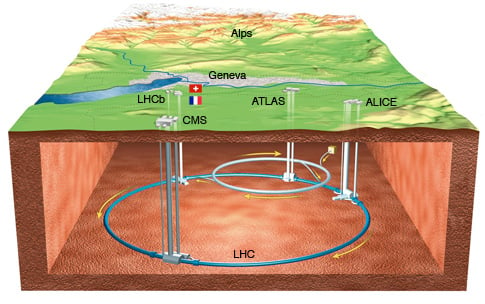 A map of the LHC and its components, including the LHCb. (CERN)
So the scientists’ big breakthrough is the potential detection of the decay of a particle known as a Bd meson into a muon and an anti-muon.
The meson in question is composed of two weird particles, called a beauty quark and a down antiquark.
Quarks come in six flavors, and two of them, called up and down quarks, combine in triads to form neutrons and protons.
The other quarks are more esoteric but essential for exploring the greatest Universal mysteries.
Accordingly, “beauty quarks” were common in the soupy aftermath of the Big Bang, perhaps when the cosmos was just a hundredth of a billionth of a second old, but are naturally absent today.
So then where did the researchers get their hands on a beauty quark to make the meson and start the whole shebang?
They made these quarks from scratch.
First, they collided protons at near-light speed, producing an ephemeral spray of particles including many beauty quarks and down antiquarks, which don’t like being alone, so they combine almost instantaneously via the strong nuclear force, which also binds quarks inside protons and neutrons.
These mesons are incredibly fleeting, decaying in one and a half trillionths of a second. But only one in every ten billion of these ‘beauty-ful’ decays yields the desired result: a muon and an anti-muon pop out of the energy of the quantum realm to conserve the energy-mass law.
These muons themselves only ‘live’ for around two millionths of a second before decaying into particles like electrons and positrons.
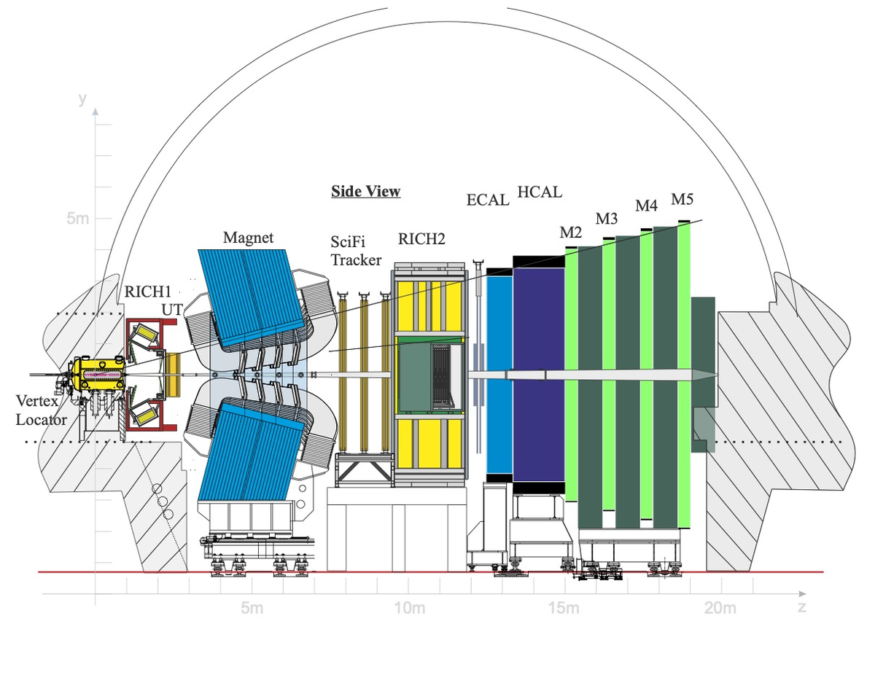 A cross-section of the LHCb’s mechanical workings, including the Vertex Locator (VELO) sub-detector. (CERN)
Claiming evidence for a phenomenon like this requires a significance level of three standard deviations, or “3 sigma,” corresponding to a 0.3 percent chance that the result is a fluke.
This newest evidence, courtesy of the LHCb experiment from 2024 and 2025, combined with previous data gathered between 2011 and 2018, yields a comfortable significance level of 3.2 sigma.
Attaining the ‘gold standard’ 5-sigma significance value will require further research to confirm this decay. Future upgrades in the 2030s will boost the number of LHC collisions and again increase the data collection rate, by an order of magnitude.
As the researchers summarize: “All results are consistent with [Standard Model] expectations and constrain new physics contributions at energy scales beyond those accessible through direct production at the LHC.”
This highlights that the results of this work align with the Standard Model, which explains much of our Universe but doesn’t illuminate dark matter, or the slight asymmetry in normal matter and antimatter that prevented the entire cosmos from annihilating itself in a puff of energy after the Big Bang.
It also tantalizes us with the suggestion that discovering novel physics may not rely on the LHC directly cranking out a new particle, but on indirect evidence, perhaps seen in other decay rates.
This has been the case in the past discoveries of the charm quark and the top quark, the latter of which is the heaviest of the quarks, about as massive as an entire gold atom.
“Seeing clear evidence for this rarest decay for the first time was thrilling,” concludes Harry Cliff, a particle physicist at the University of Cambridge and leader of the analysis team.
“We’re knocking on the door of the zeptoverse now. I can’t wait to see what we find as we explore deeper.”
A preprint of the research paper is available on arXiv.
This article was fact-checked by Rebecca Dyer and edited by Rebecca Dyer. While we pride ourselves on our process, we are only human. If you spot a mistake, please let us know.