
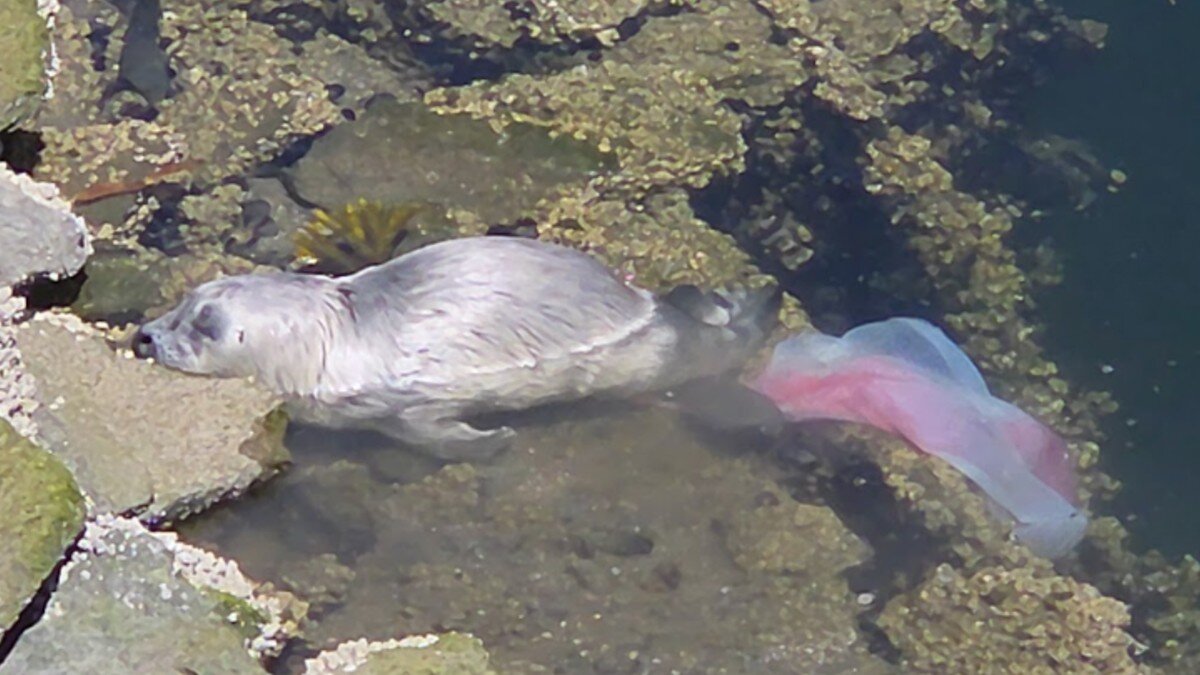
This past summer, residents of Canada’s Granville Island came across a baby seal who needed help. He was stranded by a crowded marina near Downtown Vancouver all by himself, with no mama in sight.
“[A] ton of people were watching this animal,” Kendra Luckow, registered veterinary technologist with VA Marine Mammal Rescue Society, told The Dodo. “It was at a really public spot, so we immediately started getting … inundated with phone calls.”
 VA Marine Mammal Rescue Society
As the crowd of people observed the seal, it quickly became clear that he wasn’t just a baby — he was a newborn. Floating behind him in the water was his placenta, still attached to his body. Luckow estimated that only about 1 percent of the baby seals the organization rescues still have their placentas attached.
“[H]e was as fresh as they come,” Luckow said.
There’s no way of knowing why the baby ended up separated from his mama, but it’s likely that the crowds in the area may have scared her off. So this story serves as a reminder to always stay a respectful distance away from wildlife.
 VA Marine Mammal Rescue Society
A rescuer from VA Marine Mammal Rescue Society quickly arrived at the scene. Because the newborn was located at the bottom of a rocky embankment, the staff member had to approach the baby from the water.
“One of my colleagues rowed up to him, got out, and then was able to pick him up and put him in a kennel from there, and then go back to shore that way,” Luckow said.
The seal pup, named Puck by a VA Marine Mammal Rescue Society supporter, was still covered in the fluffy fur seals typically shed in utero. Because Puck still had this white lanugo fur, he was most likely born premature and needed even more support than a typical baby seal.
 VA Marine Mammal Rescue Society
The rescue staff worked hard to help Puck grow and get stronger. They started him on baby seal formula, then transitioned him to a fish diet and got him used to bigger and bigger pools. As he grew, he shed his baby fur — which ended up looking hilarious.
“[It] looked like he was wearing little pants, because he shed his entire top half of his body, and then he had this thick lanugo fur still on his back end,” Luckow said.
After four months at the rescue facility, Puck was finally ready to venture out into the water on his own. On his release day, he and the other seals he was released with stayed close to the shore for a bit, taking in their surroundings. Then, when they were ready, they swam off.
 VA Marine Mammal Rescue Society
“[T]o be able to put all that work into him, and to watch him thrive through that process, and then watch him be released, it’s so exciting,” Luckow said.
If you’d like to support the VA Marine Mammal Rescue Society, you can symbolically adopt Puck here. Workers Find Pack Of 22 Stray Dogs Living In Dangerous Oil Field And Call For Help“It was definitely alarming.”