
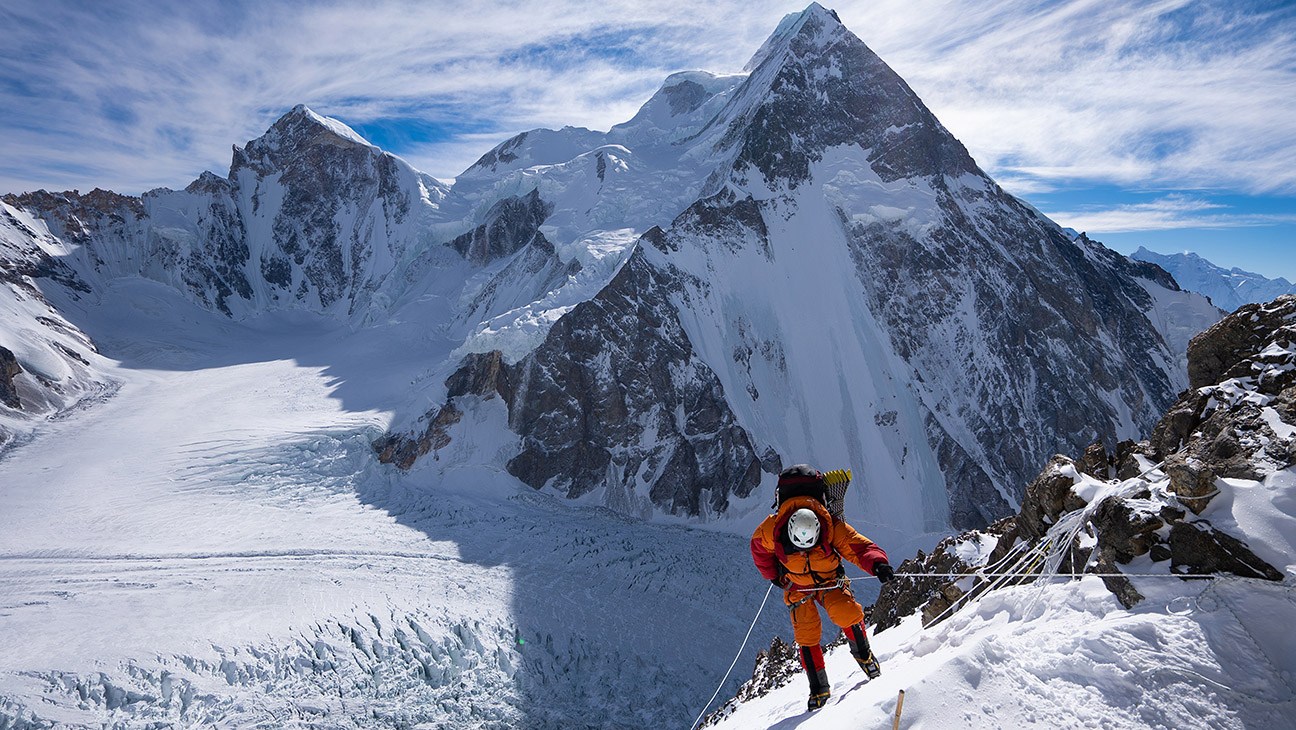
Amir Bar-Lev has been making documentaries for more than 25 years in all kinds of genres, but the Tillman Story and Long Strange Trip director never thought he’d approach the category of mountaineering. He had some personal issues with the field on a cinematic level and knew nothing about it on an informational level. Then a producer with whom he’s worked before got him up to speed on the chaos that happened around six years ago at Pakistan’s K2, the second highest mountain on Earth, and told him she saw him as the right person to tell the story.
The Last First: Winter K2 captures the frenzy around a group of mountaineers’ attempt to become the first people to ascend the mountain in winter — essentially, completing the last epic “first” that exists for the extreme sport. Some people fall in love; others die in pursuit of the goal. The project came to Bar-Lev with a ton of material captured on the ground already licensed, from potential documentary footage to videos made on iPhones and GoPros. Taken all together, the content introduced a slew of fascinating characters, as well as deeper meditations on the human condition, the perilous function of modern social media, and the reality of what it means to face death in the face.
Bar-Lev joined The Hollywood Reporter at the SCAD Savannah Film Festival, as part of its Docs to Watch program, for an in-depth breakdown of how he made the movie. Watch the video below and read on for edited excerpts of our conversation.
You were not on the ground making a movie about this in real time — it came to you thereafter. Talk a little bit about your awareness of this period of time and when the idea to make the movie came your way.
I’m not a mountaineer at all, and if it’s not clear, I got involved like three years after these events. I got a funny call. Two [producers] are a married couple, John Battsek and Sarah Thomson. They’re British, and I’ve worked with John a bunch before they got married; Sarah called me and said, “John doesn’t think you’re going to be interested in this, but I think you would be.” He thought I wouldn’t be interested in it because I didn’t really know anything about mountaineering; she thought I would be interested because in some ways it’s about mountaineering, but it’s about something that I find in every film — the way people find meaning, the way culture works. I thought of it like a science-fiction film where there’s an alien landscape and humans go there, but they bring their human foibles.
What was the process of understanding the amount of footage you would have and how you would access that footage? I would imagine there were many ways to tell this story, so how did you find your own narrative center?
There were 60 people on the mountain, so we could tell 60 stories if we wanted to. I had the best collaboration experience I’ve had yet with films. I keep coming back to the fact that these were Brits — it has a role in the answer because when they gave me the job, they told me, “You’re going to be the only non-Brit, because they have really good tax breaks in England that we don’t have here.” So they said, “You’re going to have to work with people.” I worked with an all new, very young, really great British team, and we all had different ideas about what this film would be. The editor said, “It’s just a film. For me, it’s really just about [John] Snorri [Sigurjónsson] and [Muhammad] Ali [Sadpara].” I said, “I see it as a kind of a Robert Altman thing.” We met in the middle.
Before I was involved, they had licensed the footage from Elia, the filmmaker that you see in there. And they had licensed Snorri’s GoPro footage and stuff like that. … There were six different documentaries being made there. One came to fruition, which was a little short film about Sergi [Mingote], and the rest, we incorporated their footage into ours. It was a very hard film to structure because it’s a strange story. It’s about a competition, and the competition is done a third of the way into the story, so figuring that out was complicated. There were a lot of misfires, as one does in editing.
The point of there being six different documentaries made at this time is in the text of the movie as well, right? Can you talk about, as you were learning more about what your film was, what this frenzy of activity represented to you?
It’s a kind of story that you turn over and over in your mind. There’s a reaction I get a lot with this film so far where people go, “What’s wrong with these people? Are they crazy?” And they’re a little bit crazy, but I think that what they are is a little bit transgressive. There’s this exalted thing around mountaineering, and I feel it’s a little bit like the last film I made, which was about The Grateful Dead. They’re sort of druggies in a way — they don’t take drugs, necessarily, but it’s a similar kind of appeal. I don’t feel totally judgmental about druggies, and at the same time, it’s dangerous — I’m a parent of three. I don’t try to romanticize drugs, and I don’t feel super judgmental about it. That’s how I feel about mountaineering. Where it gets complicated is filming druggies or mountaineers because by its nature, you’re giving it a platform, in a way. Especially with this kind of mountaineering, which is so risky, there’s a concern that people play to the camera in a way. As a filmmaker, that bears scrutiny.

Amir Bar-Lev speaks onstage at the 29th SCAD Savannah Film Festival.
Derek White/Getty Images
When it came to the edit, what were some of the most central challenges of putting everything together and finding the story? As you got deeper into it, what came up?
Reining myself in was the main challenge. This story is a container for all these really interesting things about class, about race. You want to expand on that and make sure that it’s coming across. The edit team had a joke at my expense at some point, a shorthand of cave-drawing scenes because I wanted to have — and we did even have at some point — a scene about cave drawings, which thankfully I was talked out of. That happened a bunch of times, where I would say, “Documentaries are just another example of what we’ve been doing since the beginning of time. Somebody seems to cheat death or somebody seems to be less afraid of death, and you tell the village about it or you write it.” This was essayistic stuff that I had to work through my system and then not put into the film because there was so much strictly narrative material that we needed to get through.
One of the great appeals of mountaineering movies is the visual awe and splendor, the sense that we as an audience are going into the unknown with these subjects. I wonder how you thought about the visual language of your movie, since you’re working against that to some degree.
I essentially thought of it as a base camp story. This is the interesting thing. We all know that in documentary, there’s tons of artifice, but it runs the gamut. Sometimes it maybe crosses certain ethical lines; other times it’s just how you have to tell a story. I came to realize that in order to film way up at the top, anywhere past camp two, takes a huge amount of artifice, essentially — to get the beauty shots of people climbing and stuff like that. It’s almost like a nature documentary. You’re pretending something happened later in the edit, but you’re doing it saying, “OK, come through the shot.”
If you were to watch the raw tapes of some mountaineering films that look better than ours, it’s because of that artifice. I’m not saying there’s anything wrong with artifice, but we don’t want to do that. It felt like we would just be doing the thing that we’re trying to be critical around. So we got a lot of footage from people’s iPhones; we just embraced that aesthetic. Even though you do occasionally take a break and see a drone shot or something like that, the aesthetic was to try to be lo-fi and homemade rather than cinematic and sweeping.
This movie premiered at Sundance. How have you found the conversations that it’s sparked over the past year?
I’m a very slow filmmaker. The last film I did, that Grateful Dead film, was 2017, so this was the longest gap. I’m not always this slow. But in the interim, Letterboxd became a thing. It might have been a thing back then, but I’m kind of late to the party. This is the first film where I’ve watched Letterboxd in real time, which is amazing. You get so much feedback; it’s like a firehose of feedback. I like when the feedback starts to be on opposite sides. If somebody says, “It’s too short,” another person goes, “It’s too long.” Somebody says, “Why didn’t he go into this?” and then “Why didn’t he go into that?” I feel like I got it exactly right.
When I was a student making my first film, an absurdist short of a guy walking around Prague with a stack of dishes, we came up with this phrase like, “It’s very hard to say nothing.” And I kind of feel like I’m trying to do that in every film. I’m trying to say nothing. I don’t want you to think it’s like, “Oh, I just made a mess and that’s the film.” What you’re trying to do is not be didactic. You’re trying to leave room for the audience to draw their own conclusions, and it’s really fun when they draw different conclusions from the same film. Then I feel like I’ve done my job. I’ve said nothing.