
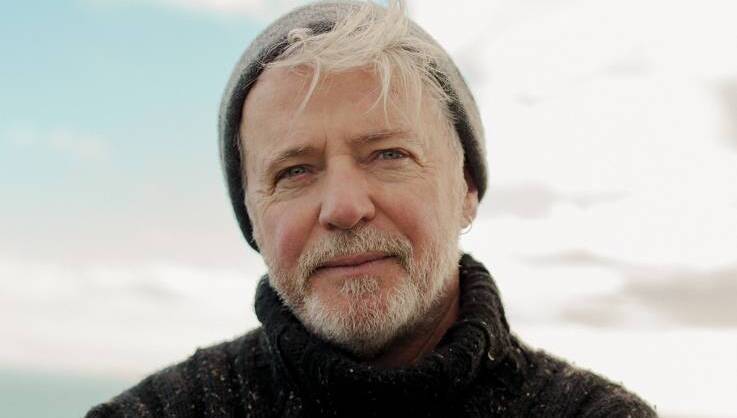
At the 71st Academy Awards in 1999, Judi Dench won an Oscar for eight minutes of screen time in Shakespeare in Love, while in 1977, a five-minute monologue in Network secured Beatrice Straight hers, proving that brevity is no barrier to achieving Hollywood’s highest honour. If mastery of craft does indeed trump minutes on screen, then Aidan Quinn should be a shoo-in for his brief, bravura turn in writer-director Vicky Waldron Wight’s latest film, The Body is Water.
The film follows grieving father David, played by Isiah Whitlock Jr, who moves from Texas to a remote West Cork coastal village, hoping to disappear — but the villagers won’t let him.
Quinn is John Umley, a taciturn resident of the fictional Ballybrone, whom we properly meet at poetry night in the pub when his turn is up to recite his chosen verse, Eavan Boland’s And Soul, to those assembled. Seated at the bar counter, a half-drunk pint of stout cradled in his hands, Quinn, as Umley, brings to vivid life the rain-lashed summer when Boland’s mother died, the lines mirroring his unspoken past, the film’s big themes of love, loss, and grief, and how, at the end of the day, nature reclaims us all. It’s utterly electrifying.
As it turns out, Quinn “didn’t really do a hell of a lot” of prep to deliver those three mesmerising minutes. “She did the homework, didn’t she?” says the Chicago-born actor when he speaks to me over Zoom from a US hotel room. “She wrote this beautiful thing that you just needed to get out of the way of and just ride the surf of her language and her images.”
When Quinn first read the script for The Body is Water , his initial reaction to the part was puzzlement. “I thought, ‘I’m what? I’m in all these scenes silent and then I get up in the pub?’” But his reservations fell away when he read Boland’s poem. “It just slayed me when I read it … her words are so extraordinary.”
Those extraordinary words became the basis for Umley’s backstory, with Quinn imagining him as a “young man from Dublin” who was “transplanted” to West Cork and has been “down there for 20, 30 years, or forever”. “I tried to give it that flavour,” he says. “I would just let the poem take me.”
Quinn, too, was once a young man in Dublin. His parents Michael and Teresa, who hailed from Co Offaly, had emigrated to Canada before settling in Chicago, Illinois, but moved the family back to Ireland several times over the years, first returning in the early 1960s when Quinn was three. This peripatetic childhood gave him a “hybrid existence”, shuttling between the US and Ireland.
You’re grateful for the width and breadth of experiences and culture but you’re always a little bit of a stranger in a strange land sometimes in both places, so it can go back and forth, but I think overall it’s a blessing, at least it was for me.
At 18, Quinn lived in Dublin for a year. “I was basically just wandering around reading Yeats and Joyce and wanting to be a writer,” he told Irish America magazine in 1999. “I’d go into Stephen’s Green in the middle of the night, climb the fence, and sit up in the tree, and I’d talk to myself and scribble poems and just fantasise.”
He also enjoyed lunchtime theatre performances in Trinity College and, on his return to Chicago after a stint as a roofer, Quinn made his professional acting debut in a Chicago theatre production, followed by an off-Broadway role in Sam Shepard’s Fool For Love.
More recently, Quinn bought the rights to another of Shepard’s plays, 2009’s Ages of the Moon — a two-hander commissioned by the Abbey Theatre and first staged at the Peacock — having done a reading of it “with my friend Steve Buscemi two years ago at The Abbey”.
“I thought, ‘Oh, I’d like to buy the rights to this and make it into a little screenplay and a film.’ It took a couple of years but we ended up getting a small bit of money together and doing it. We self-funded it to begin with, Steve Buscemi and myself. We’re co-producing it, I directed it, and the two of us are acting in it. And my older brother, Declan, who’s a well-known cinematographer, shot it. We shot it in 10 days, believe it or not.”
The degree of multitasking required was “crazy”, Quinn says. “I don’t think I ever want to do that again. If I ever directed myself, it would be in a supporting role, not in the lead role.”
For an actor whose CV includes some of the most iconic films of the past four decades — Desperately Seeking Susan (1985), The Mission (1986), Legends of the Fall (1994), Michael Collins (1996), Song for a Raggy Boy (2003), to name but a few — Quinn is not at all starry. Despite it being there for the taking, a Hollywood-megastar level of fame has never been a motivator for him.
“It never interested me, that,” he says, explaining that he’s seen first-hand the effect of the “intrusion” friends who are “super famous” have to deal with. “I’m quite comfortable with the fans that come up to me and say something. They’re usually very nice and it’s not that often, and I can live a normal life. That means a tremendous amount to me. So I guess the level of fame, or whatever it is that I have, is just enough for me.”
For Quinn, it’s always been about finding good parts and working with good people. “I’m too old to…” He pauses. Then, in his Irish-American drawl, adds:
I don’t want to work with amadáns.
While the 67-year-old actor considers himself American, he holds a US and an Irish passport, and has continued to spend periods of time here. Accepting the role in The Body is Water presented a “no-brainer” opportunity for him to revisit a part of Ireland he knows and loves, and to bring along his wife, actress Elizabeth Bracco, and their youngest daughter Mia.
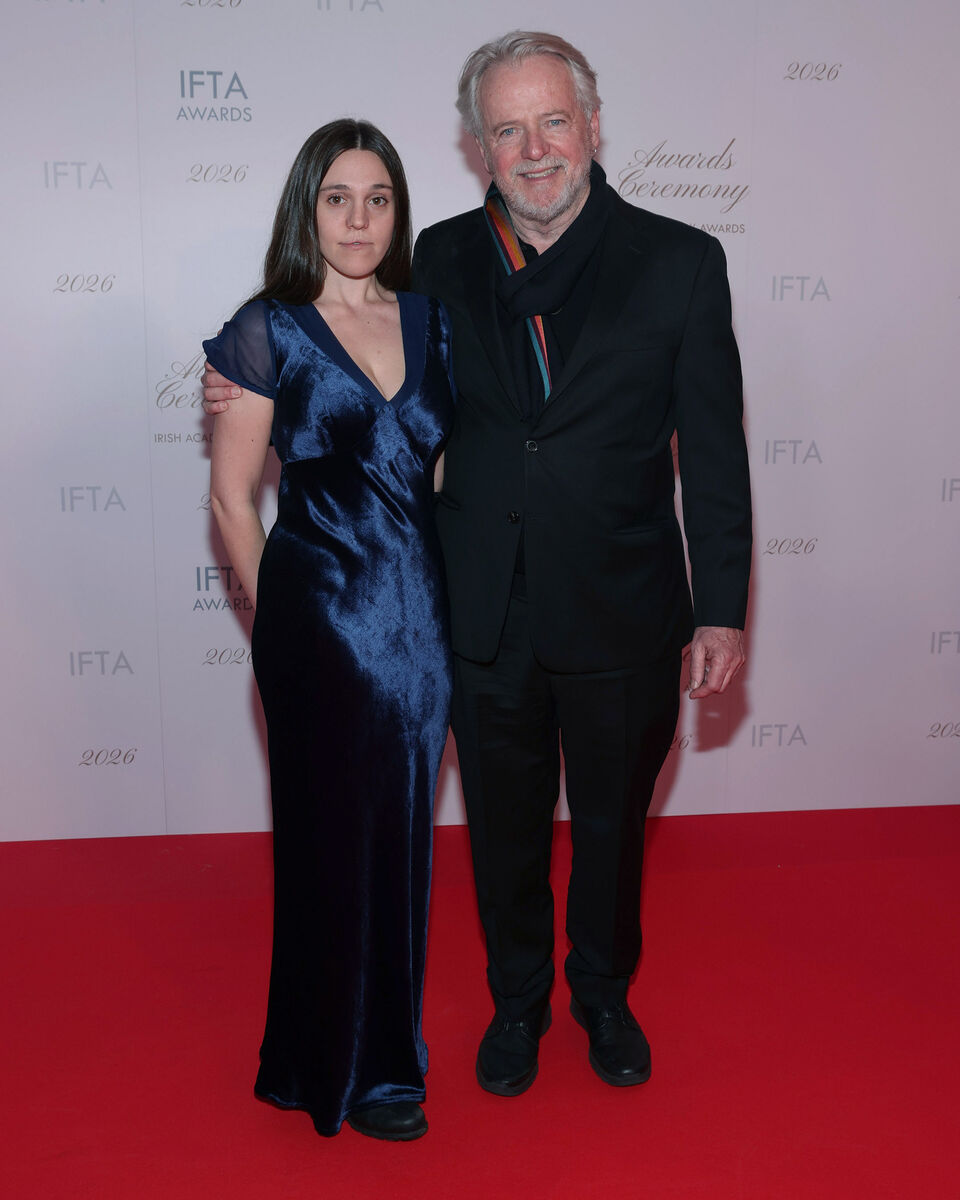 Aidan Quinn and his daughter Mia pictured at the IFTA Awards 2026 at the Dublin Royal Convention Centre. Picture: Brian McEvoy
“It doesn’t take much for me to want to go back to West Cork because it’s just such a lovely spot,” he says, adding the trio stayed in Goleen for the duration. There were other draws too. He “loved the script” and “what a cast”, he says, effusively listing off a string of well-known names, including Saoirse-Monica Jackson, who plays the eccentric Lou to Whitlock Jr’s grieving David.
Sadly, Whitlock Jr, who’s best known for playing Clay Davis in The Wire, died from a short illness a few months after filming wrapped. It was Quinn’s first time working with the veteran actor.
“He was a lovely man,” he says. “It was lovely to get to hang out with him and he had such a lovely nature and we all loved him.”
Quinn’s never had a grand plan, career-wise: “I’ve never known a year or two in advance of what I was doing, ever. It’s always been like that”.
He recently wrapped filming on season two of The Walsh Sisters, in which he reprised his role as family patriarch Jack Walsh.
“Doing that job, it’s kind of a joy,” he says, adding that this season Daddy Walsh gets involved in something that gives him a “new zest”, which he hasn’t had since taking early retirement “years and years ago”.
Quinn has had a taste of retirement and didn’t like it. When the pandemic hit, not knowing if he’d ever work again, he took his union pension early, and he also has a social security pension. “I guess I’m semi-retired because I’m taking two pensions but I didn’t like being retired. It’s not for me. I like working. I don’t like working all the time. I’m working maybe too much right now…”
Hopefully, being in West Cork makes it easier, as he’s imminently due back there for a week to play a supporting role in Mark and Kealan Ryan’s Through The Silent Lands, a film about the 1983 manhunt for Irish republican paramilitary leader Dominic ‘Mad Dog’ McGlinchey. “So that’ll take me to the end of the year,” he says. “And we’ll see what next year brings.”
A shiny statuette for those three mesmerising minutes, if there is any justice.
The Body is Water will have its Cork premiere at the 71st Cork International Film Festival on November 21. See corkfilmfest.org
A note from Fiona Clark, Cork International Film Festival
Last year, we celebrated Cork’s extraordinary film heritage. This year, we turn our gaze to the future. Milestones offer a chance to reflect on why film festivals matter: They are places of discovery, connection, and shared experience. The lights dim, a story unfolds, and a roomful of strangers laugh, gasp, cry, or cheer together. In an increasingly fragmented world, there is something quietly powerful about that.
The festival extends far beyond the screen: The conversations around a film, meeting the people who made it, and discovering connections between cinema, music, art, food, and the city around us. Over 11 days, more than 200 films bring the best of Irish and international cinema to Cork, alongside a celebration of local talent and our creative community that makes our city so distinctive. Our Cork Film Trail invites audiences to explore the city through podcasts, walking tours, a film quiz, and even a pub trail.
This year, our Cinema of Foresight retrospective explores how filmmakers have anticipated the forces shaping our world. Our expanded The Bigger Picture programme brings filmmakers, artists, and experts together with audiences to debate the ideas and urgent questions of our time. Cinema doesn’t simply reflect the world we live in; it can help us imagine the world we might create.
This edition is particularly special for me, marking 10 years as festival director. Much has changed in Cork, the film industry and the world, but this city’s affection for cinema remains constant. Cork takes pride in hosting Ireland’s oldest and largest film festival. And even as streaming and AI transform how and what we watch, our audience’s appetite for the big-screen experience has grown, not diminished. Since the pandemic, our festival audience has grown by 40% — a powerful reminder of cinema’s enduring appeal.
Now we must look ahead. I believe Cork deserves a dedicated city-centre home for independent cinema: a place for film, education, exhibition, and conversation. A permanent film destination for filmmakers, film lovers and the simply curious has the potential to elevate and strengthen Cork’s standing among Europe’s leading cultural cities. Making this vision a reality will take ambition, collaboration, and support. If you share our belief in cinema’s importance to our city, we’d love you to help us make it happen.
A film can change how we see the world, introduce us to lives unlike our own, or stay with us for a lifetime. That is the power of cinema, and why its future matters. I hope you’ll join us in shaping it.
Fiona Clark is festival director and CEO of Cork International Film Festival