
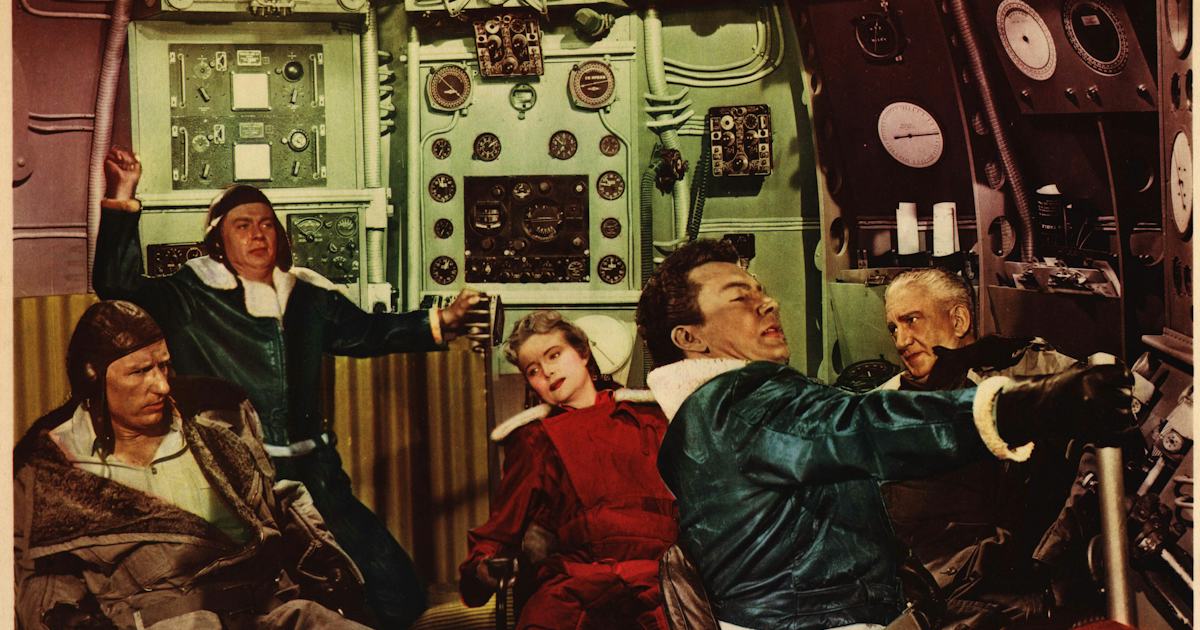
Following a string of black-and-white interplanetary adventures, in 1951 Hollywood boldly went where no cinematic journey to Mars had gone before. Shot in glorious Cinecolor, Flight to Mars gave theatergoers the first opportunity to see the Red Planet in actual red. Yet like many sci-fi pictures of the era, it was more interested in romance, bureaucracy, and old-fashioned chauvinism than awe-inspiring spectacle.
Premiering 75 years ago, and 41 years after the short film A Trip to Mars first imagined life on Earth’s neighbor, the movie was only the second time director Lesley Selander ventured outside the western genre, where he eventually racked up more than 100 credits. The prolific filmmaker was resourceful, borrowing props from 1950’s Rocketship X-M, the monochromatic story of a lunar mission that ends up on an atomic war-ravaged Mars, and costumes from the same year’s Technicolor Oscar winner Destination Moon.
But his naivety also shines through in a tale which drowns in expository mumbo-jumbo while continually defying the laws of physics. See how “Getting the magnetic fields stabilizer to equalize the gravitational pull” apparently explains the lack of floating about, or how the gang climbs aboard their spacecraft dressed in the kind of Sunday best you’d expect for an excursion to church.
This seemingly ill-equipped motley crew includes Professor Jackson (Richard Gaines), physicist Dr. Lane (John Litel), reporter Steve Abbott (Cameron Mitchell), engineer Jim Barker (Arthur Franz), and, in what seems like a progressive move, his assistant Carol Stafford (Virginia Huston). However, it doesn’t take long for Flight to Mars to lean into trad-wife propaganda. During their ascent, the only woman on board starts opining about how she’d much rather become a mom than an intrepid explorer. And her first question on arriving at the Martian base is, unfathomably even for times, “Where is the kitchen?”
Arthur Franz’s Barker and Marguerite Chapman’s Alita in glorious Cinecolor.
Monogram Distributing
It’s a miracle that Stafford is alive to ask such a question in the first place. Following an equipment-disabling meteor storm that creates the dilemma of whether to head back home to safety or continue the dangerous mission (no prizes for guessing which option they choose), the crew crash-lands into a snow-capped mountain with such force that everyone should have been blown to smithereens. Instead, they miraculously exit with barely a scratch.
They’re greeted by a group of Martians sporting entertainingly ridiculous outfits that sit somewhere between NASA and Teletubbies, and who initially seem non-threatening. Handily speaking English picked up from Earth’s broadcast signals, they offer their visitors a guided tour of the underground city where flying vehicles and, much to Stafford’s delight, automated dinners are the norm. However, powered by the rare mineral named Corium, this apparent “woman’s paradise” is in danger of becoming a wasteland within 10 years.
Cameron Mitchell’s Abbott and Virginia Huston’s Stafford, the latter no doubt still thinking about the kitchen.
Monogram Distributing
Step forward big baddie council leader Ikron (Morris Ankrum) with a dastardly plan to fix the humans’ spaceship, mass-reproduce its mechanics, and launch a takeover of Earth, all while acting as the perfect Good Samaritans. It’s never quite clear why, despite blatantly possessing a technical skill that far outweighs their guests, they haven’t been able to build their own spacecraft long before. Still, this subterfuge sparks a sense of jeopardy the film previously lacked, even if the focus continues to remain elsewhere.
Indeed, while you’d expect the enslavement of its five Earthlings and the possibility of a Martian invasion to take center stage, Flight to Mars is more interested in soap opera-style affairs of the heart. As you’d expect, poor Stafford is given short shrift, her unrequited love for Barker so strong that she’s willing to let the utterly icky Abbott — a man who describes her as a “prize package” and “very feminine” — slobber all over her to provoke jealousy.
The Martians in their fetching outfits.
Monogram Distributing
Barker, meanwhile, only has eyes for Mars’ answer to a leggy supermodel who, like all the women on the planet, parades around in prototype miniskirts. Presumably named in honor of Aelita, the title character of the groundbreaking 1924 Soviet film, Alita (Marguerite Chapman) comes over from the dark side to help save the day and, having broken Stafford’s heart, inadvertently reinforce the notion that “women are too emotional” to be in science. “How many tears do you think it’ll take to wash out three years?” the charmless Abbott asks his sobbing crewmate as she finally realizes she’s lost her man.
It’s little surprise to learn that it’s the guys who formulate the escape plan, fabricating an explosion that lets the gang sneak back home before their technology can be copied. Interestingly, Selander, who didn’t foray beyond his wheelhouse again, wraps things up without showing whether the return trip reached its destination. But with only five days at his disposal to bang out the entire film, you can perhaps forgive the various gaps in logic, purpose, and narrative drive. And while they inevitably looked dated by the time the space race started for real, Flight to Mars’ visuals ensure this voyage at least occasionally soars.
Flight to Mars is available on YouTube.
Learn Something New Every Day