
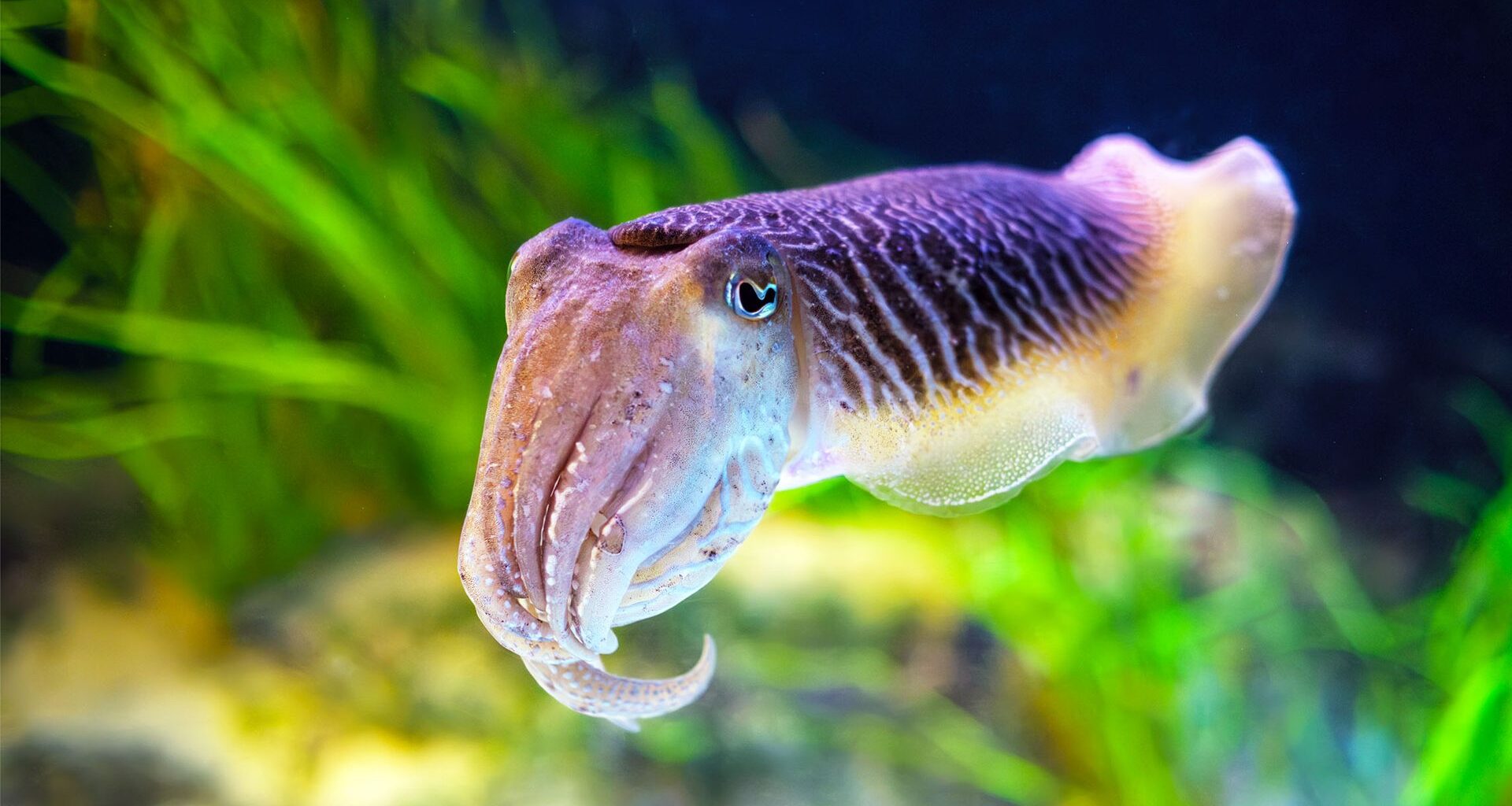
On the seafloor, a cuttlefish can make its skin look so much like the sand and pebbles around it that the animal disappears. Earlier experiments made the trick…
On the seafloor, a cuttlefish can make its skin look so much like the sand and pebbles around it that the animal disappears.
Earlier experiments made the trick look simple: the eyes read the background, and the brain sends out the matching pattern with no checking afterward. Up close, the change is slower and busier than that.
The skin reaches its match in steps. The change slows down, speeds up again and slows once more, and each step brings the pattern closer to the background. The animal seems to be checking its own work as it goes.
Sam Reiter at the Okinawa Institute of Science and Technology (OIST) in Japan co-led the study of cuttlefish camouflage. He shared the lead with Gilles Laurent at the Max Planck Institute for Brain Research in Germany, and the study came out in Nature in June 2023.
Reiter and Laurent’s team filmed a dozen young common European cuttlefish, Sepia officinalis, in a lab tank. The animals had hatched from eggs collected in the English Channel and the North Atlantic, and their main bodies measured 1.7 to 3.5 inches (42 to 90 mm) long.
“Prior research suggested that cuttlefish only had a limited selection of pattern components that they would use to achieve the best match against the environment,” said Reiter, who heads the Computational Neuroethology Unit at OIST.
“But our latest research has shown that their camouflaging response is much more complicated and flexible – we just hadn’t been able to detect it as previous approaches were not as detailed or quantitative.”
Muscles pull each dot open
Cuttlefish are cephalopods, the group that also includes squid and octopuses. They change their skin color with millions of tiny sacs of pigment. A set of muscles surrounds each sac, and nerve cells in the brain control those muscles directly.
When the muscles pull, the sac stretches wide and shows its color. When they relax, it shrinks back and the color is hidden. Expand some and shrink others, and a new pattern appears, the way dots on a screen make a picture.
Biologists call these sacs chromatophores. To build one pattern, the brain controls tens of thousands of nerve cells at once, and the whole routine runs on instinct. Cuttlefish branched off from the line that led to humans more than 550 million years ago.
The skin can also raise small bumps to change its texture, but this study looked only at the flat pattern of light and dark.
17 cameras filmed the skin
The filming tank was about 28 inches (70 cm) on a side. Printed photos of pebbles and rock ran across the tank floor on a roll of fabric. Every 5 to 10 minutes, a researcher turned a hand crank to change the scene.
Above the tank, 17 high-resolution cameras filmed the skin at 25 frames a second. At that magnification, a single pigment sac covered about 54 pixels. A separate wide-angle camera filmed the whole animal at the same time.
From the wide-angle footage of a single animal, the team collected more than 200,000 images. They came from 27 hours of video.
A neural network, a kind of artificial intelligence, turned each image into a list of numbers describing the pattern, with a supercomputer at OIST doing the processing.
With the patterns written as numbers, the team could ask how many independent ways a cuttlefish pattern can vary. Earlier studies had sorted the patterns into three basic types.
For these animals, the number of independent ways came out close to 60, and the method the team used usually underestimates.
The pattern changes in steps
Next, the team swapped one background for another and watched the skin change. A change typically took around a minute, and it didn’t happen at a steady pace.
The skin changed quickly, then almost stopped changing, then sped up again, and it settled only after several of these pauses.
In 85 such changes across three animals, the team checked which way the pattern changed each time the change restarted after a pause.
Each time, it moved toward where it would finally end up, rather than continuing in the direction it had started out in.
The closer the pattern got to its final form, the more often the change paused and the longer each pause lasted. Each step improved the match with the background.
“The cuttlefish would often overshoot their target skin pattern, pause, and then come back,” said Theodosia Woo, a graduate student at the Max Planck Institute for Brain Research and one of the study’s two first authors.
“In other words, cuttlefish don’t simply detect the background and go straight to a set pattern, instead, it is likely that they continuously receive feedback about their skin pattern and use it to adjust their camouflage.”
The authors compared the process to a hand correcting its path as it reaches for something, rather than a throw that can’t be corrected once it leaves the hand.
Each repeat came out different
Even repeats weren’t exact repeats. When the same animal faced the same background change again, the final patterns looked identical to a person.
Underneath, though, different sets of pigment sacs expanded and shrank together each time. In one case, about 1,100 sacs that changed size as one group during the first change split into 15 separate groups during the second.
Going pale leaves a trace
The team also looked at a different skin change. When something threatens a cuttlefish, it turns pale, a response called blanching.
In the lab, the threat was a researcher’s hand reaching toward the animal and stopping 8 inches (20 cm) away. In other trials, it was a dark circle growing larger on a screen beside the tank.
“Unlike camouflaging, blanching was fast and direct, suggesting it uses a different and repeatable control system,” said Dominic Evans, a postdoctoral fellow at the Max Planck Institute for Brain Research.
The pale skin wasn’t blank, though. Up close, faint traces of the camouflage pattern the animal had been showing were still there. And in 16 of 17 threat trials in one animal, the skin went back to nearly the same pattern afterward.
“This suggests that information about the initial camouflage somehow remains,” said Xitong Liang, the study’s other first author, who did the work as a postdoctoral researcher at the Max Planck Institute and is now at Peking University.
“The blanching is more like a response that temporarily overrides the camouflage signals from the brain and might be controlled by a completely different neural circuit in the brain.”
What remains unknown
If a cuttlefish adjusts its pattern by checking the result, something has to tell its brain what the skin currently looks like. The study can’t say what.
“Exactly how they receive that feedback – whether they use their eyes, or whether they have a sense of how contracted the muscles around each chromatophore are – we don’t yet know,” Woo said.
So far, nothing like a muscle-position sensor has been found around a cuttlefish’s pigment sacs. The authors also raised a third possibility: the brain might keep a copy of the commands it just sent out and use that copy to judge the result.
The authors suggested a way to test whether the eyes are involved. Cover the animal’s skin while it camouflages, so it can’t see its own pattern, and watch whether the pauses and corrections still happen.
Liang said the next step is to record activity from cuttlefish brains while the animals change pattern, to work out how they control the skin.
The full study was published in the journal Nature.
—–
Like what you read? Subscribe to our newsletter for engaging articles, exclusive content, and the latest updates.
Check us out on EarthSnap, a free app brought to you by Eric Ralls and Earth.com.
—–