
Follow us
Add us as a preferred source on Google
Newsletter
Subscribe to our newsletter
Ever since NASA’s James Webb Space Telescope (JWST) started observing the early universe, it has been providing almost as many surprises as it has answers. One such surprise are the so-called Little Red Dots, cosmic objects that seemingly disappear completely before the universe is two billion years old.
New research suggests that Little Red Dots may actually be connected primordial black holes, tiny black holes born not from dying stars but rather from fluctuations in the density of matter just after the Big Bang, in the earliest moments of cosmic history. Should they exist, primordial black holes would predate stars, galactic dust particles, and elements heavier than hydrogen and helium.
Now, researchers have used JWST data to test whether one particular Little Red Dot, known as blackAbell 2744-QSO1 (QSO1), could host a primordial black hole.
“A black hole is an object born from the gravitational death of a star. Primordial black holes are a very different story,” study team member Valerio De Luca, of the Department of Physics and Astronomy at Johns Hopkins University (JHU) in Maryland, said in a statement.
“They come from the physics of the early universe that predates the first stars, when the universe was expanding exponentially in time and space. So the mechanisms for creating primordial black holes are different,” De Luca added.
Little Red Dots could be the smoking gun of primordial black holes
Though scientists have theorized about the existence of primordial black holes since they were first proposed by Stephen Hawking in the 1970s, no hard evidence has presented itself. One of the issues scientists have puzzled over is how to tell the difference between a primordial black hole and a “traditional” or astrophysical black hole formed from the supernova death and collapse of a massive star.
You may like
“Little Red Dots could surround astrophysical black holes, and most probably many of them do, but they could also be primordial black holes, if primordial black holes exist,” De Luca said. “So the question becomes, Which ones are primordial and how can we tell?”
De Luca and colleagues turned their attention to QS01, located around 13.1 billion light-years from Earth, which is seen as it was just 700 million years after the Big Bang. What makes this Little Red Dot stand out is the fact that it is almost entirely composed of hydrogen and helium. Because these were the universe’s first elements, it could be more unspoiled and primordial than other Little Red Dots.

The team modeled how a Little Red Dot like QS01 could form from a primordial black hole. That was necessary because the circumstances under which this could happen would have to be very specific.
“There are constraints on primordial black holes from cosmological observations,” said team member Loris Del Grosso, also of JHU’s Department of Physics and Astronomy. “There can only be so many primordial black holes in the universe, for example, and there cannot be too many of them in a given cluster.”
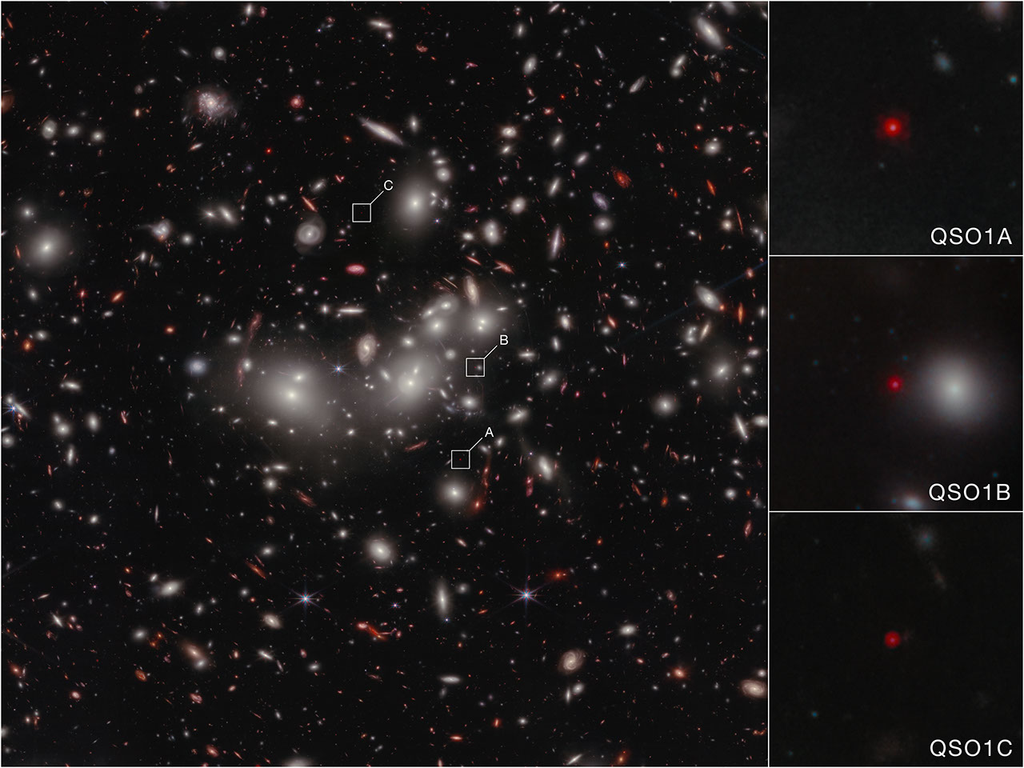
An image from NIRCam (the Near Infrared Camera) on NASA’s James Webb Space Telescope shows Abell 2744-QSO1. (Image credit: NASA)
Considering three possible scenarios, the team found that the most likely situation is a smaller primordial black hole consuming surrounding gas and energy until it grew to be the size of QSO1.
What to read next
“The door was open on this theory — that Little Red Dots could be primordial black holes,” Del Grosso said. “We’ve now cracked it open a little farther by showing some scenarios are more likely than others.”
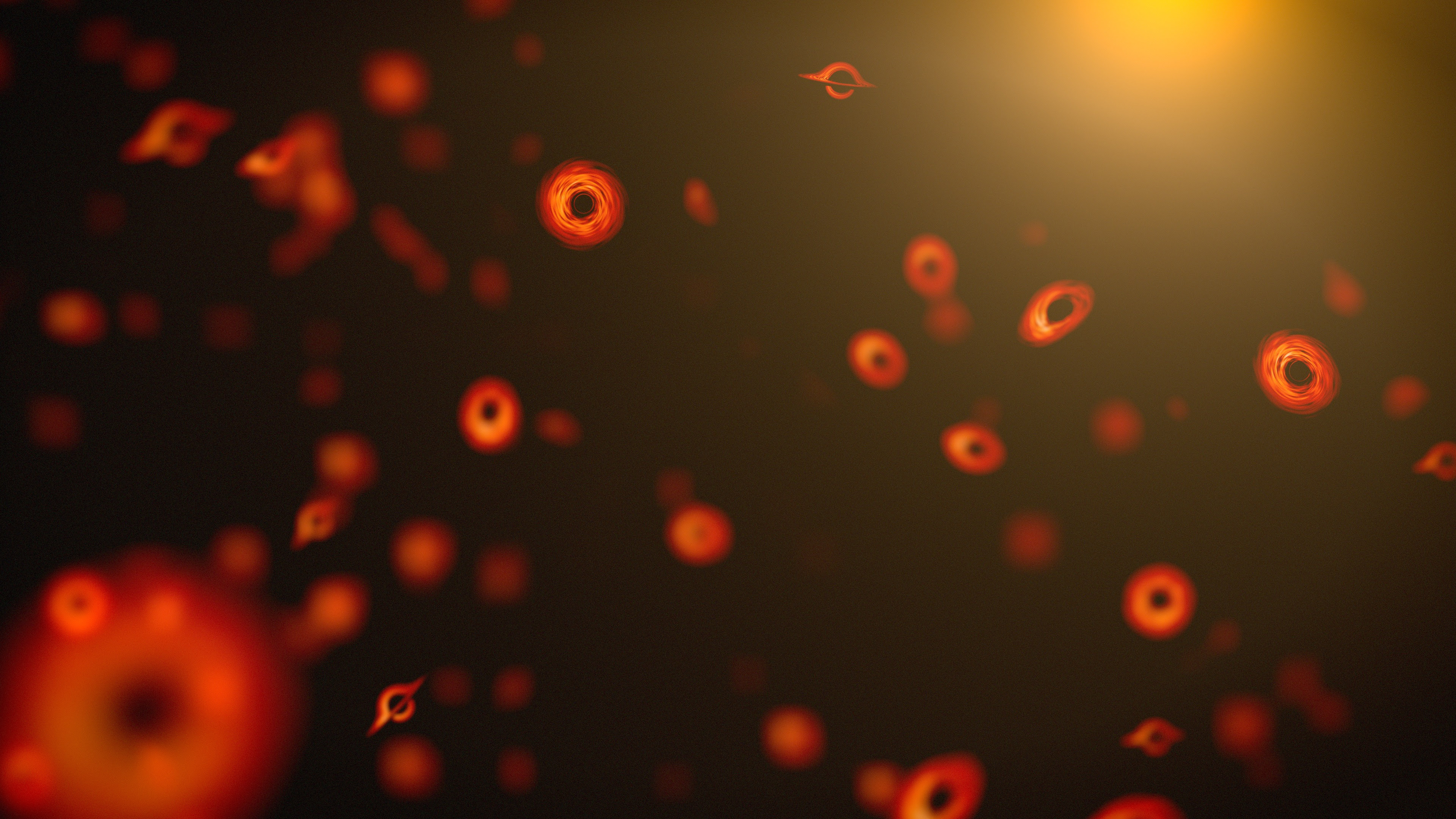
An illustration of primordial black holes. (Image credit: University of Massachusetts Amherst)
Del Grosso and crew now intend to look at the other 100 or so Little Red Dots seen by the JWST to determine how many of them could have started life as primordial black holes.
Then scientists may finally have the evidence to say these long-theorized ancient black holes actually existed.
“We don’t have a clear understanding of what happens in the early universe right after the Big Bang,” De Luca concluded. “If primordial black holes do exist, then something had to happen to make them in the first place, which would be a groundbreaking discovery in physics.”
The team’s findings were published in June in the journal Physical Review Letters.