
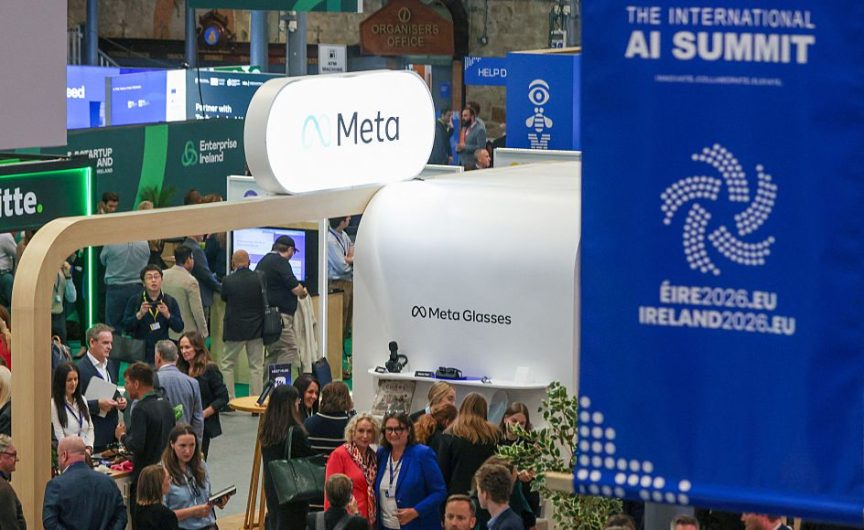
 At the International AI Summit in Dublin, it was clear that European companies are figuring out how to keep pace with adoption in the US and China while balancing safety with innovation.Paul Faith/AFP via Getty Images
Ireland is a small country with about 5 million people, but it’s a heavy hitter in terms of economic and cultural impact. From the popularity of Hozier and Derry Girls to, yes, Guinness, the global interest in Ireland can’t be underestimated. That much was clear when I visited Dublin for the International AI Summit in October to learn more about the nation’s status as one of Europe’s biggest players in artificial intelligence.
The country has a thriving AI economy. Ireland ranks ninth overall in Europe in the number of venture capital deals so far in 2026 — second if you adjust for population. That data comes from Enterprise Ireland, the Irish government’s trade and innovation agency responsible for investing in and growing Irish enterprises globally.
While attending the summit in Dublin, I quickly found that European companies are figuring out how to keep pace with adoption in the US and China while balancing safety with innovation. While Europe is well-positioned to become a global player in building trusted AI that people actually want to use, many believe it doesn’t need to move at Silicon Valley’s pace to be successful. There is a real opportunity for Europe, and Ireland in particular, to be a difference-maker in scaling AI globally.
I sat down with Eoin Hinchy, co-founder and CEO of Tines, a workflow company specializing in AI-powered automation for security and enterprise operations, and Dorothy Creaven, co-founder and COO of Jentic, which creates AI agent infrastructure for businesses. We discussed Europe’s tech ecosystem, the creation of unicorn companies and Ireland’s evolution as a global leader in AI.
The interviews below were edited for length and clarity.
Eoin Hinchy is the CEO and co-founder of Tines. Before that, he spent a decade focused on security operations for prominent companies, including eBay, PayPal and DocuSign. Hinchy and I discussed the company culture and business goals, including a commitment to making half of its next 100 hires entry-level roles across all departments. There are growing concerns that AI will replace entry-level roles. Early reports suggest that postings for entry-level jobs in the US have fallen by 35% over the last 18 months. And hiring for entry roles in “AI-augmented occupations” in Ireland has dropped by 16% during the second quarter of 2026. Tines wants to change this course.
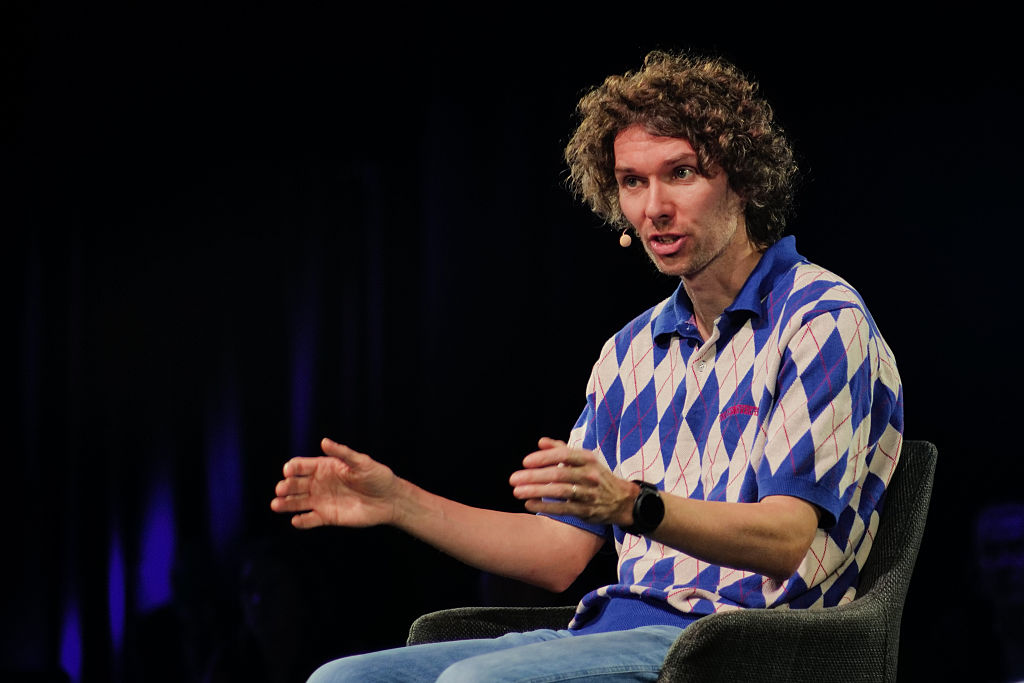 Eoin Hinchy on stage at the International AI Summit in Dublin. Paulo Nunes dos Santos/Bloomberg via Getty Images
You’ve said you’re committed to entry-level jobs. I’m interested in what that looks like. When you hire these new graduates, what kind of workflows or automations or responsibilities are they going to own as an AI-native employee?
Hinchy: You’re right, we’re really proud of that, and I think as one of the companies that’s helping to bring about this change in how companies operate, I think we have a responsibility to help create a new path for entry-level employees. I think the types of jobs that these people are going to be doing, firstly, it’s going to be across the company, so it’s not just going to be engineering or customer success or marketing.
The type of jobs that those people will be doing is going to be so different from what it would have been like 10 years ago, and I find that really exciting. And so I think the roles will be less about, “Here’s a long list of tasks that we need you to do on a daily or weekly basis,” which is what a lot of those entry-level jobs are. And it’ll be much more about, “Hey, AI and automation are already doing the vast majority of those tasks. What we need you to do is observe them, apply your creativity to them, listen to problem-solving, and help us level up everything we’re doing with your new ideas and fresh perspective on things.” Because a lot of the folks that we have in the company are used to doing things a certain way, and there’s nothing wrong with that, but the fresh eyes and the creativity and the willingness to try AI in a native way, that’s just going to be paramount for our success in the next few years.
What do you think people in Silicon Valley get wrong about building a team there versus in Ireland?
Hinchy: I’ve lived and worked in the Bay Area, and it is an amazing place. And some of the brightest people that I have had the pleasure of working with live in the Bay Area. But I think it’s also safe to say that it’s in a little bit of a bubble. As you drive down the 101, all you see are billboards for AI companies. And that’s really valuable and beneficial because of all the networking capabilities and access to talent, but the world is so much broader than that. Not every company is an AI-native company. And so I think one of the things that’s been really beneficial to us in Ireland, not just the access to talent that we get and the multilingual workforce and the cultural melting pot that we have here, it’s just the diversity of business that we get to see from here. We get to work with the big technology companies, of course, but we also get to work with pharmaceuticals, steel companies and a huge diverse range of organizations.
And as a result, I believe that the platform that we have built is much broader and can solve a larger set of problems because we’re not just selling to a particular type of company. We’re selling to this huge range of companies that you may not get access to if you’re based in the Bay Area and just selling to the same couple of dozen companies that every other AI-native company is working with. It also means that we get to work with a more diverse set of users. Because the problems that our customers are solving are more diverse than, “Oh, we need to speed up our engineering throughput” or whatever it is. We get to work with problems that are not typical of your Bay Area problems.
Tines has grown remarkably fast internationally, but still remains an Ireland-based company. What is it about the Irish company culture that you think has led to so much global success?
Hinchy: I don’t think it’s a single thing. I think what’s worked for us is that we’ve been able to hire people who are extremely experienced and have web-scale experience working in large multinational companies, but who also have a healthy cynicism — for want of a better term — towards some of these trends.
And so we didn’t release our first AI product for a year because, while everybody else was racing to release a product, because that’s where the market was heading, we really took our time and were quite kind of cynical about: “What is the use case here? And how is this actually going to benefit our customers?” And I think that kind of level of critical thinking has been really beneficial to us. And it’s allowed us to pave our own path towards success rather than following this classic playbook. And as a result, we’ve grown at a rate that is abnormal because we’ve done things in an abnormal way.
Any other advice for Irish companies?
Hinchy: The advice that I would have for other founders, especially ones who are based in Ireland, is don’t be afraid to be ambitious. I think that as a nation we’re quite humble, traditionally, and we’ve got low egos, and so on. And that’s really important and really good, but it can act as almost a constraint to growth and ambition. I think one of the reasons we’ve been successful is because we have been extremely ambitious and continue to be ambitious — not just in the product that we’re building, but also in the customers that we win and the contracts that we win. I would encourage anyone reading or listening to ramp up their level of ambition.
Dorothy Creaven is COO and co-founder of Jentic, a company that helps build AI-native enterprises and has achieved “unicorn” status, meaning it’s a privately owned startup that has reached a valuation of over $1 billion. Prior to Jentic, Creaven was the managing director and vice president of technology at Rent the Runway, an e-commerce platform that allows subscribers to rent designer clothes, and co-founder of Element Wave, another startup specializing in mobile marketing automation.
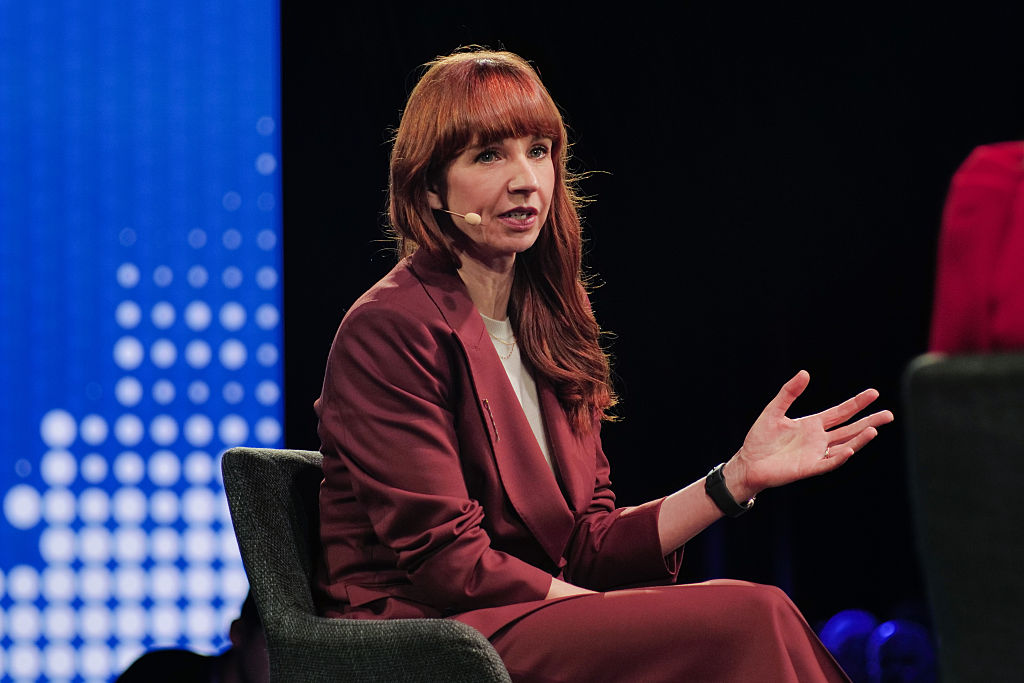 Dorothy Creaven, co-founder and COO of Jentic, at the International AI Summit in Dublin.Paulo Nunes dos Santos/Bloomberg via Getty Images
You have a diverse background. How did you go from a company like Rent the Runway to now Jentic? And how does Ireland fit into your journey?
Creaven: My first role out of college, I was very much hit by the startup bug post-university. And after a number of years developing software, I think I really put my education to good use because I’ve always been really good at problem-solving and very solution-oriented. From there, I moved more into a business and operations role.
Jentic is my second startup. So, back in 2010, I founded a company also based in Ireland focused on mobile marketing automation. So mobile was pretty much brand new and marketing automation isn’t actually dissimilar to how we’re automating with agents right now. It’s a brand-new technology, and there are new opportunities to serve your customers better, to save on costs and to experiment more. So, funnily enough, there are quite a lot of similarities. And because of my technical background, I was able to translate a lot of what we did into the thinking that’s needed to build my second startup.
But in the middle of that, so pre-Jentic, I was headhunted actually for a brand new company that was coming to Ireland, except it was a very well-established company in New York, Rent the Runway. And when I joined, it hadn’t gone through an IPO. It was a billion-dollar company, and it was a very exciting time. And it was such a fantastic part of the journey to again start a company from Ireland — not my company this time, but really scale a very established organization and to open one of their first international offices (in Ireland).
As an Irish company scaling internationally, I’m interested in whether you’re seeing any kind of differences in how European companies adopt AI versus American companies?
Creaven: Not that we’ve seen necessarily. I think the risk appetite and the readiness to move is probably a little faster with US companies, which is exciting for us as well. On the flip side, I think Ireland and Europe are kind of fully on board with the whole ambition of creating this opportunity for applied AI. So I think we’re going to see more and more adoption, and more and more companies buying from Irish companies or from other European companies.
What do you see as the biggest challenge or opportunity for building and scaling in Ireland?
Creaven: I feel like there’s a real opportunity to create more unicorn companies in Europe and in Ireland specifically. I think the US has such a great track record, and I think the ability for us to generate ones that can also remain in Ireland and Europe, because it’s such a great way to advance the skills of people here. We have incredible, experienced leaders. With growth capital, the rounds are often smaller here and the rounds are so much bigger in the US, which is a big reason why a lot of companies leave Europe. Well, up to 30%, apparently, is the early data that’s reported, which would be looking to locations outside of Europe.
But I think we want to try and really do it here (in Ireland) ourselves. And we often see startups that are based in Europe raising half the capital as their Silicon Valley peers in a similar period. So I think being from Europe, we’d love to see that shift.
Editor’s note: Macy Meyer’s travel costs for the International AI Summit were covered by Enterprise Ireland. The judgments and opinions of CNET are our own.

Macy is a writer on the AI Team. She covers how AI is changing daily life and how to make the most of it. This includes writing about consumer AI products and their real-world impact, from breakthrough tools reshaping daily life to the intimate ways people interact with AI technology day-to-day. Macy is a North Carolina native who graduated from UNC-Chapel Hill with a BA in English and a second BA in Journalism. You can reach her at mmeyer@cnet.com.
See full bio