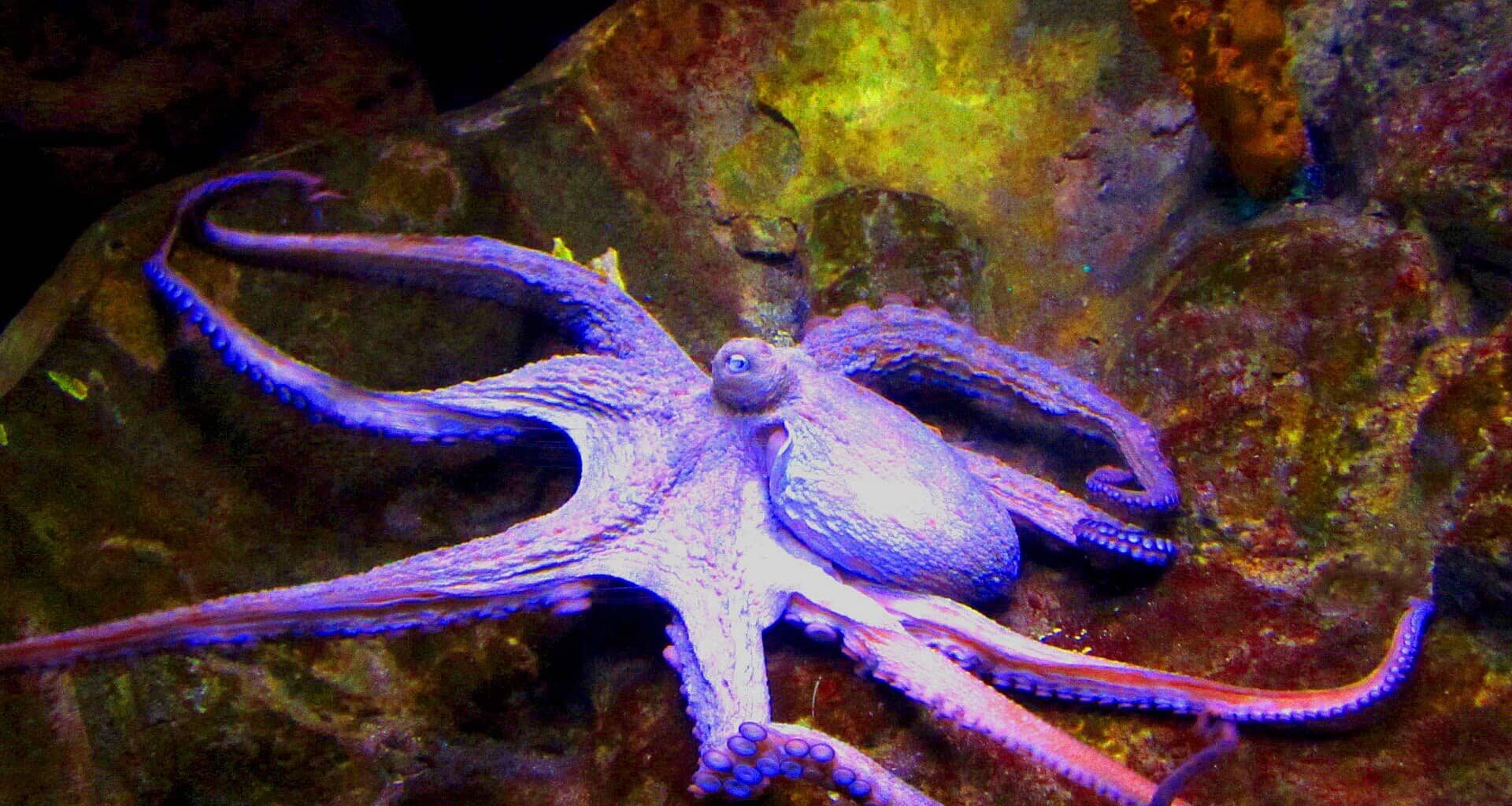
 Octopus vulgaris—the common octopus. Credit: Wikimedia Commons
How does one contain that which is uncontainable?
Octopuses are among nature’s greatest escape artists. They can squeeze through openings that look absurdly small for their bulbous bodies, turning what appears to be a solid barrier into little more than an inconvenience. Videos of these extraordinary escapes have fascinated millions. Yet scientists have never fully understood how octopuses pull off the trick.
Now, researchers have caught these slippery escape artists in action, filming their movements from multiple angles to unravel the mechanics of their seemingly impossible escapes.
What they discovered was surprisingly methodical. Rather than simply squishing their bodies through a gap, octopuses follow an organized sequence of movements. When the opening is relatively spacious, they use three steps. When it’s tighter, they typically add a fourth, squeezing their arms through first and their bulky mantle afterward.
It’s an unexpected level of coordination behind one of the animal kingdom’s most remarkable physical abilities.
“So, we know that octopuses have to squeeze to either hide in crevices and caves to avoid predators,” said Michael Kuba, a biologist at the University of Naples Federico II in Italy, in an interview with ZME Science.
“On the other hand, they need to explore the same structure to look for food—octopuses often eat rather small prey, which is often hiding in crevices and caves in the rocky shores the common octopus likes to inhabit.”
Super Easy, Barely an Inconvenience
Working with colleagues at the National University of Singapore and Vienna’s Haus des Meeres aquarium, Kuba’s team filmed three common octopuses and four juvenile Mayan octopuses navigating holes in clear acrylic partitions.
×
Thank you! One more thing…
Please check your inbox and confirm your subscription.
They analyzed the footage frame by frame. In 30 successful passages by common octopuses, a consistent routine emerged.
Credit: Journal of Experimental Biology (2026)
First came reconnaissance: one arm slipped through the opening. The second arm on the left led in 47% of trials. Next, the animal threaded another three to five arms through.
Then came the clever part. The inserted arms curled backward, their suckers gripping the far side of the partition. By stiffening and extending their arms, the octopus pushed against the wall and pulled its remaining limbs and body toward the opening.
For a larger hole, this completed the maneuver in three stages. But when the gap was narrower relative to the animal’s size, the octopuses generally split the finale in two. They rotated upward and worked the remaining arms through first. Only then did they pull their head and mantle across, visibly narrowing the muscular mantle to fit.
Credit: Journal of Experimental Biology (2026)
“The organization and coordination of the arm activity is impressive, but I was most impressed by how they move their body/mantle through the hole,” Kuba said. “They release and contract the muscles in the mantle to move through the hole!”
All 14 passages through the relatively larger opening used three steps; 15 of 16 through relatively smaller openings used four.
How Small Is Too Small?
Credit: Journal of Experimental Biology (2026)
People often repeat that an octopus can squeeze through any hole large enough for its beak, the hard, chitinous mouthpart tucked where its arms meet. But the observations suggest a more complicated answer.
The animal must also crowd thick arm bases into the opening. Those bundled limbs might become an obstacle even when the beak would fit. The cartilage surrounding its central nervous system could also matter; the team used the distance between the eyes as a rough indicator of its size.
The Mayan octopuses provided another clue. They did not pass through the smallest, 10-millimeter holes. When offered openings of different sizes, they probed a smaller one before eventually using a larger passage.
Credit: Journal of Experimental Biology (2026)
But does an octopus recognize an impossible opening in advance?
“I think that it might do this but for this we will need to conduct further experiments to find out if the exploration of a hole tells an octopus if he/she can fit through the hole,” Kuba noted.
There is another important qualification. Only three common octopuses participated, and each experienced one hole size relative to its body. The researchers therefore cannot rule out individual preferences, rather than opening size, as the explanation for the different strategies. Asked why they hadn’t tested the same octopus with progressively smaller openings, Kuba acknowledged that more research was needed.
“The present experiments are non-invasive experiments where the animals are not exposed to the stress you might need to convince them to try to move to a narrower hole,” Kuba explained. “All the activity of the animals was voluntary and supposed to be a behavioural enrichment.”
What Octopuses Could Teach Robots
Scientists have long studied how octopuses manage eight extraordinarily flexible arms.
In a 2015 experiment coauthored by Kuba, researchers showed how an octopus adapted a single arm’s reaching and fetching movements to pass through a hole. A 2025 study of deep-sea octopuses identified repeatable patterns in how their arms bend and stretch while crawling.
An octopus reaching through the hole in the 2015 experiment coauthored by Michael Kuba. Credit: Journal of Experimental Biology (2015)
The new study tackles a different problem: how the entire animal organizes its moving parts to get through an obstruction. That could eventually help engineers build soft rescue robots that squeeze through rubble without sacrificing space for sensors and tools.
“One of the biggest questions for me is how an animal can deal with so much sensory input and coordinate a flexible body!” Kuba said.
Octopuses have extensive nervous systems. Exactly how they translate all that sensory information into such coordinated movements remains a mystery.
And that’s the challenge for robotics, too. A flexible body is one thing. Knowing how to use it is another.
The study was published in the Journal of Experimental Biology.