
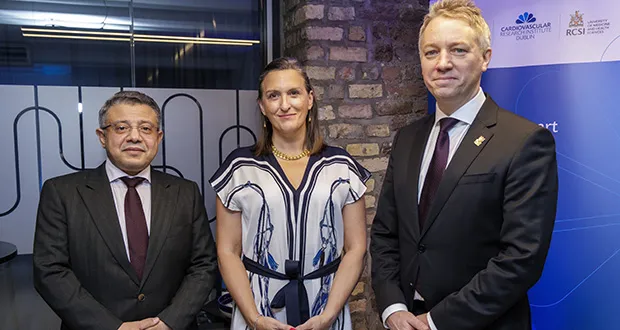
Dublin 2 based site will allow institute – which comprises 30 researchers working with more than 45 consultant cardiologists – to grow its operations
Ireland’s only dedicated cardiovascular research centre has opened a new office as part of plans to grow its operations.
The Cardiovascular Research Institute (CVRI) aims to meet an unmet need for cardiovascular research in Ireland. The Institute comprises a team of 30 researchers and working with more than 45 consultant cardiologists across Dublin and Cork, with a new office now opened in Dublin 2.
By bringing clinical trials, AI-enabled imaging and patient outcome data together under one roof, the Institute gives patients earlier access to new treatments and helps clinicians, researchers and medtech innovators improve how heart disease is prevented, diagnosed and treated.
“When Mater Private established CVRI Dublin in 2019 with RCSI, our aim was to integrate advanced clinical research into the everyday treatment of patients with cardiovascular disease,” said CVRI director and consultant cardiologist Prof Robert Byrne.
“Patients put their trust in us, and we repay it through safer care, access to new therapies in our clinical trials, and research that improves treatment in Ireland and worldwide. This new building is a launch pad for our next phase, and for a coordinated network for cardiovascular research across Ireland and further afield.”
Part of CVRI’s work is partnering with Irish medtech innovators to help develop devices specifically designed to improve cardiovascular health outcomes.
Among them is CroíValve, which has developed a device to repair the heart’s tricuspid valve without the need for open-heart surgery. Around 40 patients have been treated so far, with ongoing studies in the US.
CroíValve is working with the institute’s PRECISE Core Lab, led by Prof Osama Soliman, to assess patients through imaging, moving towards AI-driven assessment, so that each patient is matched with the device best suited to them.
The PRECISE Core Lab combines imaging analysts and AI engineers to provide regulator-ready analysis for international clinical trials. Its research was published in the New England Journal of Medicine this year, and the team is developing an AI-powered cardiovascular ‘digital twin’, a virtual model of an individual’s heart.
The institute’s trials also include CYCLOPES, an RCSI-sponsored study at 25 sites across Europe on how best to treat heavily calcified coronary arteries.
During the pandemic, its SETANTA study asked GPs to invite everyone who had tested positive for COVID-19 for a cardiac MRI, and quickly dispelled concerns that the virus would cause widespread long-term scarring of the heart.
“While other people were still formulating the question, we were already moving on to the answer,” said Prof Byrne.