
If rap is the new rock, then older rappers ought to inspire the same respect as classic rockers. But that’s not what Snoop Dogg noticed when he turned 50 in 2021.
“Don’t put no time limit on how old we are or what we are, because we don’t look at the rockers and say, ‘Man, he got white hair now when he used to have black hair,’” the titan of American west coast rap said. “We should get the same love in hip-hop because we created something that’s gonna last for ever, it’s generational.”
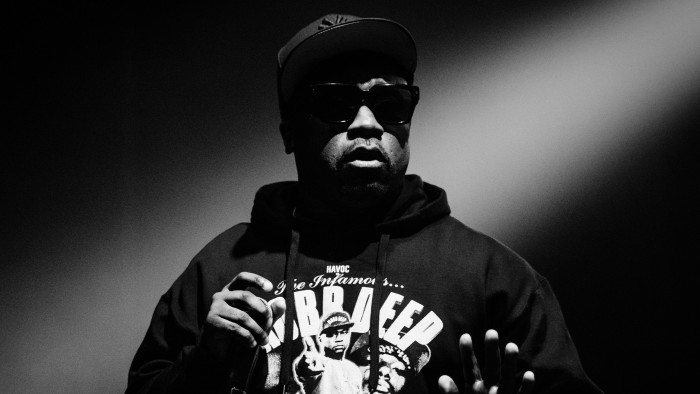
On the opposite side of the US, a former antagonist agrees. “Rightfully so, Snoop Dogg and a few other artists like him have raised that concern,” Havoc tells me. He is one half of Mobb Deep, the rap duo from America’s east coast who feuded with the likes of Snoop in the so-called rap wars of the 1990s.
Havoc, 51, was born Kejuan Muchita and raised in New York. His partner in Mobb Deep, rapper Albert “Prodigy” Johnson, died in 2017 while being treated in a Las Vegas hospital for sickle cell anaemia. Nevertheless, a new Mobb Deep album, titled Infinite, came out last week, featuring Havoc rapping alongside previously unheard vocals by Prodigy.
 Mobb Deep in 1995, the year they released their album ‘The Infamous’ © Des Willie/Redferns
 Mobb Deep on stage at the MetLife Stadium, New Jersey, in June 2017. That year, one half of the duo, Albert ‘Prodigy’ Johnson, died from sickle cell anaemia © Johnny Nunez/WireImage
Posthumous albums have a dubious reputation. Murdered rappers Tupac Shakur and Biggie Smalls, iconised as martyrs of the coastal rap rivalries, have both released a greater number of albums after dying than they did while alive. But Mobb Deep’s addition to the genre, produced by Havoc with underground rap beatmaker The Alchemist, a longtime collaborator, is unusually good.
Nothing is wrong with beef. As long as you settle it on the wax, later on maybe you’ll be able to patch it up’
“I’m not going to do anything outside the box,” Havoc says of his intentions with Infinite. “I’m going to stay true to Mobb Deep.” That means uncompromising boom-bap beats — the signature heavy crump of 1990s east coast rap — and belligerent vocals recorded in unfiltered close-up.
“Yeah, just like letting everyone know that we’re the best,” Havoc says. “You can’t mess with us, man! This is the Mobb right here.”
He speaks by video call while driving through New York on a gloriously sunny autumn day. Sporting a baseball cap, he keeps his eyes on the road, occasionally flicking them towards the screen. A gold piece of jewellery hanging from his neck is obscured by a seatbelt. He appears to be a careful driver.
Mobb Deep emerged from the largest public housing project in North America, Queensbridge Houses in the New York borough of Queens. Their breakthrough came with 1995’s The Infamous, a hip-hop classic. Over vividly grimy music mostly created by Havoc, he and Prodigy recounted street tales of drug dealing and violence. At once boastfully macho and chillingly observational, it was a hard-boiled riposte to the gangsta rap of west coast figures such as Snoop.
 Mobb Deep photographed in New York’s Meatpacking District in August 2003 © Gregory Bojorquez/Getty Images
The eye-opening anecdotes of bloodshed and gunfire in Prodigy’s 2011 memoir My Infamous Life indicate that art, for both men, was in proximity to life. “Unfortunately, yes,” Havoc says. “But we survived it. That’s one thing that I have to give credit to myself and Mobb Deep: we survived the ’90s, man. It wasn’t an easy feat.”
There were feuds with fellow New Yorkers such as Jay-Z as well as with west coast rappers. A recently released diss track aimed at Tupac was withdrawn from radio when he was shot dead in 1996. The circumstances remain murky, but gang-like beefing between different rap camps was running at a dangerous pitch. In contrast, the recent rap battle between Drake and Kendrick Lamar resembles a glitzy boxing bout.
“It does feel slightly different. Thankfully we don’t feel like nobody’s going to die over these beefs,” Havoc says. “But let me just say this: nothing is wrong with beef. As long as you keep it professional and settle it on the wax, eventually later on maybe you’ll be able to patch it up. Hip-hop is a contact sport. It’s not for the faint-hearted.”
Infinite is being released as part of a series of seven albums under the banner Legend Has It. Overseen by east coast heavyweight Nas, also from Queensbridge, the sequence of records brings us new work by old hands. Joining Mobb Deep are De La Soul and the Wu-Tang Clan’s Raekwon and Ghostface Killah. The seventh album will be a link up between pioneering producer DJ Premier, a boom-bap maestro, and Nas himself.
I don’t have nothing against other [newer] forms of hip-hop, but I think these kids want something more. They want to feel the history of hip-hop
A number of acts in the Legend Has It line-up turn up as guests on Infinite. But there are no contemporary rap stars, who might have brought fresh ears to Mobb Deep.
“I wouldn’t be honest if I said there wasn’t any temptation for that,” Havoc admits. “But after really deliberating, I just went, ‘Nah don’t do it.’ I think it would hurt more than do good. I just want to keep it as real as can be for our supporters.”
Rap celebrated its 50th anniversary in 2023. It has a powerful sense of its past, as symbolised by frequent references to the “old school” and use of sampling to repurpose classic recordings. (Kendrick Lamar has sampled Tupac’s voice on his albums to create an imaginary dialogue.) But rap is also at the forefront of youth culture in a way that rock has ceased to be. It has a global listenership for whom notions of America’s east and west coasts are remote.
 Ghostface Killah and Killah Priest at Best Buy Theater, New York, in 2011 © Bennett Raglin/WireImage
Since the 1990s, different styles of rap have developed outside rap’s traditional centres, such as trap and drill music. Last year, a youthful drill producer by the name of EMRLD Beats caused a flurry of outrage when he dismissed classic rap’s boom-bap beats and soul samples as “uncle” music (“Yeah, get that unc shit out of there bro”).
“There’s a lot of trap and drill music that I absolutely love,” Havoc says. “I don’t have nothing against other forms of hip-hop, but I think these kids want something more. They want to feel the history of hip-hop. Most of the time when we go over to Europe, there’s a younger audience attending the shows. In the US, not so much. But there’s still a section of the youngins, they mess with the older style of hip-hop.”
He performs a tidy turn on to another New York street. Eyes glance down towards me. “Listen man,” he says, “music changes, it evolves — and then it comes back.”
‘Infinite’ is out now on Mass Appeal Records
Find out about our latest stories first — follow FT Weekend on Instagram, Bluesky and X, and sign up to receive the FT Weekend newsletter every Saturday morning