
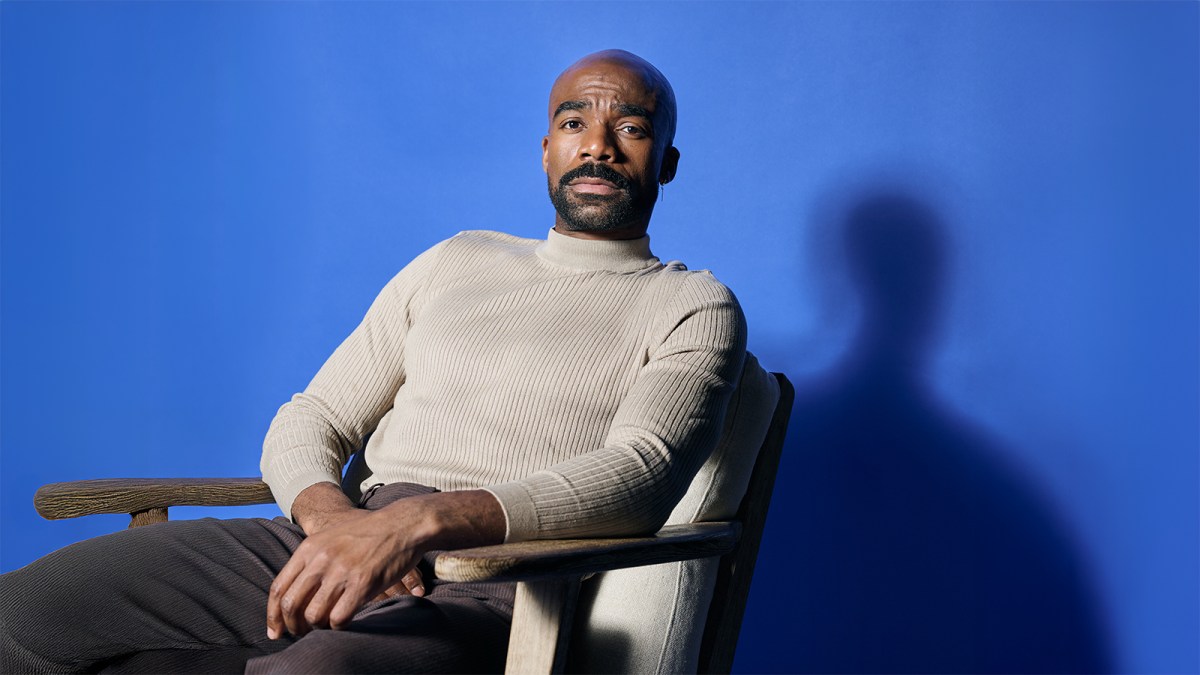
Ore Oduba jived into the nation’s hearts in 2016 when 13 million watched him become the surprise winner of Strictly Come Dancing. He said it was the most incredible experience of his life, and Gene Kelly’s widow, Patricia Ward Kelly, praised the American smooth that he and his dance partner, Joanne Clifton, performed to Singin’ in the Rain, saying her husband would have been proud of it.
That joyful national moment gave the former Newsround presenter a platform to build a career as an actor, mostly in musical theatre, alongside presenting work. But now he has revealed that behind the twinkly smile he was hiding an addiction to pornography that he can trace back to his first exposure to explicit online content when he was just nine years old.
The addiction, he said, destroyed his life “from the inside out”, leaving him consumed by self-loathing and contributing to thoughts of suicide. Oduba, 39, decided to speak out after seeking help for his addiction following the death of his father and the end of his marriage. His addiction was something he had hidden from all those close to him. “It is the perfect taboo,” he says.
An older boy first showed him sexualised images of a video game when he was nine. “I didn’t choose to be in this position. I was a child. I fell into something. [I had] a curious mind. By the time I was 14 or 15, this was a daily occurrence,” Oduba says by video call, choosing not to switch his camera on as he articulates better without the overstimulation of looking at faces. He also prefers to use the phrase “adult explicit content” rather than the word “pornography”, which he finds is “a trigger”.
Oduba grew up in Dorset, where his parents had moved the family from Nigeria in 1988. His father, a lawyer who continued to work in Nigeria, was a strict disciplinarian and after a sibling was caught smoking, Oduba understood that if any of them transgressed further they would be punished by being sent back to the west African country. Oduba went to Canford School, an independent school in Dorset, and then Loughborough University.
Sometimes, as a child, he would wait until his parents had gone out to watch pornography online all day, or late at night when everyone was asleep. “I became a master of masking what was going on,” he says of his porn habit, which he attributes to childhood trauma. “There was emotional neglect. There was fear. I didn’t feel safe at certain times in my house. [I was] intimidated by my parents.” His older brother suffered a psychotic episode and disappeared. Oduba hasn’t seen him for 20 years.
Porn sites became a haven. “If you have found something that has given you what you want, from a desire point of view, at your fingertips, without rejection, it’s giving you the connection that maybe you’re lacking from your caregivers. Through highs of dopamine it’s suppressing a lot of that negativity. It becomes like a friend. It felt like the first relationship I ever had.”
• How porn-addicted men can learn true intimacy
The dopamine hits were like taking a drug, and as Oduba built a “tolerance” to the material he was looking at he went deeper into the dark heart of the internet. “The tolerance level just goes higher and higher and higher. You’re seeking more of the stuff, you’re seeking more regularly and then you’re seeking something that’s going to give you a higher hit because you’ve already reached the tolerance level.”
He went behind paywalls, including to sites offering webcam porn. “I spent thousands of pounds over my adult life.” His secret online world affected his relationships. “It became the lens through which I saw the world and I saw relationships.”

With his dance partner, Joanne Clifton, after winning Strictly Come Dancing in 2016
GUY LEVY/BBC/PA
As an adult he would binge on porn. “I’m with partners and then I’m using afterwards,” he says. “You have discovered a shortcut to meet your own desire. And it’s very hard for anybody else to meet that because I have kind of hardwired the things that I need.”
He was disgusted with himself. “Complete self-loathing, zero self-worth. You feel like you are all of those things that you believe society would tell of you if [the addiction] was ever to see light. And that is how shame builds.”
Strictly hugely raised his profile and he was able to pivot towards stage musicals (he is currently playing the title role in Young Frankenstein in Manchester). “Seemingly, on the outside, everything was going wonderfully. Nobody asked if I was OK. Post-Strictly I had no idea what to do. I found myself in this world of celebrity and a new career and not knowing how to navigate it.”
His lowest point, when he started to have suicidal thoughts, came around the time of the Covid lockdowns, which were a particular ordeal for Oduba, who describes himself as a workaholic. “Internally a very loud voice started screaming. I started having panic attacks. I was lost. I was running away from all of that hurt and that pain and that childhood.”
The pornography was “a huge part of the incongruence I felt. For years I had been trying to quit. I tried to go cold turkey. I tried to remove myself from websites.” Detaching himself from sites to which his credit card was linked was harder than he expected because it sometimes involved sending an email and he worried about sharing his name with a domain administrator.
“I never brought this up with anybody until a year and a half ago. I didn’t bring this up with friends, I didn’t bring this up with partners, I didn’t bring this up with family, I didn’t bring this up with the therapist. Because I said this version of me cannot be known.”
A very difficult period in his life led to him addressing his addiction. Two years ago his father died. Last year his marriage to Portia Jett, with whom he has two children, ended. He does not wish to discuss his marriage.
This year Oduba’s sister, who had been living as nonbinary, died by suicide. He posted a rainbow in his Instagram biography because he said it brought him closer to his sister, who was gay. He posed in a pair of Pride underpants and wrote that he was not gay “in the traditional or sexual sense” but was embracing “coming out” in the sense of shedding a former self to put forward “the truest version of me”.
“Grief will force you to take a look at your life,” he tells me. “My dad’s death. The divorce. My sister’s death. That gave me perspective enough to go: why am I so fearful?
“And it became very obvious to me that I had been using [pornography] as a way to hide all of the pain, run away from all of the suffering that I was going through.”
He began discussing his addiction with his therapist. Today he has been “sober” for 18 months. “And it’s still something that I have to work at daily.”
• How to stop your child from scrolling — the doctor’s guide
He spent months deliberating whether to talk publicly about porn, which he did first on Paul Brunson’s podcast, We Need to Talk.
“I knew that no one in their right mind was going to bring this up because of the risk, reputationally, personally, publicly [and to] relationships of bringing up something that is so taboo and so shameful,” Oduba tells me. “But I just reached a point in my life when I’ve lost enough. It was something that I felt compelled to do. I saw this was a public health issue.”
He is concerned that so many children come across pornographic images accidentally and that their first exposure to it is not the relatively tame material that might once have been found in a top-shelf magazine. “It’s really important for people to understand they are seeing violent, extreme, hardcore stuff as the first way in.”
A report by the children’s commissioner found that frequent users of pornography were more likely to engage in aggressive sex acts. “If children are normalising sexual violence as their go-to at the back of the bus, in the back of the classroom, on WhatsApp threads, in the playground and they’re just sharing these images and this is normal, that is a crisis,” Oduba says.
Although he welcomes the introduction of new age verification requirements for accessing porn sites in the UK, he notes that there has been a huge rise in downloads of VPNs (virtual private networks) to circumvent the restrictions.
Oduba’s elder child will be eight in a few months — a year younger than he was when he first saw pornography, and that was at a time before smartphones and iPads.
“I have started speaking to him about seeing things that make him feel scared or confused or unsafe on his iPad,” Oduba says. “I am so desperate as part of my learning, for my healing and how I want to help educate my own children to not let my suffering project on to them. They have to understand that Daddy struggled with something for a very long time and they know that Daddy wants to make it better for a lot of people and is speaking to some special people that might be able to help. So we’re speaking about it in roundabout ways.”
• My teen son, the porn addict: ‘Please, Mum, can you help me’
After Oduba went public, Jett reportedly re-shared a social media meme about co-parenting, which featured a video of John Cleese banging his head into a wall. “No comment,” Oduba says.
Since he disclosed his addiction to Brunson, the response has been “overwhelming support, love, a resonance with so many people that they, as a parent, feel they can now have a discussion with their adolescent that they had been putting off”.
He hopes that revealing his experience will contribute to the conversation about porn. “It is going to cause a generational crisis unless we do something. This isn’t a problem for everybody, but the way that the world has developed and the way that we’re engaging with our phones, it could be a problem for anybody.”