
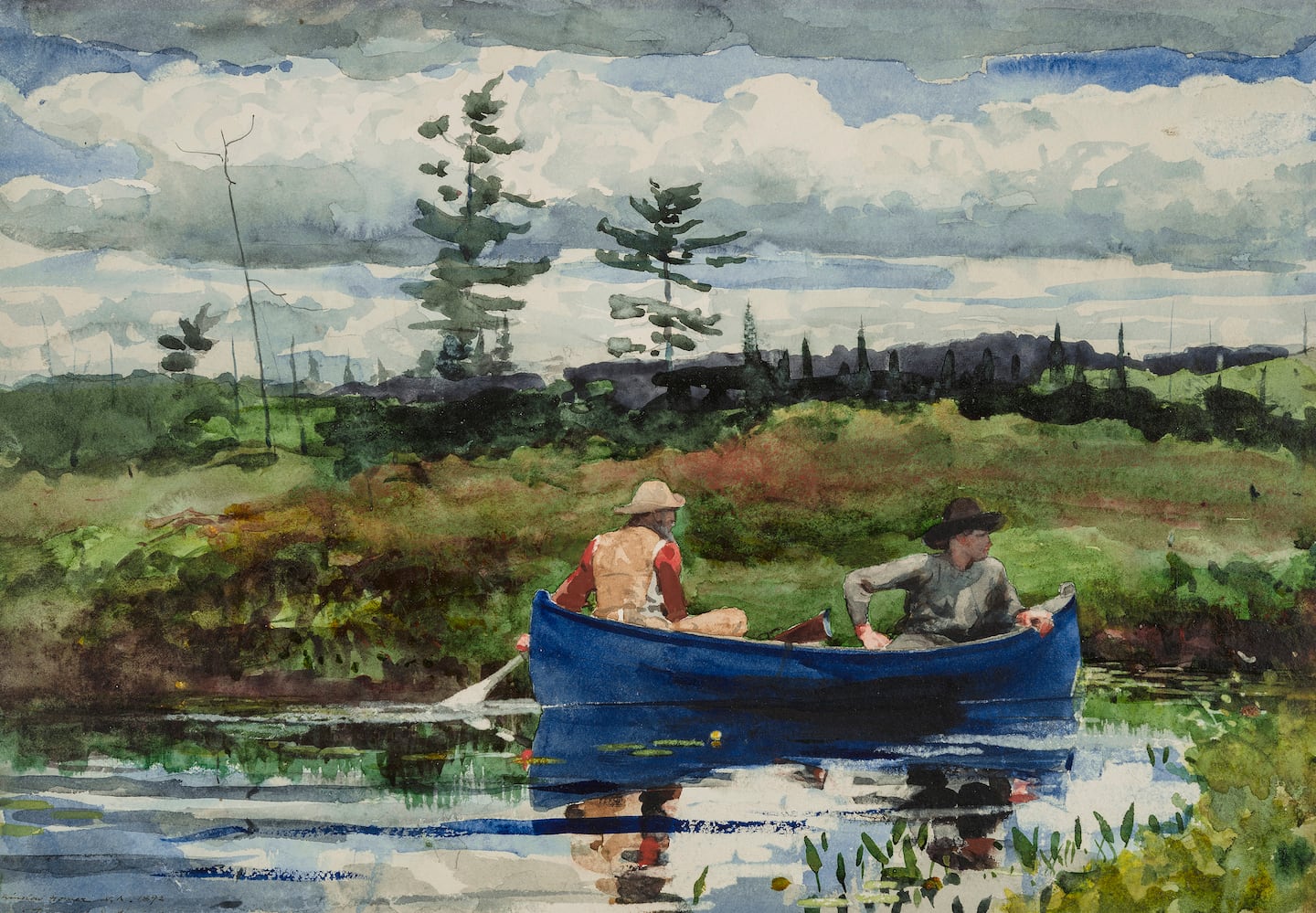
 Winslow Homer, “The Blue Boat,” 1892.
Museum of Fine Arts, Boston
Watercolor — immediate, capricious, not entirely tameable — would be the ultimate medium for an artist alive to his volatile moment. That he didn’t even start painting in watercolor until midlife — he was 37, seasoned by an early career as a news illustrator on the front lines of the Civil War, and still finding his feet as a painter of frank, somber oils of a nation in pieces in its aftermath — is some cause for lament. But even a glass half full offers much, and the MFA is better positioned than any to offer the chance to drink deep. It owns the largest collection of the watercolors than anyone. This exhibition, the first time this many — more than 50 — have been seen together in a generation, is its showcase.
“Of Light and Air” hews loosely to a timeline, but disrupts it at the outset with “The Blue Boat,” 1892, a visual touchstone brimming with the artist’s singular gifts. No one in America could quite do with watercolors what Homer did (though J.M.W. Turner, a generation earlier and in Britain, to my mind remains the world heavyweight champion), and this little painting makes it clear.
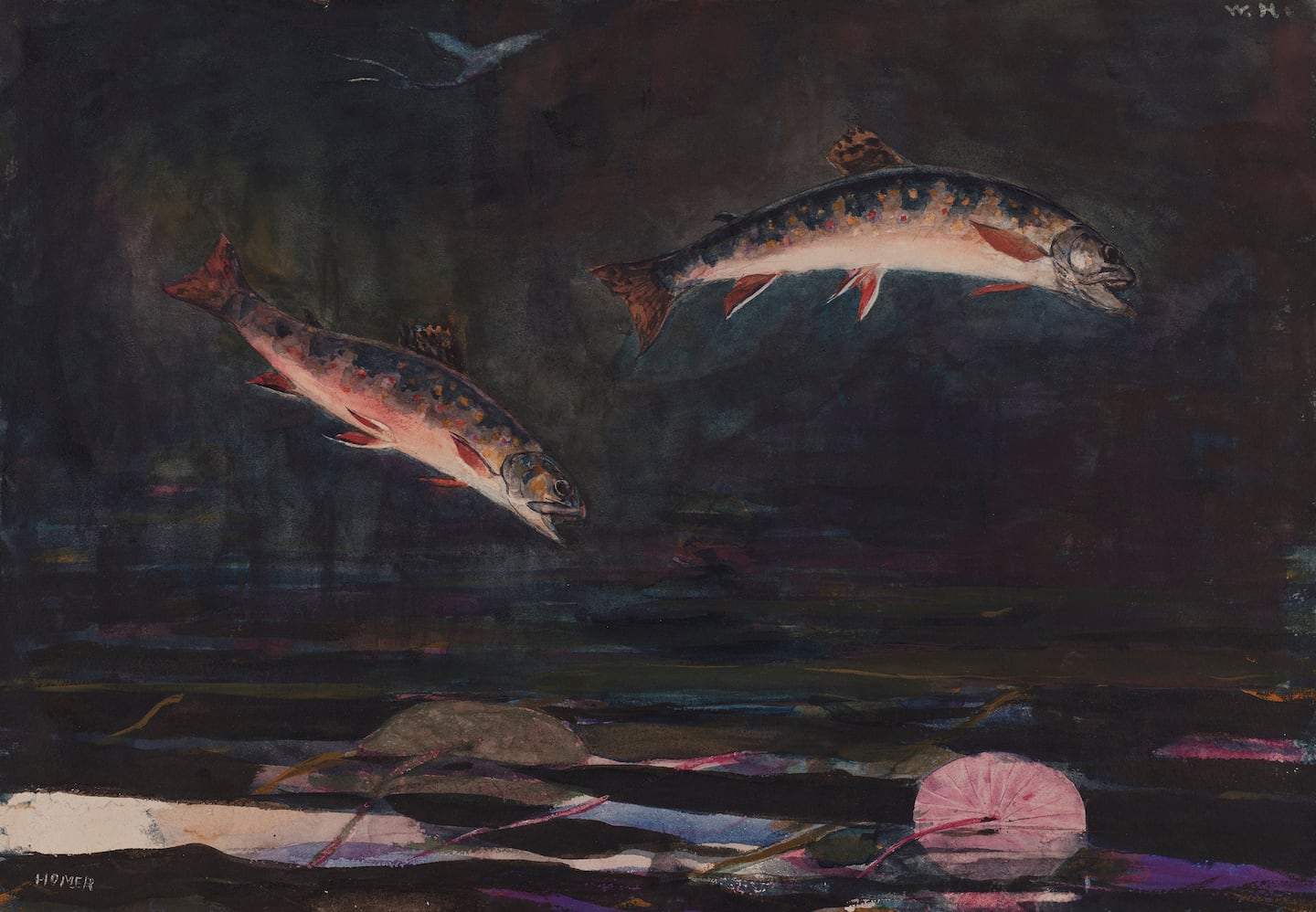 Winslow Homer, “Leaping Trout,” 1892.
Museum of Fine Arts, Boston
Swift daubs and stains in blues, greens, and grays pool and merge into a loose and fluid scene of two men paddling lazily ashore in their canoe amid the rugged overgrowth of a wilderness lake under the bulk of gathering clouds. It does so much with so little — Homer, by now a seasoned pro, guiding the puddles and pools of aqueous color into shapes and forms that suggest in a whisper an eerie scene of the remote wild.
Homer was in his 50s when he painted it, living a life increasingly more remote and detached from the burgeoning urbanism of the 19th century and its relentless upheavals. Born in Boston and raised in Cambridge, he pursued his illustration career in New York, and then turned more purposefully to oil painting after the Civil War, an attempt at the history painting of the old European masters — to craft a collective memory of the pivotal fractures of a young nation in tatters. He had traveled to France, and to England, only to eventually pack up his New York studio in 1883, never to return.
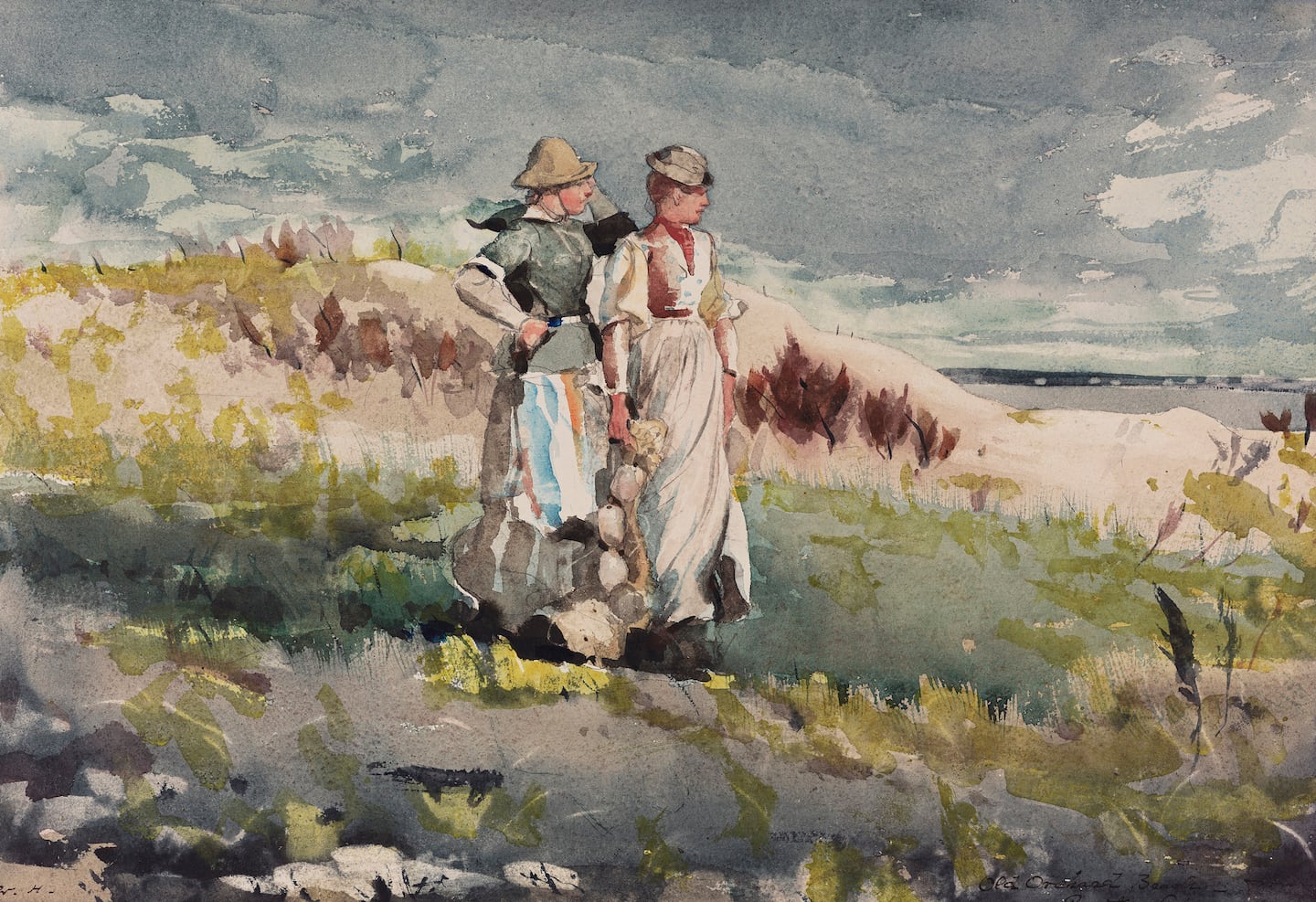 Winslow Homer, “The Dunes,” 1894.Museum of Fine Arts, Boston
His retreat was to Prout’s Neck, his family’s summer seaside home in Maine, where he lived year-round from 1884, and where he died in 1910. Best known for the thundering seascapes he painted here in heavy oils during the last decades of his life, Homer’s parallel pursuit in watercolor rivals, and even supersedes, them in their brisk, close-to-the-bone touch.
“Of Light and Air” snaps you to attention in that first gallery. ”The Blue Boat” shares space with another thriller, “Leaping Trout,” 1889, an inky eggplant-black wash of heavy shadow sliced by the speckled, silver skin of fish breaching. Like all of his watercolors, it feels wildly alive, almost in motion. His oils — not all, but plenty — are often weirdly turgid and overworked, like a thought held too long and muddied by deliberation. (The show includes several oils, probably not to prompt that particular contrast, but they do nonetheless.) In watercolor, Homer’s gift for immediate observation is liberated, and at the same time, so was his thinking.
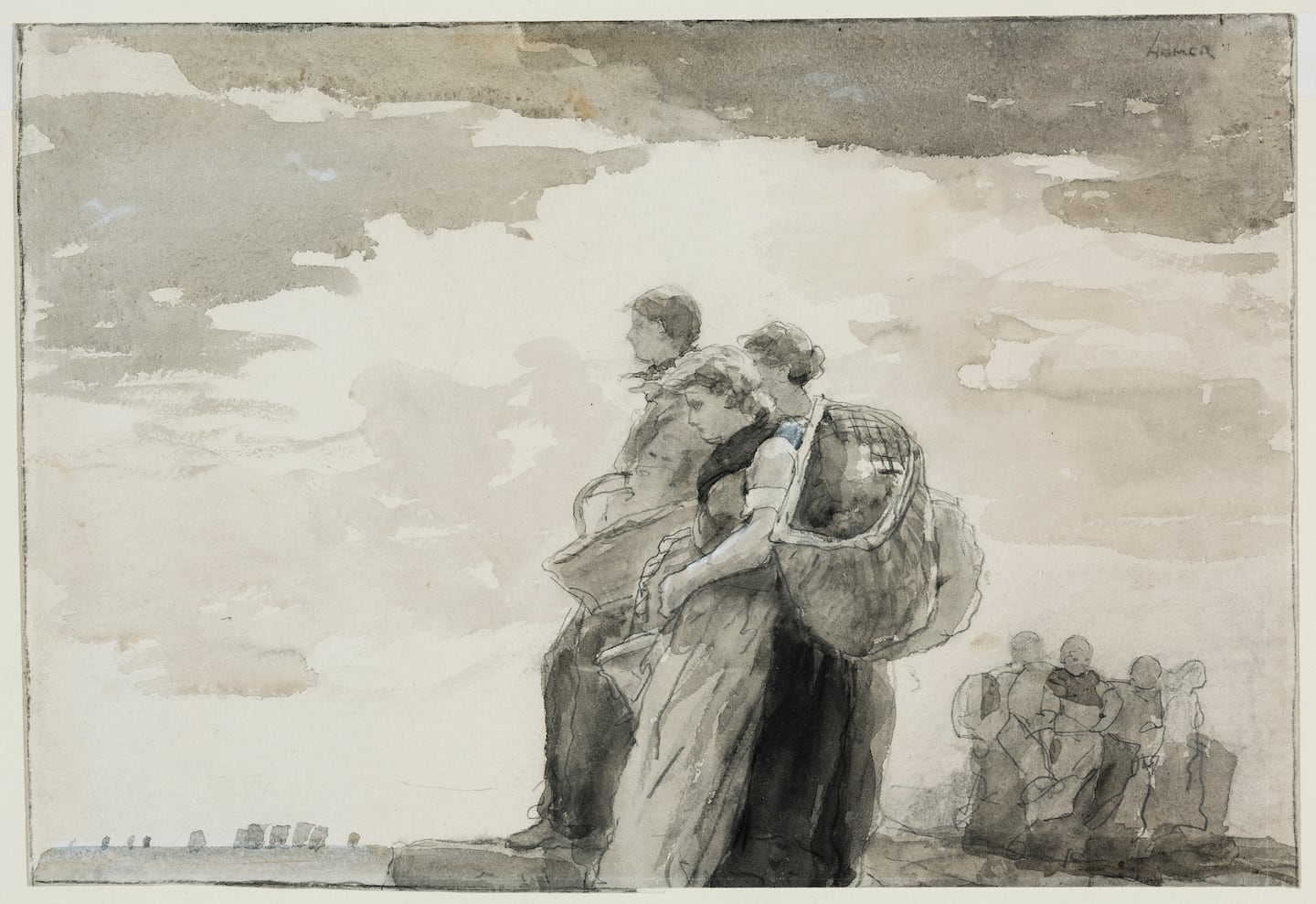 Winslow Homer, “Fisherwomen,” 1881–82.Museum of Fine Arts, Boston
A pair of small spaces are a set up for what’s to come: A collection of Homer’s Civil War illustrations, and a nod to his mother, Henrietta, whose still-life watercolors likely inspired her son’s eventual shift. One gallery, “Transitions,” touches quickly on Homer’s post-Civil War pursuits: First, his leisurely beachside scenes, an attempted salve for the nation’s ruptures. (The unnerving claustrophobia sense of “Rocky Coast and Gulls,” painted in Manchester-by-the-Sea in 1869, is one of many to suggest the unresolved postwar ruptures in Homer himself.)
But the critical moment here is in Homer sloughing off the stiffness of oil for a spurt of visceral experiments: “Three Boys on a Beached Dory,” a Homerian scene if ever there was one, but sketched in black crayon and brought to life with hesitant squibs of white watercolor paint. It was made the first year of his watercolor forays, 1873, and he seems unconvinced. Nearby, “Going Berrying,” from 1879, more black crayon, is the idea fully embraced. The undergrowth behind two loosely-sketched girls bursts with confident flecks of bright white.
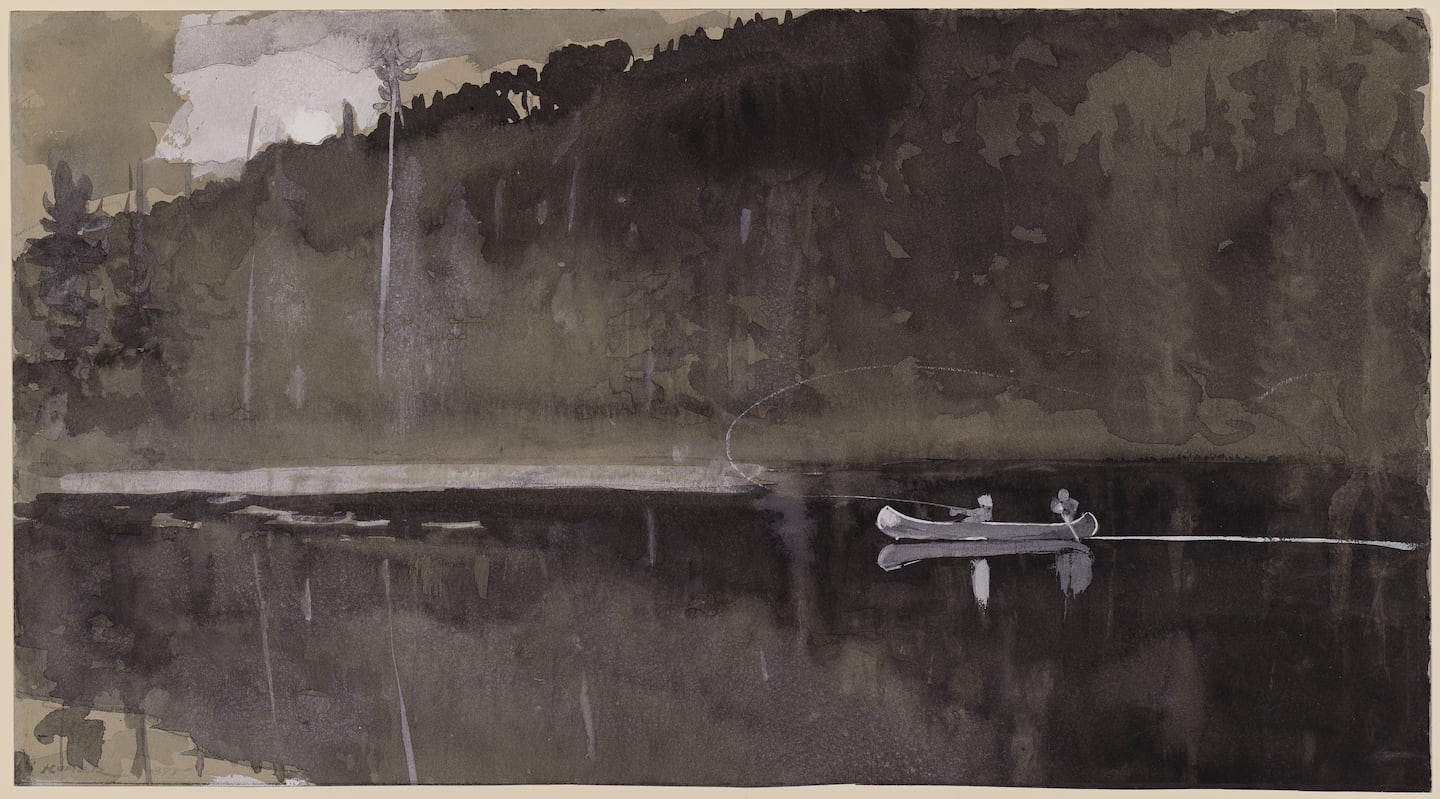 Winslow Homer, “Trout Fishing, Lake St. John, Quebec,” 1895.Museum of Fine Arts, Boston
“Of Light and Air” means to be a crowd-pleaser, and so you’ll find a great big space with walls painted the steel-blue of an icy northern sea chock full of Homer’s much-loved ocean scenes. There are dorys aplenty, most famously in the “The Fog Warning (Halibut Fishing),” Homer’s great big 1885 oil painting of a fisherman rowing furiously home amid an onrushing haze blackening the horizon.
That painting, along with “The Lookout — ‘All’s Well,’”1896, another biggie, is Homer at his most cliched and grandiose, both of which ill fit his temperament and skill. Homer, to me, always seemed uncomfortable with declarative statement, and more powerful in insistent whispers. That’s why watercolor belonged to him.
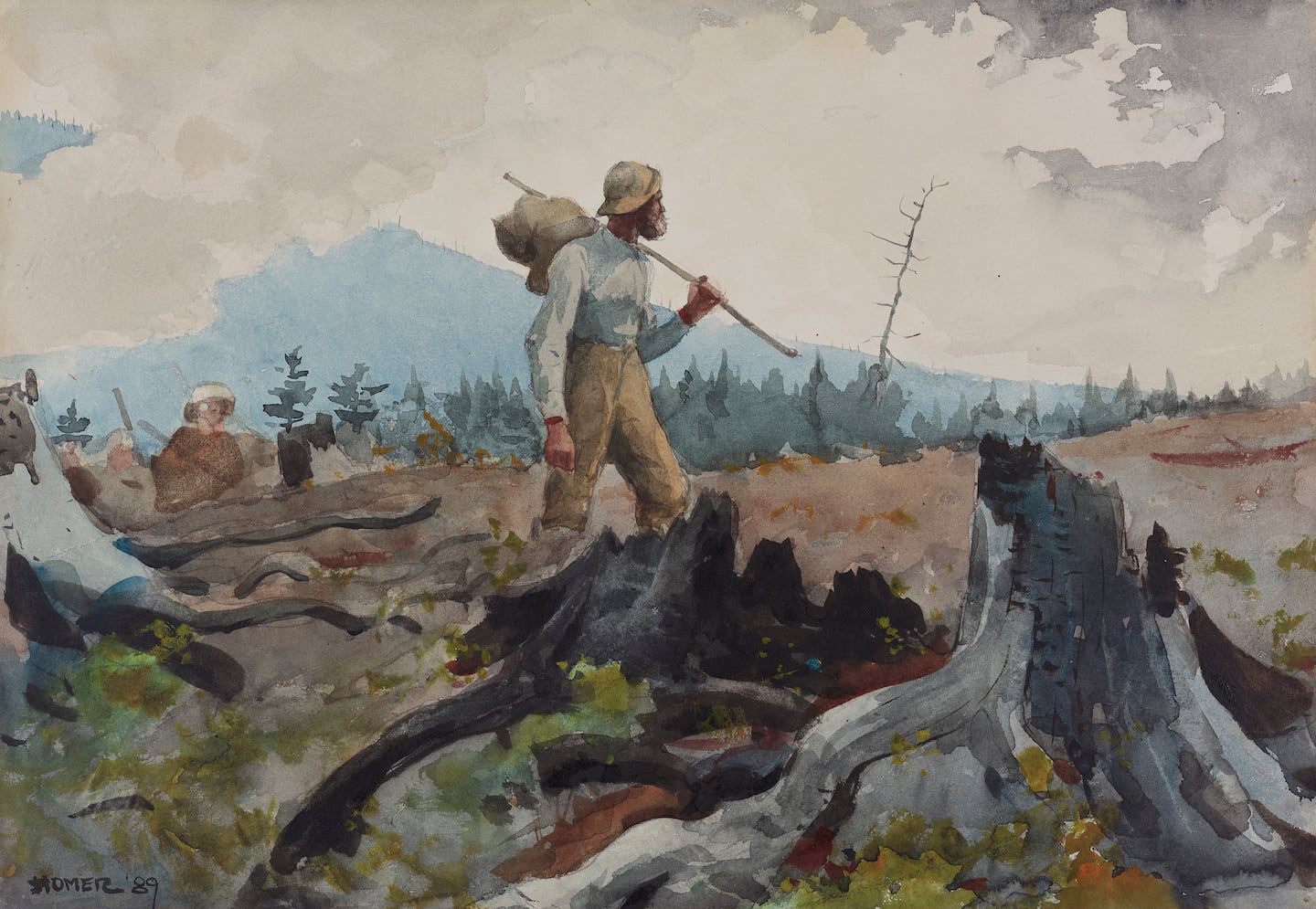 Winslow Homer, “The Guide and Woodsman (Adirondacks),” 1889Museum of Fine Arts, Boston
Amid the grand gesture, don’t let your attention be pulled from the subtle power of some truly special things here. “Trout Fishing, Lake St. John, Quebec,” 1895, is a shadowy scene of a dark mountainside thick with forest looking over a lone angler casting a thin wisp of a line into the inky depths of water. The whole thing is conjured from shades of gray to black, and feels infinitely more alive than the color-filled explosions of his oil paintings nearby.
Life — its fragility, its relentlessness — is the pursuit that made Homer Homer, and watercolor was the medium that allowed him to both celebrate its resilience and lament its loss. A final chapter of the show takes us to the northern woods, where Homer in his later years would forge ever deeper in pursuit of an authentic view of a natural world disappearing at rapid pace.
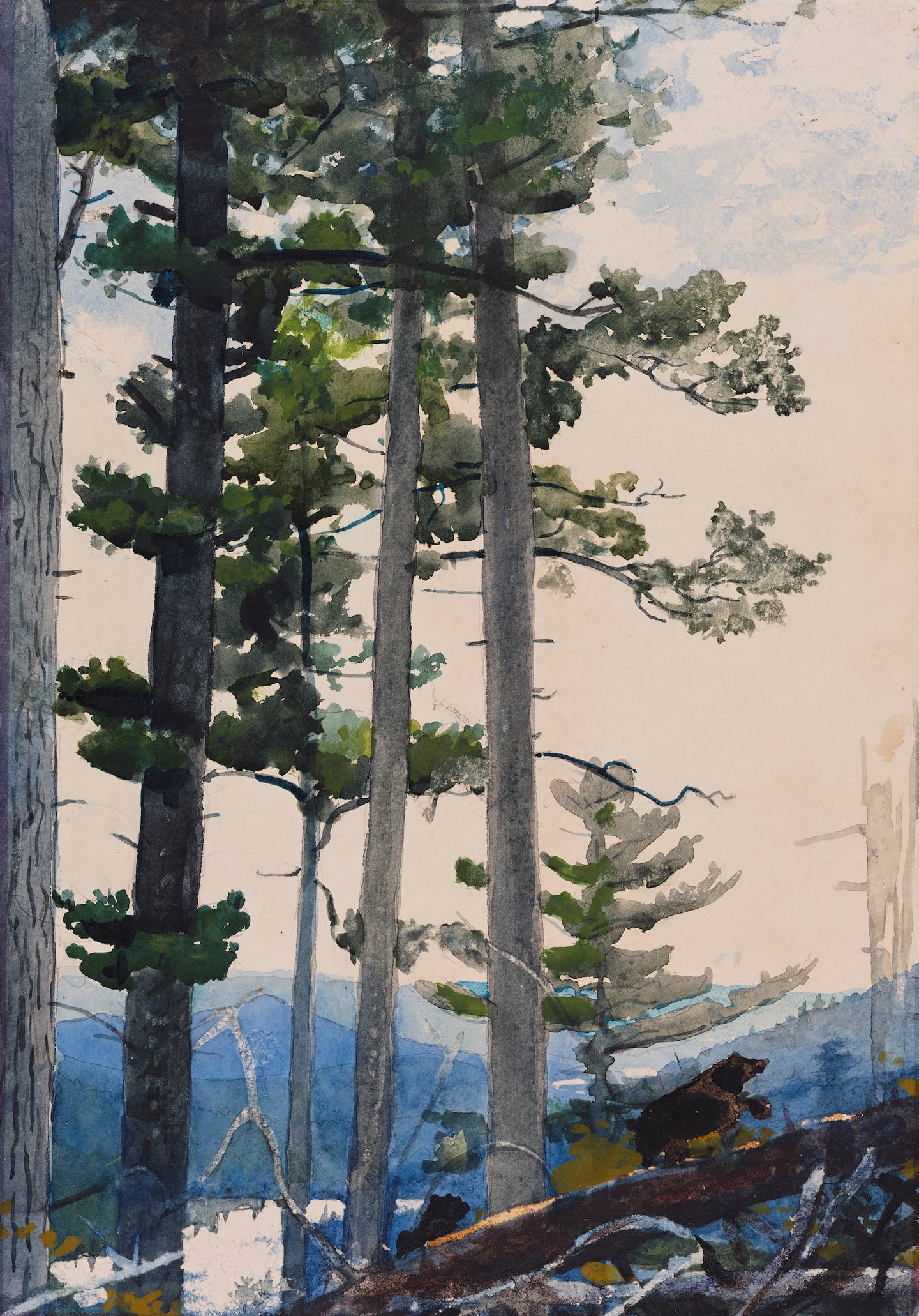 Winslow Homer, “Old Settlers,” 1892.
Museum of Fine Arts, Boston
What began as curiosity — I think of his genuinely funny 1868 painting of a painter and easel in the White Mountains on a hobbyist excursion in the vanishing wild — turned to an urgent concern. In his lifetime, remote wilderness was being transformed both by industrial logging and tourism brought by new rail lines pushing farther and farther north, modernity in full, unstoppable and accelerating.
You can read his concern in works like “The Guide and Woodsman (Adirondacks),” 1889, with a thick-bearded wilderness guide trudging through a smoldering forest clear-cut, or the radical, stark beauty of “Old Settlers,” 1892, a rare vertical composition made to capture the towering presence of the remaining old growth white pine, ragged against a bleached-white sky — waiting, you expect, to be felled.
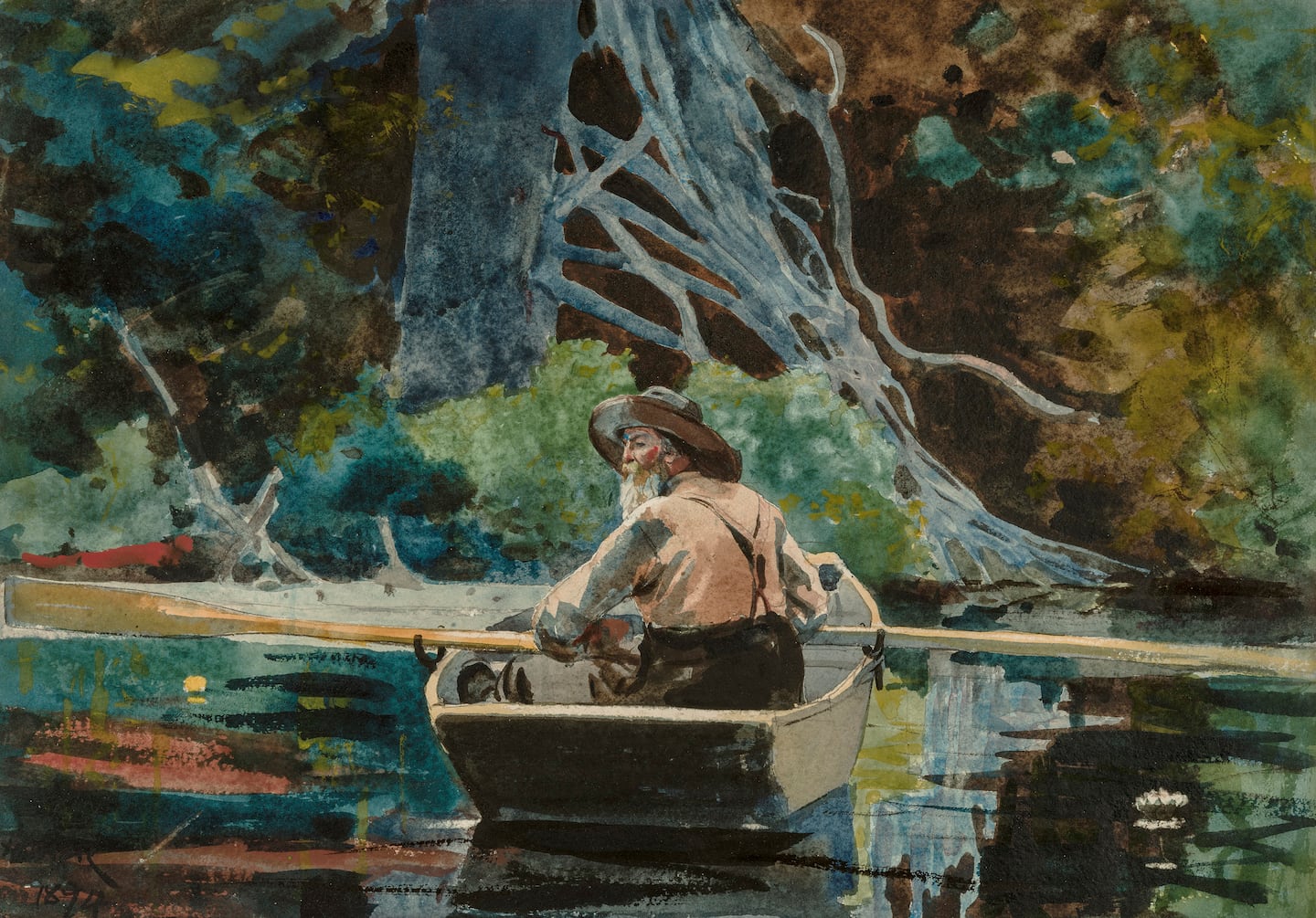
In his various laments, Homer also found joy. “The Adirondack Guide,“ 1894, explodes with the color of heavy forest bulked up to the shore of a lake where a wizened outdoorsman rows on mirror-sheen water. It feels otherworldly, everything Homer loves, and stands to lose. It’s loose with affection and familiarity, colors bleeding magnificently, organically, just enough but never too much. It feels like a letting go: An artist so long in the wind, at rest and at home with himself and his work at last.
WINSLOW HOMER: OF LIGHT AND AIR
At Museum of Fine Arts, Boston, 465 Huntington Ave. Through Jan. 19. 617-267-9300, mfa.org
Murray Whyte can be reached at murray.whyte@globe.com. Follow him @TheMurrayWhyte.