
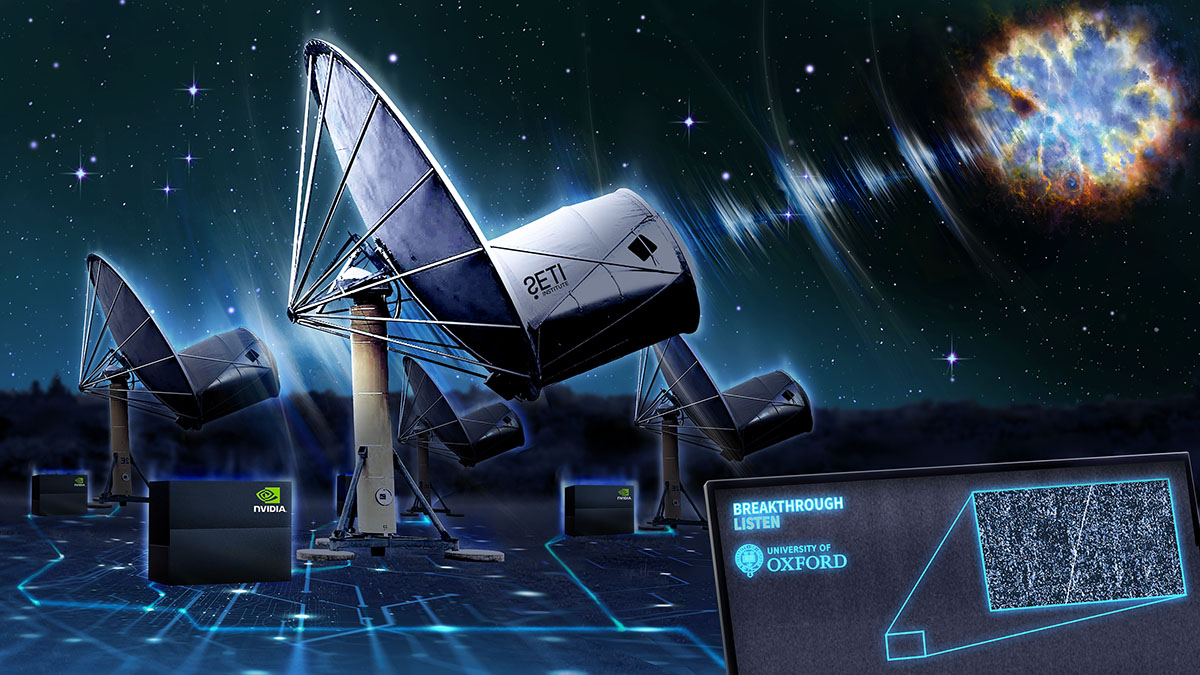
Researchers from the Breakthrough Listen initiative have developed a new AI system for detecting Fast Radio Bursts (FRBs) that operates on the NVIDIA Holoscan platform. This new system was utilised on the SETI Institute’s Allen Telescope Array (ATA) in California.
Speed And Accuracy In Detecting FRBs Met With The New AI System
Many facets of Astronomy are undergoing remarkable change, and one such area in the discipline is the detection of Fast Radio Bursts (FRBs). Existing FRB detection methods involve dedispersion, which can be time-consuming.
However, the new AI system from the Breakthrough Listen initiative improves the entire process. It eliminates the need for dedispersion and analyses signals in real time, processing observational data in seconds.
According to SETI, “The new AI-driven system performs the same task 600 times faster, operating over 160 times faster than real-time.” During tests at the Allen Telescope Array (ATA), this AI system is able to process 16.3 seconds of observational data in 53 seconds.
This new AI system is not all about speed, as it also boasts a 7% accuracy improvement in comparison with other FRB detection methods. With this improvement, there is now room for rapid follow-up observations, which can drive more discoveries.
A New Era For FRB Detection
This new AI system was developed thanks to a collaboration between Breakthrough Listen, the SETI Institute, and academic and industry partners, like NVIDIA. It brings the powers of AI into the discipline of astronomy for increased performance, ensuring better results.
Already, the system has been able to analyse over 86 gigabits per second of data worth of pulses from the Crab Pulsar. In the near future, we might get to see this system in use globally for the detection of extraterrestrial signals.