
George W Carver, born into slavery, became one of the most important American agricultural scientists of his time. He was rejected by several schools based on his race — one, Highland College in Kansas, accepted his application but turned him away at the door once they saw he was black. Carver grew up in a time when it was legal to turn away someone based on their ethnicity or race. With this not being the case anymore, inequality in education is something that is very difficult to imagine, especially in modern Ireland, yet it happens every day. Since the 1960s, when discrimination against Travellers was institutionalised, the Travelling community has been held back from prospering in modern Ireland. When looking into Traveller inequality, the numbers today tell a story of little progress.
Transition Year enrolment among students from the Travelling community is up by more than 70 per cent since 2016, but still only 31 per cent complete their Leaving Cert compared to 92 per cent of all students in Ireland. Furthermore, according to the last national census reporting on the issue, there are only 312 Travellers in the country who hold a third-level qualification — that’s barely one per cent of the Travelling community. The inequality does not stop there. Employment statistics paint an even darker picture, with 80 per cent of Irish Travellers out of work, and a Bank of Ireland report showing 59 per cent of Irish Travellers believe their ethnicity is a barrier to access to employment — the highest among all ethnic groups. Traveller wellbeing is severely impacted by this ostracisation, with suicide rates in the community six times larger than among settled people. Despite historically being a key part of Irish society, Travellers have consistently been left behind.
In pre-modernised Ireland, Travellers played important economic roles in the communities they engaged with. Travellers were known to be skilled artisans, metalworkers, horsemen, traders, and crucial seasonal farm labourers. After the 1960s, Ireland’s need for this type of labour diminished, and so the community was outcast — the unwillingness of the settled community to integrate with Travellers in educational and work settings has led to the existing inequality we see today.
A notable catalyst of the current inequality was the 1963 state education policy, which labelled members of the Travelling community as a “problem” to be solved. The commission’s plan to “absorb” itinerants framed their educational needs in terms of deficiency, stating that “little can be done about the problem of illiteracy among adult itinerants.” This perception of Travellers as of lesser intellect than settled people provided justification for segregated classes. And with a minimised curriculum, it set back Traveller literacy and reinforced that their culture, history and potential would lay outside what the government then perceived as a modern Ireland.
It was only the 2002 Traveller Education Guidelines and 2006 Traveller Education Strategy that shifts toward inclusion were attempted, finally recognising Traveller cultural identity and advocating for mainstream integration. In 2011, austerity cuts decimated vital visiting-teacher and resource-teacher posts. The 2017 National Traveller and Roma Inclusion Strategy — embedding education equity across various government departments — restarted the movement, and the 2024 to 2030 Traveller and Roma Education Strategy aims to set out coordinated, culturally informed actions from curriculum content and teacher-training programmes to dedicated link workers and the TOBAR teacher-recruitment initiative. However, due to these initiatives being terribly underfunded, Traveller children still face lower expectations, high absenteeism and missed opportunities. Without proper funding, these initiatives fail to act as more than token inclusion strategies — putting a clean peel-off plaster on a deep wound.
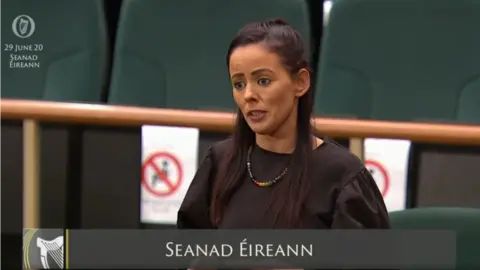
One activist frontlining the strive for change is Senator Eileen Flynn: a Trinity graduate and the first Traveller woman elected to the Seanad. Senator Flynn has worked closely with Traveller-rights movements such as the Irish Traveller Movement, the National Traveller Women’s Forum and the Ballyfermot Traveller Action Programme, campaigning for women’s rights, housing, marriage equality, abortion rights and against racism. We asked the senator to provide her opinions and insights as both a member of the Travelling community and a senator on how these policies play out on the ground, why systemic barriers persist, and what concrete actions settled Ireland can take to create real change:
Q: In your experience and through your observations, how has discrimination toward the Traveller community changed over your lifetime? Has it improved, worsened, or taken new forms?
A: Discrimination has not disappeared; it’s just taken on new forms, while the old prejudices unfortunately persist. Growing up in Labre Park, I remember the way people would look at us in shops and public spaces. Just last year, I was refused a taxi to my home because I lived on a halting site, and I had to ring the gardaí to resolve it, only to be told the matter was “a waste of their time” until I said I was a senator. That shows how embedded this discrimination still is. I often say that, no matter what I do or achieve, to a lot of people I will always just be a member of the Traveller community. There has been some progress — we are talking about racism and we are seeing hate-crime legislation finally moving — but intolerance and “othering” of Travellers remain a daily reality, showing up not just in words, but in actions and access to basic services.
Q: Why do you think progression rates in secondary and higher education remain significantly lower for Traveller youth? Do you think the issue is more systemic, or in your opinion do deep-rooted prejudices among non-Travellers play a bigger role?
A: It’s a mixture of both systemic failure and deep prejudice. There are systems in place from which Traveller students are not expected to stay on. The education system never fully acknowledged the trauma and exclusion Travellers have suffered, and as a result, generations have missed out, creating intergenerational obstacles. When the system doesn’t get things right, families and young people lose faith. Add to that the way settled society often views us — that “othering,” that expectation that Travellers are always going to fall short — and you see why so many talented young Travellers fall out of education. We need a system that meets Traveller children where they are and supports them all the way.
Q: What are practical things every day that Irish people — workers, students, neighbours — can do to support Travellers through education and employment and create change for the better?
A: For a start, if you see discrimination happening — in your workplace, at school or in public — don’t turn away. Speak up. Silence helps no one. Employers and colleagues should actively include Travellers, not as a “favour,” but because we bring value. In schools, teachers should make an effort to know and respect Traveller culture, challenge stereotypes and foster real belonging. Neighbours should reach out, get to know Traveller families and not judge based on myths or hearsay. In general, society needs to realise that Travellers aren’t asking for special treatment, just for equality. Every bit of solidarity, every moment of standing against prejudice, helps create change.
Q: In your opinion, what do our government and educational institutions need to do to get rid of the obstacles Travellers face?
A: We need real, funded implementation of the strategies that already exist, not just plans gathering dust. Far too often, commitments do not materialise, leaving legacy issues to continue. Schools must confront the reality of institutional racism and provide positive representations of Travellers. We need hate-crime legislation and accountability for councils that repeatedly fail on Traveller accommodation. Most importantly, we need a public commitment from the state, including an apology for historical wrongs, and then clear action to right them. Progress comes from leadership, not token gestures.
Q: What are some examples of success and progress in the Traveller community over recent years that give you hope for the future?
A: Despite all the obstacles, the fact that I sit in the Seanad as the first Traveller woman is thanks to the strength and support of my family and community. I draw hope from young Travellers achieving degrees, our growing numbers in community health work, and from the way Traveller Pride is being celebrated more openly. The official recognition of Traveller ethnicity was historic. Traveller organisations are making a real difference, from health projects to education advocacy. Every day I see resilience and talent in our community. These successes show what’s possible when there is support and recognition, and they give me hope that change is both necessary and achievable.
It is important to note that despite clear setbacks, there are strong signs of change. Traveller Pride events celebrating music, art and storytelling are now featuring around the country. The Mincéiri Archives project has digitised centuries of Traveller oral history, preserving family narratives for future generations. And community health initiatives — such as Pavee Point’s Traveller mental health service — have reduced emergency calls by 15 per cent among Traveller families.
There is still, however, a clear difference between policy promise and lived reality. Travellers will not find equality through plans alone. As Senator Flynn emphasises, progress must be made through everyday solidarity — through inclusion, speaking up when you see discrimination, and treating everyone as equals. Accountability needs to occur at every level, from classmates to teachers, to colleagues to representatives in government. The only way Ireland can fulfil its commitment to justice and inclusion for everyone is through combining well-resourced and specific strategies with a major societal effort to change attitudes toward our most vulnerable communities.
To quote George W. Carver, “Education is the key to unlock the golden door of freedom.” His life, going from a freed slave, and being rejected by every institution on account of his race, to becoming a well-respected scientific leader shows just how education can be a pathway to dignity and opportunity. Travellers today face systemic and social barriers which are the biggest factors preventing the majority of the community from attaining educational freedom. Depriving a whole community of this opportunity because of poor planning, miscellaneous funding and targeted bullying seems to stand against what it means to live in a free and equal society.