

Introduction: SoftBank shares slide after Nvidia stake sale
Good morning, and welcome to our rolling coverage of business, the financial markets and the world economy.
Shares in Japanese tech investor SoftBank have taken a knock, after it revealed it has sold its stake in chipmaker Nvidia.
SoftBank surprised investors yesterday by revealing it sold its shares in Nvidia last month, raising $5.8bn, to fund its other investments in artificial intelligence pioneers, such as ChatGPT parent OpenAI.
And the market verdict today has been decisive. SoftBank’s shares touched a one-month low when trading opened in Tokyo – down as much as 10% at one stage – before closing down 3.5%.
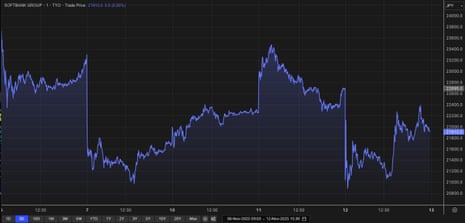 A chart showing SoftBank’s share price over the last five days Photograph: LSEG
Although SoftBank insisted there wasn’t a “specific” reason to sell its Nvidia shares in October, the move has raised more questions about whether the sky-high valuations given to companies in the AI sector are solid.
It also highlights the growing funding demands SoftBank faces to bankroll its bet on OpenAI and other investments.
Shares in Nvidia, whose high-speed chips are used to power AI data centres, fell 3% yesterday, amid a wider drop in tech shares.
Analysts have suggested SoftBank’s move shouldn’t cause alarm, though, as it isn’t giving up on AI.
Ipek Ozkardeskaya, senior analyst at Swissquote, explains:
It appears SoftBank is looking to boost its bets further down the AI chain — toward companies that actually use AI, like OpenAI and ABB Robotics.
For those unhappy with the circularity of current AI deals, this is good news….
Meta, for instance, signed a deal with Dutch cloud provider Nebius, which predicted rapid growth next year – and when I say rapid, it’s rapid: their sales soared by more than 300% last quarter. Their share price? It tanked 7% yesterday, along with CoreWeave, which fell 16%.
The agenda
7am GMT: German inflation report for October
Noon GMT: US weekly mortgage approval data
2.15pm GMT: Treasury Committee hearing on property taxes ahead of the budget
Updated at 02.44 EST
Key events
Show key events only
Please turn on JavaScript to use this feature
Japan’s finance chief issues warning over weakening yen
Japan’s government is growing anxious about its weakening currency.
The yen, which has been generally weakening since the start of October, is approaching the significant level of ¥155 to the dollar, a point where Toyko has intervened in the markets before
Japan’s finance minister Satsuki Katayama told the country’s parliament today that the government was watching the sutation closely, saying:
“We’re seeing one-sided, rapid currency moves of late.
The government is watching for any excessive and disorderly moves with a high sense of urgency.”
Katayama also warned that the negative aspects of the weak yen are becoming clearer.
The yen’s weakness may be a sign tht the “yen carry trade” is growing in popularity, as risk returns to the markets. This is the situation where investors borrow yen, and use it to buy other, higher-yielding currencies such as the US dollar.
Hopes that the US government will reopen soon have spurred risk-on moves, such as the yen carry trade, explains Stephen Innes, managing partner at SPI Asset Management:
The reopening of the U.S. government has been a bittersweet elixir for the greenback.
On one hand, risk is back on — stocks have caught a second wind, buybacks are flowing, and high-beta FX like AUD are catching the same tailwinds that power stocks. On the other hand, the same optimism that revives equity appetite also reawakens the yen’s old nemesis: carry.
When risk levels rise, the mechanical gears of the USD/JPY carry trade start spinning again — cheap yen funding chasing higher U.S. dollar returns, pushing the pair higher almost reflexively.
ShareTaylor Wimpey blames budget uncertainty for sales slowdown
UK housebuilder Taylor Wimpey has warned that sales growth has slowed in the usually busy autumn season.
Taylor Wimpey told the City this morning that it was seeing “softer market conditions in the second half of the year”, which it blamed on current uncertainty in the housing market ahead of the November Budget.
This slowdown has pulled down Taylor Wimpey’s net private sales rate to 0.63 per outlet per week since June 30, down from 0.71 a year earlier.
Jennie Daly, chief executive of Taylor Wimpey. says:
“We have delivered a resilient performance thanks to the hard work of our teams on the ground. Market conditions remain challenging, impacted by uncertainty ahead of the upcoming UK Budget and continued affordability pressures.
We welcome the Government’s planning reforms, and we hope to see continued momentum to enable the supply of much needed new homes across the UK as focus moves to the implementation phase. However, the Government’s housing ambitions, and the significant economic and social benefits of increased housing supply can only be unlocked by effective demand, particularly for affordability constrained first time buyers.
The debate over tech stock valuations has intensified, reports Tony Sycamore, market analyst at IG, following the sharp decline in CoreWeave’s share price yesterday.
CoreWeave, the Nvidia-backed cloud computing and AI infrastructure provider, plummeted 16.31% to $88.39, driven by disappointing Q3 guidance escalating debt concerns, market rotation away from growth stocks, and supply chain challenges within Nvidia’s ecosystem.
It was joined by Nvidia, which slid 2.96% to $193.16, reflecting broader tech weakness ahead of its November 19.
Elsewhere, AMD dropped 2.65% to $237.52 and Oracle fell 1.94% to $236.15, significantly below its September peak of $345.72, a decline of about 33%.
Updated at 02.44 EST
Introduction: SoftBank shares slide after Nvidia stake sale
Good morning, and welcome to our rolling coverage of business, the financial markets and the world economy.
Shares in Japanese tech investor SoftBank have taken a knock, after it revealed it has sold its stake in chipmaker Nvidia.
SoftBank surprised investors yesterday by revealing it sold its shares in Nvidia last month, raising $5.8bn, to fund its other investments in artificial intelligence pioneers, such as ChatGPT parent OpenAI.
And the market verdict today has been decisive. SoftBank’s shares touched a one-month low when trading opened in Tokyo – down as much as 10% at one stage – before closing down 3.5%.
A chart showing SoftBank’s share price over the last five days Photograph: LSEG
Although SoftBank insisted there wasn’t a “specific” reason to sell its Nvidia shares in October, the move has raised more questions about whether the sky-high valuations given to companies in the AI sector are solid.
It also highlights the growing funding demands SoftBank faces to bankroll its bet on OpenAI and other investments.
Shares in Nvidia, whose high-speed chips are used to power AI data centres, fell 3% yesterday, amid a wider drop in tech shares.
Analysts have suggested SoftBank’s move shouldn’t cause alarm, though, as it isn’t giving up on AI.
Ipek Ozkardeskaya, senior analyst at Swissquote, explains:
It appears SoftBank is looking to boost its bets further down the AI chain — toward companies that actually use AI, like OpenAI and ABB Robotics.
For those unhappy with the circularity of current AI deals, this is good news….
Meta, for instance, signed a deal with Dutch cloud provider Nebius, which predicted rapid growth next year – and when I say rapid, it’s rapid: their sales soared by more than 300% last quarter. Their share price? It tanked 7% yesterday, along with CoreWeave, which fell 16%.
The agenda
7am GMT: German inflation report for October
Noon GMT: US weekly mortgage approval data
2.15pm GMT: Treasury Committee hearing on property taxes ahead of the budget
Updated at 02.44 EST