
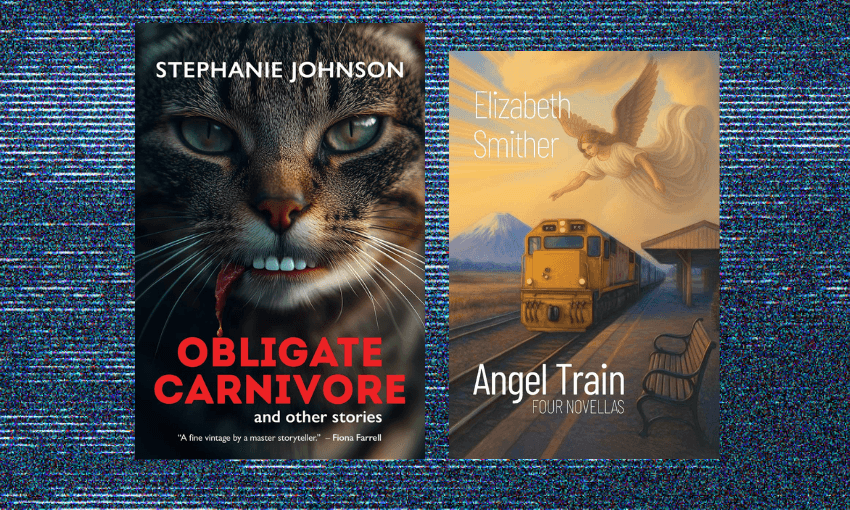
Elizabeth Smither and Stephanie Johnson’s latest books, both published by Quentin Wilson Publishing, have been yeeted from the Ockhams.
Author Stephanie Johnson had no idea that the image of a cat with human teeth on the cover of her book of short stories, Obligate Carnivore, was created with AI. Had she been made aware that the designers of her book cover were using AI, she says she’d have asked them not to. “I’m concerned about AI,” she told The Spinoff. “And I understand that there has to be rules.”
Johnson is referring to the revised rules of the New Zealand Book Awards Trust who govern the Ockham New Zealand Book Awards, the most prestigious in the country. The trust has eliminated Johnson’s book, and Elizabeth Smither’s collection of four novellas called Angel Train, from contention for the Ockhams 2026 due to the use of AI on both of their covers.
Their publisher, Quentin Wilson, says that the trust isn’t being fair. “Although the submission guidelines for the 2026 Ockham Awards, released in August, included in their eligibility criteria a clause specific to AI,” he told The Spinoff, “the covers of every title published within the specified time period would have been designed months before. It was, therefore, far too late for any publisher to have taken this clause into account in their design briefs.”
 Stephanie Johnson.
Wilson had previously worked with Sugarcube Studios, the design studio that created the two book covers, and says “they have a long-standing commitment to thoughtful, high-quality design”. The studio has a page on its website dedicated to its “AI-assisted book cover design for Quentin Wilson Publishing”. The page shows covers for books by CK Stead, Karen McMillan and Alan Goodwin. “Ana [the designer] employed AI-powered design tools to generate a range of concepts,” reads the copy underneath the images, “taking into account the genre, tone, and target audience of each publication.”
Wilson told The Spinoff he is happy if the designers use AI after they have come up with original concepts for the AI to work with. He believes this is the case with both Smither and Johnson’s covers. The studio told Wilson that it sees AI “not as a replacement for creativity but as a natural extension of our craft, a new way to explore ideas and enhance our process,” and that “AI is a tool we use to enrich our book cover design workflow.” Wilson told The Spinoff that Sugarcube Studios was disappointed by the trust’s decision to disqualify the books and shared a statement from the studio, via email, saying they “hope this situation sparks a constructive conversation about how awards might evolve to recognise the changing realities of contemporary, human-directed digital design.”
The Spinoff has contacted Sugarcube Studios but the studio has not responded.
No other books have so far been disqualified for Ockhams contention due to AI use, including within the text itself. The trust’s AI policy allows the “use of AI for research, minor editorial, or formatting support”. The trust’s AI clause was in the entry criteria in the “call for entries pack” available from the date submissions were open, on August 7. All submitters were asked in the entry form to ensure they had read the pack, and to make a declaration that they had understood the eligibility criteria.
The trust told The Spinoff that during the submission process, the trust’s awards administrator received a few enquiries for clarification about book cover artwork that used AI, but did not receive queries from Quentin Wilson Publishing which submitted its entries on September. “Publishers entering books that were printed locally had ample time to have read the conditions of entry prior to submitting to the awards.” The Spinoff understands that Johnson’s and Smither’s books were printed locally. Quentin Wilson told The Spinoff he did not enquire because he believed the books were within the criteria.
In terms of actually identifying the use of AI, the trust says it will review its criteria annually to take in the fast-changing presentation and use of the technology. For now, the trust “relies on submitters [usually publishers] confirming with authors and designers that AI has not been used in the creation or generation of text, or disclosing AI use when querying a book’s eligibility”. It is easier, for now, to identify the use of AI in illustration compared to in text – in this particular scenario the trust was alerted to the AI in the two covers by booksellers. Johnson told The Spinoff she’s worried that booksellers might refuse to stock her book now that the AI has been outed. The Association Manager of Booksellers Aotearoa New Zealand has written an open letter expressing “unequivocal support” for the trust’s decision.
Elizabeth Smither, one of New Zealand’s most acclaimed writers and a former poet laureate, is agnostic about the elimination of her book from awards contention. “I remember Maurice Shadbolt and others working out who was going to win an award, rather like plotters in Shakespeare,” she told The Spinoff. “The real pleasure in writing is just doing it. Everything else is performance.” However, the author did tell her publisher that she was worried the work of the designer was being disrespected due to the fact that the angel on Smither’s cover “took many hours” to get right.
Johnson, on the other hand, is worried that her AI cover will dilute her reputation as a writer and repel book buyers and booksellers from her work. If the cover is AI-made, who’s to know that the text within isn’t, too? But she doesn’t blame Wilson. On the contrary she “adores” him and is concerned about the toll of this situation on him. “We need Quentin,” says Johnson. “The likes of Penguin aren’t publishing as much as they used to. We need small publishing companies like Quentin’s to survive.”
Wilson is in his 70s; Smither is in her 80s. Johnson is in her 60s. Johnson describes herself as technologically challenged and said she didn’t have much to do with the cover process beyond the original brief. She didn’t have any contact at all with Ana at Sugarcube Studios and neither did Smither. Wilson does his best to include his authors “at every stage of decision-making, including the look of their covers” but says most traditionally contracted authors don’t have much to do with the technical process of their creation. He didn’t tell Johnson and Smither that AI might be used to create their final cover designs but did assume that the studio would be doing so.
Elizabeth Smither. Image: Liz March
Renowned book cover designer, Todd Atticus, feels “awful” for the authors who he says have been betrayed – “[their] work deserves better than to be represented by this bland slop”. He admits that “it’s easy to hate on AI if your job is threatened by it” but says “it’s even easier if the job the AI does is just bad”.
Atticus recently worked for a major UK publisher who banned the use of AI at every stage of a book’s production. “Their rationale is that in doing so they help preserve the sanctity of the book in an age where the veracity of authorship is crumbling around us,” says Atticus, who supports such a stance. In Aotearoa, the Ockhams can be at the forefront of making this an industry-wide concern, he says.
Designing a book cover takes time and money. For small publishers that can be a significant investment and Atticus understands the lure of AI in alleviating cost pressures.
The creeping use of AI in publishing raises questions of author’s rights when it comes to the publishing process and whether authors should be able to include clauses in their contracts to state that their publisher must not use AI in the production process. It is now standard that publishers will include a clause to assert that AI has not been used in the writing of the text, but far less common that authors ask for reciprocal assertions from publishers.
The New Zealand Society of Authors is soon to publish revised guidelines for author-publisher contracts with regards to AI, including the following clause:
‘No substantial generative AI use without consent’
Neither party will, without the other party’s prior written consent, use or authorise others such as sub-licensees to use, Generative AI to wholly or substantially fulfil that party’s material obligations pursuant to this agreement…
In particular, the publisher must seek the author’s prior written consent to the use of generative AI in relation to their work for:
a) audiobook narrations
b) translations
c) illustrations or artwork
d) cover design
e) animation
f) substantial visual elements
g) revisions and new editions
h) substantive editing
Elizabeth Smither and Stephanie Johnson, both MNZMs, are two of the country’s longest-working authors with nearly 50 books and nearly 20 awards between them.