
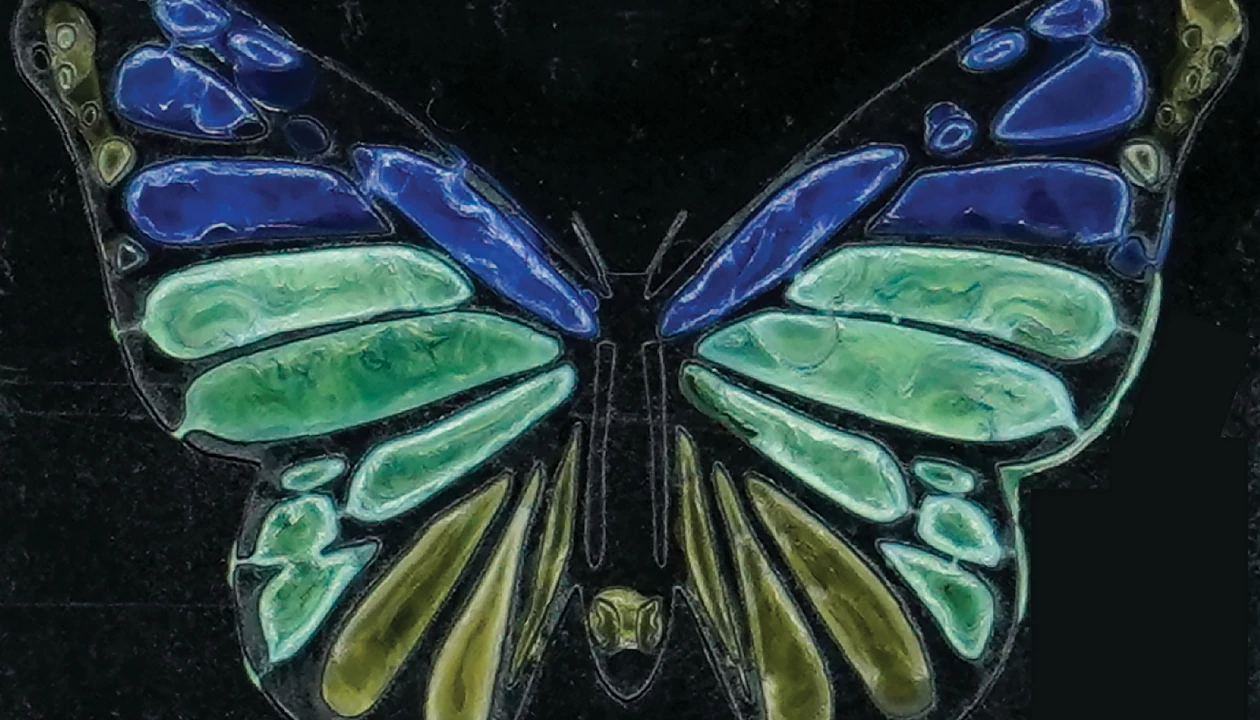
Structural color, which comes from light waves interacting with matter on the nanoscale, is found in many places in nature—bird feathers, insect shells, even some plants. But chemists have also devised lots of clever ways to manufacture materials with structural color. Block copolymers that self-assemble into nanoscale layers are a good way to generate structural color because researchers can fine-tune the materials’ overall optical properties, says Ming Xiao of Sichuan University. Xiao and his team published a physics-based model that can determine what polymer architecture will create a given color (Nat. Commun. 2025, DOI: 10.1038/s41467-025-66015-0).
The researchers based the model on block copolymers composed of polydimethylsiloxane and either poly(ethylene glycol) or polycaprolactone, and demonstrated the polymers’ colorful capabilities by printing patterned films to make images such as this butterfly. They also found that changing the temperature changed the crystallinity of the soft polydimethylsiloxane layers, leading to chameleon-like shifts in hue. “We didn’t expect this color change,” Xiao says, but once they discovered it, they quickly figured out how to intentionally design for it. Xiao says that his team’s next steps are to continue refining the polymers’ tunable color-changing properties and start developing the materials for applications such as anticounterfeiting.
An image of a chameleon printed using a color-changing polymer.

Credit:
Dong Yang/Nat. Commun.
Credit: Dong Yang
Do science. Take pictures. Win money. Enter our photo contest.
See more Chemistry in Pictures.

Chemical & Engineering News
ISSN 0009-2347
Copyright ©
2025 American Chemical Society