

An Israeli startup is developing a high-power electromagnetic launcher system designed to propel payloads and enable cargo deliveries into space at hypersonic speed using electricity rather than chemical fuels.
The Caesarea-based Moonshot Space came out of stealth on Monday, announcing it had raised $12 million to build a delivery launch system that uses electric acceleration instead of relying on traditional chemical-based rocket propulsion and expensive missiles to hurl payloads at hypersonic speeds and deliver raw materials and supplies to space at a fraction of the cost.
Moonshot was founded in 2024 by Hilla Haddad Chmelnik, former director-general of the Science Ministry and member of the team that developed the Iron Dome anti-missile system; Fred Simon, co-founder of software unicorn JFrog; and Shahar Bahiri, co-founder of the AI-driven smart mobility company Valerann.
The startup is one of several in Israel and around the world exploring the use of electromagnetic pulses to accelerate a payload to speeds capable of escaping Earth’s gravitational pull. Most designs use high kinetic energy railgun or coilgun concepts, which are also being developed for military use, a field Moonshot is entering as well.
“Space exploration is getting more diverse and more complex in what we want to do involving science, manufacturing, and mining, and as any industry that is evolving, there needs to be more than just one mode of transportation, which for now is based on chemical rockets and is too expensive,” Haddad Chmelnik told The Times of Israel. “The concept of a kinetic spacecraft launch has existed since the days of Jules Verne, but now the technologies, renewable energy, and computing power to make a kinetic launch affordable and achievable are available.”
Sign up for the Tech Israel Daily
and never miss Israel’s top tech stories
By signing up, you agree to the terms
The startup has a diverse team of 32 chemical, material, and aerospace engineers, including Gil Eilam, former chief system engineer for the David’s Sling missile defense system; and Ran Livne, former CEO of the Ramon Foundation and head of Israel’s second astronaut mission. Alon Ushpiz, a former Foreign Ministry director has also joined the team, which operates primarily from Caesarea, where its first accelerator is under construction.
“We are using the unique know-how of Israel’s defense industry which has a proven track record of developing very complex systems such as the Iron Dome or the Arrow in a very short time with cheaper development costs,” Haddad Chmelnik said.

Moonshot startup founders (from right to left): Fred Simon, co-founder of software unicorn JFrog; Hilla Haddad Chmelnik, former Director-General of the Science Ministry and member of the Iron Dome development team; and Shahar Bahiri, co-founder of the AI smart mobility company Valerann. (Courtesy)
She said the company, which will eventually need to build a larger accelerator outside of Israel, hopes to reach space within five years.
The startup’s accelerator launch system will consist of a long, round tube, similar to the barrel of a cannon, with a rail running along its length. A hardened payload capsule will be sped along the rail by a series of coils that generate an electromagnetic wave until it is launched out the end and into space at speeds of up to eight kilometers per second, the startup said.
“Instead of rocket boosters burning vast amounts of fuel, the energy comes from electricity, which accelerates through the coils,” said Haddad Chmelnik. “There is capacitor that gets the energy and then releases it to the coils and the capsule goes through this tube and is going out to the sky.”
While a conventional rocket launched into space can carry a maximum of 4% of its weight as payload, a kinetic launch boosts payload capacity to around 45% by getting rid of the need for heavy fuel tanks, said Haddad Chmelnik.
The system will reduce the cost of supplying equipment, fuels, and raw materials to space stations and satellites to a tenth of traditional rocket launches, the company claimed.
Haddad Chmelnik said the launch system will enable frequent, rapid and inexpensive resupply of materials to space stations, satellites and future in-space infrastructure, but will not be suitable for astronauts or humans because of the high g-force created by the acceleration.
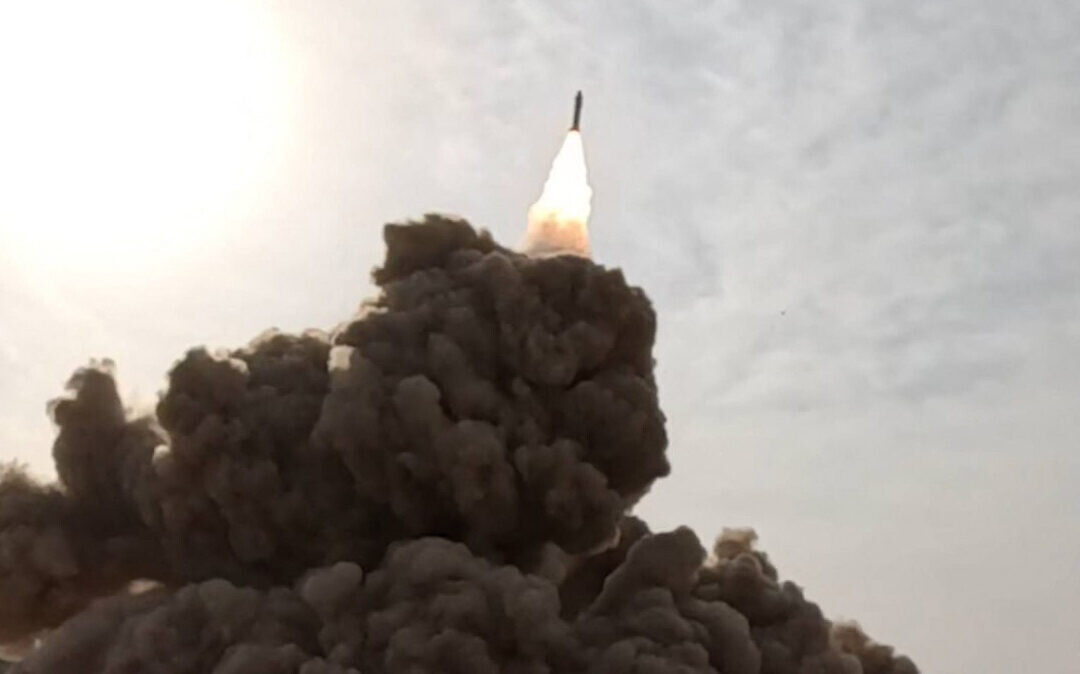
A handout picture obtained from Yemen’s Houthi Ansarullah Media Center on June 26, 2024, shows what they said was a test launch for the Hatem 2 hypersonic ballistic missile in an undisclosed area. (ANSARULLAH MEDIA CENTRE / AFP)
The space launch system will be designed for small-to-medium payload deliveries of resources and equipment, complementing heavy-lift rockets like SpaceX’s Falcon 9 or Starship.
The startup’s $12 million funding is led by London-based venture capital firm Angular Ventures and includes a $1 million grant from the Israel Innovation Authority. Moonshot said it had signed preliminary agreements with space logistics and transportation services provider, including Italy’s D Orbit and US–based Orbit Fab.
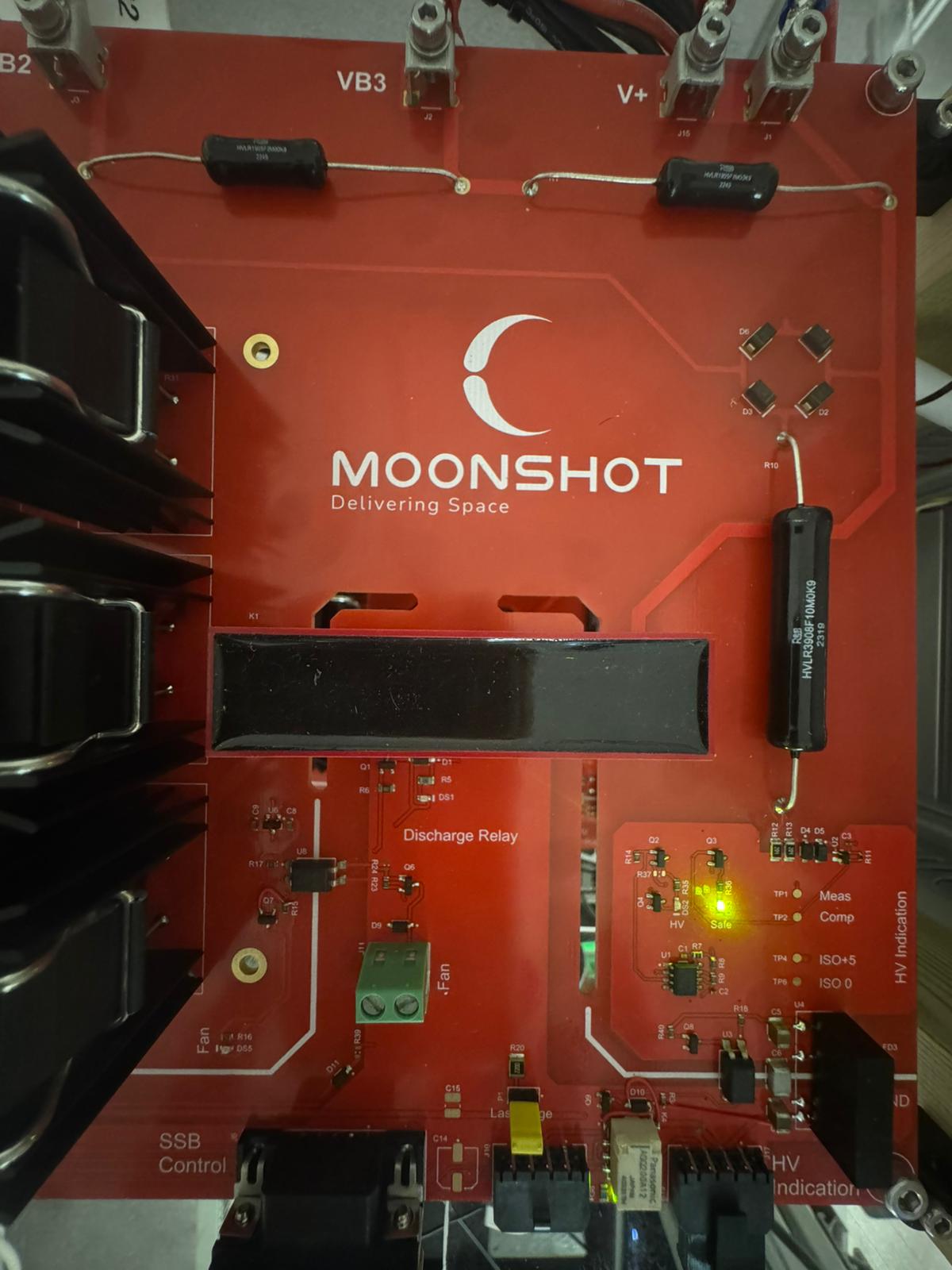
Israeli space tech startup Moonshot’s high-voltage electronic printed circuit board. (Courtesy)
“Our first milestone is to build an electromagnetic mass accelerator that can take a mass of a few kilos to a hypersonic speed to be developed in Israel and after that, we will need to build a bigger accelerator, which will require facilities outside of Israel, but the R&D will stay here,” said Haddad Chmelnik. “We think that we can reach space in about five years, depending on additional funding.”
She acknowledged that research teams in the US and China are also working on developing kinetic launch systems and have conducted tests with electromagnetic accelerators, but insisted Moonshot had an edge.
“In Israel, we have the talent and know-how from the defense industry to do it faster and cheaper,” she remarked.
Need for speed
In parallel to its space venture, Moonshot is building a scaled-down accelerator designed for defense firms to conduct hypersonic testing, shortening the development times of hypersonic weapons amid a global race to build ever-faster missiles and other arms.
Hypersonic weapons, which fly at speeds in excess of Mach 5, or five times the speed of sound, pose challenges to missile defense systems because of their speed and maneuverability.
“Today, the United States is investing heavily in its Golden Dome program, and Israel continues to advance systems like Arrow 3 and David’s Sling,” said Haddad Chmelnik. “But testing remains a bottleneck: developers rely on partial simulations, wind tunnels or extremely expensive missile launches.”
Moonshot’s Mach-6 hypersonic testing accelerator will be designed to increase trials from one test per week to several per day, with “costs reduced by an order of magnitude,” the startup said.
You appreciate our journalism

You clearly find our careful reporting valuable, in a time when facts are often distorted and news coverage often lacks context.
Your support is essential to continue our work. We want to continue delivering the professional journalism you value, even as the demands on our newsroom have grown dramatically since October 7.
So today, please consider joining our reader support group, The Times of Israel Community. For as little as $6 a month you’ll become our partners while enjoying The Times of Israel AD-FREE, as well as accessing exclusive content available only to Times of Israel Community members.
Thank you,
David Horovitz, Founding Editor of The Times of Israel