
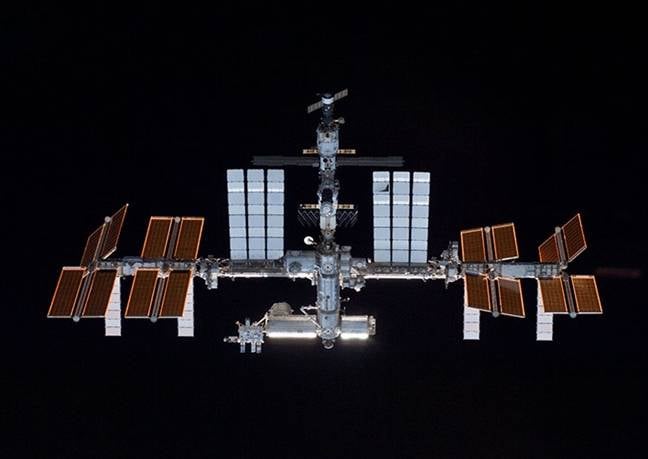
NASA confirmed this week that for the first time, all eight of the International Space Station’s docking ports are currently occupied – four by Russian vehicles.
But while the outpost is unusually busy, Russia faces a different problem. Damage to the launchpad used for sending Soyuz vehicles to the ISS has raised questions about when the next spacecraft will fly.
Space agency insiders have confirmed to The Register reports of Russian engineers conducting an urgent audit of resources onboard the ISS. Although any cargo gap could likely be filled by NASA’s commercial partners, such as SpaceX, refueling the Russian portion of the complex can only be performed by Progress freighters.
Crew transport will also be a challenge if the Soyuz is unavailable. However, there is a chance that Boeing might finally join SpaceX in flying astronauts to the outpost in 2026, should its Starliner spacecraft be declared operational.
The launchpad problems are compounded by an abrupt, unexpected change to the crew of SpaceX’s Crew-12 mission, scheduled to launch in February 2026. Soyuz veteran Oleg Artemyev has been removed due to “a transfer to another job,” according to Roscosmos. His replacement is Andrei Fedyayev.
One space agency insider questioned whether Russia might use the launchpad incident to hasten its exit from the ISS. With the outpost due for deorbit around 2030, a long Soyuz launch hiatus could strengthen arguments that it’s time for Russia to move on.
For now, however, the country remains committed to the program.
Damage to Russia’s launchpad and a sudden change of crew are not how the ISS team would have liked to celebrate 25 years of human occupation of the outpost, particularly with the end of the program looming.
There are currently ten crew members aboard the ISS, and all eight docking ports are occupied by visiting spacecraft. There are a pair of SpaceX vehicles (Cargo and Crew Dragons), the Japanese HTV-X1, Northrop Grumman’s Cygnus freighter, a pair of Russian Progress cargo spacecraft, and two Soyuz vehicles.
The crew will return to seven on December 8 when NASA astronaut Jonny Kim and Roscosmos cosmonauts Sergey Ryzhikov and Alexey Zubritsky enter the Soyuz MS-27 spacecraft, undock from the Prichal module, and parachute to a landing in Kazakhstan. Soyuz MS-28 is also attached to the ISS.
Soyuz MS-29 was due to launch in 2026, but that now depends on repairs to the damaged Baikonur launchpad or on an alternative departure point becoming available. ®