
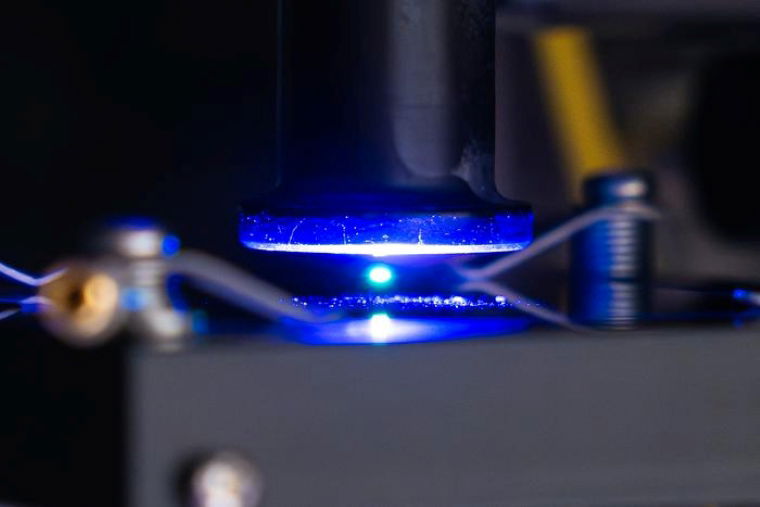
Austrian scientists working to perfect acoustic levitation have broken through a critical barrier by using electrical charges, allowing them to lift several objects simultaneously while maintaining their separation.
The researchers behind the breakthrough suggest that their new approach will offer researchers in micro robotics, materials science, and other emerging fields that rely on creating dynamic structures from small building blocks an unprecedented capability of simultaneously manipulating several objects in mid-air without them clumping together.
Scott Waitukaitis, now an assistant professor at the Institute of Science and Technology Austria (ISTA), began evaluating acoustic levitation in 2013 when the technology was still in its nascent phases.
“While acoustic levitation was being used in acoustic holograms and volumetric displays, it was essentially geared toward applications,” the professor explained in a statement detailing the ISTA team’s work. “I had the impression that the technique could be used for much more fundamental purposes.”
A central limitation to expanding acoustic levitation beyond these applications is a phenomenon the team called “acoustic collapse.” Although individual particles can be levitated and manipulated in mid-air with sound, the ISTA team said that when researchers tried to levitate multiple particles simultaneously, they tend to “snap together like magnets in mid-air.”
“This ‘acoustic collapse’ occurs because the sound scattering off the particles creates attractive forces between them,” they explain.
When hunting for solutions, Sue Shi, a PhD student in the Waitukaitis group and the first author of the study, said they initially tried to separate levitated particles individually so they would form into repetitive patterns.
“Originally, we were trying to find a way to separate levitated particles so that they would form crystals,” Shi explained.
 The study’s first author, ISTA PhD student Sue Shi, places a particle inside the acoustic levitation setup (Image Credit: © ISTA).
With some additional work, the team developed a method to charge the individual particles. When the particles were levitated, the customized charges provided the team with the ability to arrange them into specific configurations. These unique, acoustic levitation states included systems where the particles were completely separated from one another, fully collapsed” systems where they were all clumped together, and hybrid systems that included both separated and clumped particles.
“At first, it was frustrating to see these hybrid configurations and weird rotations and dynamics—they were preventing me from getting the clean, stable crystalline structures I was aiming for.
After some more fine-tuning, the team figured out how to bounce individual particles off the charged reflector plate at the bottom of the experimental setup. This unique ability enabled the team to switch particles between different preferred configurations.
“By counteracting sound with electrostatic repulsion, we are able to keep the particles separated from one another,” says Shi.

“You can’t study how individual particles interact when you can’t keep them apart,” explains Waitukaitis. “By introducing electrostatic repulsion, we can now maintain stable, well-separated structures. This finally gives us a controllable platform to investigate these subtle non-reciprocal effects.”
When discussing possible applications of the new approach, the ISTA team suggested using collapse-proof acoustic levitation in fields that rely on forming controlled, dynamic structures from smaller building blocks. These include applications across diverse fields such as materials science and micro-robotics.
According to Shi, the work reminded her that discoveries are not always predictable, including a potential breakthrough in acoustic levitation that had her fellow researchers excited when she presented the results.
“That’s the funny thing about experiments: the most interesting discoveries often come from the things that don’t go as planned,” she said.
The study “Electrostatics overcome acoustic collapse to assemble, adapt, and activate levitated matter” was published in the Proceedings of the National Academy of Sciences.
Christopher Plain is a Science Fiction and Fantasy novelist and Head Science Writer at The Debrief. Follow and connect with him on X, learn about his books at plainfiction.com, or email him directly at christopher@thedebrief.org.