
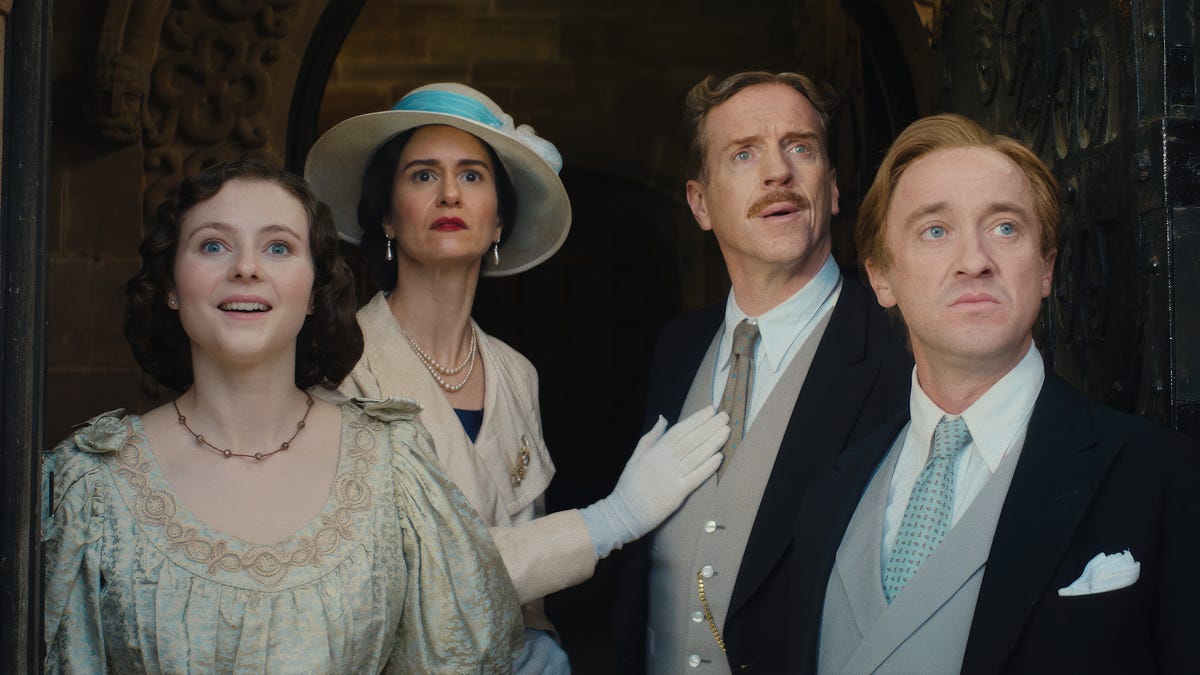


Tom Felton, Damian Lewis and Thomasin McKenzie star in ‘Fackham Hall’
“Gosford Park” meets “The Naked Gun” in new comedy movie “Fackham Hall,” which smartly satirizes British period dramas.
There’s nothing particularly funny about “Downton Abbey.”
That’s precisely what makes it so rife for parody in “Fackham Hall” (in theaters Dec. 5), a deeply silly send-up of PBS’ long-running period drama, as well as other tart British fare including “Gosford Park” and “Upstairs, Downstairs.”
Manners go out the window in the new R-rated comedy, which is packed with wall-to-wall sight gags, wordplay and pop-culture references. Think a stodgy English butler named Siri, a pair of man-hungry Bechdel sisters, or a funeral guest who’s introduced as “Bill. Bill Bo Baggins.” It’s the kind of film where someone exclaims, “He saved my life in the war,” only to flash back to a soldier suggesting, “You should really get that mole checked out.”
“Everyone takes themselves so seriously in those things, because it’s all about behaviors and not overstepping the mark and understanding the hierarchy within the house,” says Tim Inman, one of five writers on the movie, which also lovingly lampoons everything from Agatha Christie to “Mary Poppins.”
“The initial thing was, ‘What is ridiculous about this source material?’” adds co-writer Steve Dawson. “We did a bit of a rewatch party, where we were able to just sit and watch all these films and mercilessly take the piss out of them and then write down everything we got.”
“Fackham Hall” joins the time-honored tradition of slapstick parody movies, with pratfalls and fourth-wall-breaking absurdity that’s largely indebted to Mel Brooks and the Monty Python troupe, who helped usher the genre into the mainstream in the 1970s and ‘80s, along with “Airplane!” trio Zucker, Abrahams and Zucker.
Like its forebears, the comedy is played dead straight. In one lavish dinner scene, revelers carry on their conversations amid a cacophony of clanging silverware. A blushing bride is dragged down the aisle when her veil gets caught in a car door, while kitchen staff furiously chop up herbs ‒ only to roll them into joints.
It’s a hyper-specific brand of hilarity that’s made a recent comeback, thanks to Liam Neeson’s critically adored “The Naked Gun” reboot this past summer, as well as “Scary Movie 6” due next year, reuniting Anna Faris and Regina Hall for more outsized horror shenanigans. A sequel to Brooks’ 1987 cult classic “Spaceballs,” a parody of “Star Wars,” is also set for 2027 starring Josh Gad.
“The world is in a dark place, and people are ready for a really big belly laugh,” director Jim O’Hanlon says of the genre’s resurgence. “There hasn’t been a big, laugh-out-loud comedy in cinemas for a while, and people want that communal laughter again.”
Joke-dense spoofs were prominent throughout the ‘90s and early 2000s, with “Mars Attacks!” and the “Austin Powers” franchise, as well as “Wet Hot American Summer,” “Team America: World Police” and “Walk Hard: The Dewey Cox Story.” But the genre fell out of favor in the last 15 years, with poorly reviewed outings such as “The Starving Games,” and diminishing box-office returns for full-length parodies “Fifty Shades of Black” and “Popstar: Never Stop Never Stopping.”
“Those movies were designed to feel particularly disposable, and turned spoofing into just a question of referencing incredibly recent cultural stuff,” says film and culture critic Jesse Hassenger. “A lot of these movies just wind up repeating jokes from movies they’re spoofing, only more ‘extreme.’ If you’re not careful, soon you’re just loudly, stupidly ripping it off.”
As YouTube hit peak popularity in the early 2010s, people could often find smarter and better-made spoofs online – ones that weren’t beholden to “some shoddy excuse for a narrative,” Hassenger adds. The American version of “The Office” was similarly ubiquitous around the same time, as viewers seemed to gravitate toward more “naturalistic,” observational humor.
“Everyone was drawn to it because it was fantastic and new and fresh, and that documentary style seemed exciting,” Inman says. “Comedy moved away from the overproduced spoof stuff for a while, to the point where now people have forgotten about spoof and they’re discovering it again. Taste just oscillates back and forth, and we’re seeing it swing back toward things that are goofier, joyful and unashamedly stupid.”
The appetite appears to be there for “Fackham Hall,” whose writers estimate they went through roughly 35 to 40 drafts of the script, with nearly 20 alternative lines for every joke. In its first 24 hours, the movie’s trailer was trending on social media and racked up more than 7.3 million views – a record for independent distributor Bleecker Street.
“We’ll see the odd comment on YouTube that says, ‘Oh, they probably put all the good stuff in the trailer,’ but we know that’s not the case,” co-writer Andrew Dawson says. “I can think of about 200 jokes that aren’t in the trailer that audiences haven’t seen yet. There’s a lot of detailed jokes that you can spot in the background as well: signs, record labels, book covers. It’s the kind of comedy that rewards a second viewing.”