
NASA is taking significant steps towards advancing in-space robotics, setting the stage for the future of space exploration and technological innovation. The space agency, in partnership with industry leaders, is preparing to launch the “Fly Foundational Robots” mission in late 2027. This mission will demonstrate the capabilities of a commercial robotic arm in low Earth orbit, a key component in NASA’s vision to revolutionize space operations.
The Mission’s Groundbreaking Objective
In late 2027, NASA will launch its highly anticipated “Fly Foundational Robots” mission, a groundbreaking demonstration designed to showcase the potential of in-space robotics. The mission’s centerpiece is a commercial robotic arm, which will operate in low Earth orbit, testing its performance in the vacuum of space. This demonstration is expected to be a pivotal moment in NASA’s long-term plans for in-space servicing, assembly, and manufacturing (ISAM). The project marks a significant step forward in developing the technology needed for future space missions, where autonomous robotics will play a key role.
This mission is particularly noteworthy as it serves as the initial demonstration of a technology that could eventually be used to support more complex operations, such as repairing satellites, assembling large space structures, or even conducting routine maintenance on space stations.
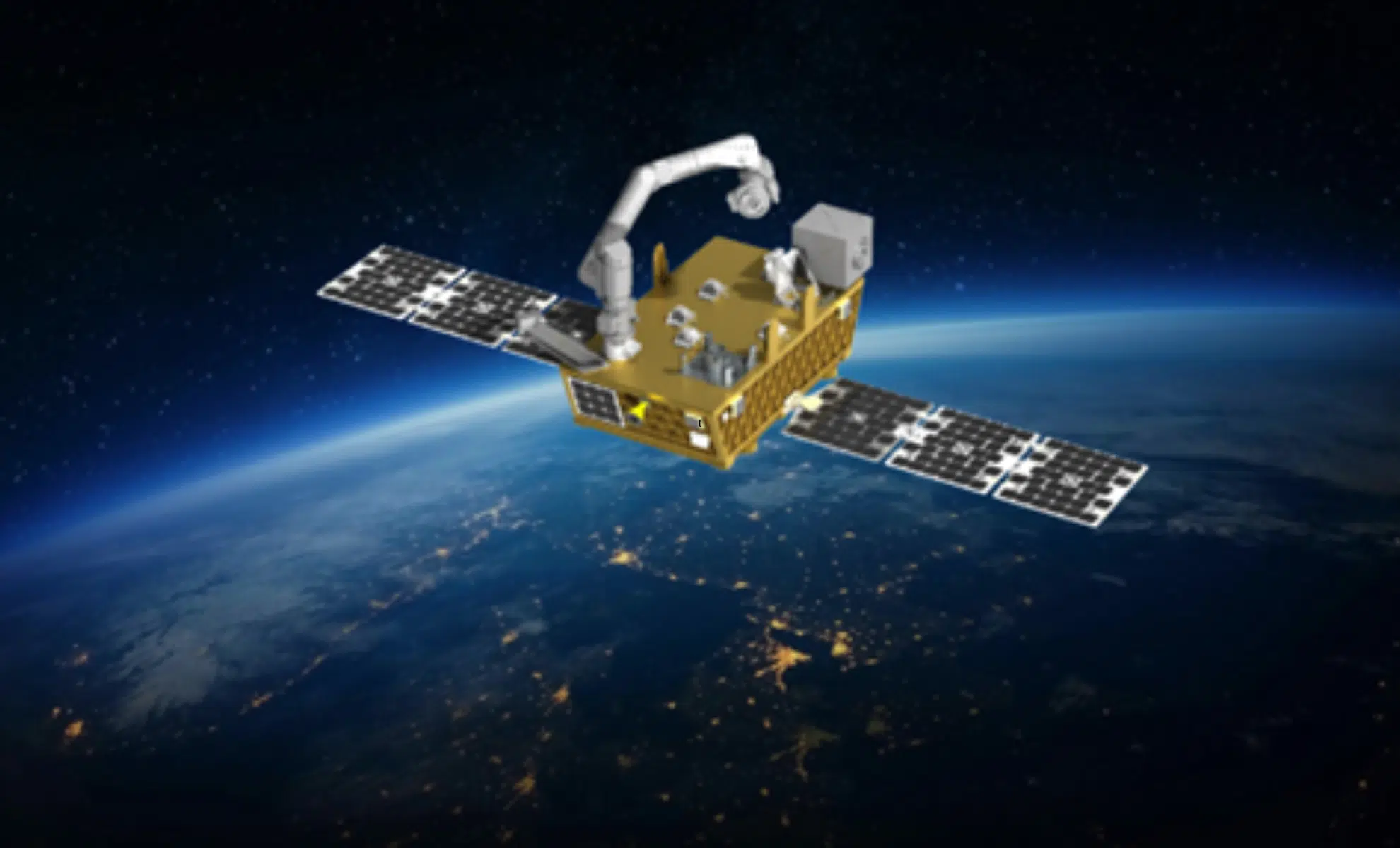 Artist concept of the FFR Mission’s robotic system payload atop the Astro Digital spacecraft. The robotic arm, provided by Motiv Space Systems, will perform robotic demonstrations in orbit. Credit: Motiv Space Systems
Transforming Space Infrastructure with Robotics
The robotic arm demonstration is just the beginning of a broader vision by NASA to transform how infrastructure is built and maintained in space. According to Bo Naasz, senior technical lead for ISAM at NASA,
“Today it’s a robotic arm demonstration, but one day these same technologies could be assembling solar arrays, refueling satellites, constructing lunar habitats, or manufacturing products that benefit life on Earth.”
The development of such technologies is expected to play an integral role in establishing a sustainable presence on the Moon and Mars. By using robotic arms to conduct delicate tasks, NASA envisions a future where human astronauts are supported by a highly capable fleet of machines, extending their capabilities and safety on distant planets. In this sense, the Fly Foundational Robots mission is much more than just a demo – it’s a stepping stone toward an entire new framework for how space missions will operate in the coming decades.
Supporting a New Era of Space Exploration
NASA’s vision extends far beyond this single demonstration mission. The development of in-space robotics is central to the agency’s long-term goals for space exploration. With a focus on sustainability, the agency is working toward the creation of autonomous systems that can assist in the construction of space stations and other structures needed for human habitation on the Moon and Mars. These technologies will also support the transportation of resources and the construction of energy infrastructures in space.
The commercial robotic arm will be a crucial element in this larger framework, showcasing its capacity for precise, repeatable tasks. As part of NASA’s broader efforts, these robots are expected to carry out a variety of tasks that humans currently perform in space, but with greater efficiency and less risk to astronauts.
NASA’s Strategy for a Dominant Space Economy
One of the most compelling aspects of NASA’s robotic missions is the agency’s strategy for building a dominant space economy. The successful demonstration of in-space robotics is expected to lead to commercial opportunities, where private companies can develop their own technologies based on NASA’s research and findings. As NASA works alongside industry partners, the mission could help catalyze a new wave of innovation in the commercial space sector.
“These foundational technologies,” said Bo Naasz, “are how we build a dominant space economy and sustained human presence on the Moon and Mars.”
This economic impact is expected to ripple out beyond just NASA and government contractors, offering vast opportunities for private space companies to take part in space missions. The new economic model for space exploration will require partnerships between government space agencies and commercial entities, resulting in a thriving, competitive marketplace for in-space services and infrastructure development.