
Mercury, often considered the “elusive planet,” is notoriously difficult to observe due to its proximity to the Sun. However, December 2025 brings a rare opportunity for skywatchers to spot this planet with the naked eye. Here’s when and how you can catch this elusive planet in the early morning sky.
Mercury’s Elusive Nature and Why It’s Hard to See
Mercury’s orbit around the Sun is relatively small, completing a full revolution in just 88 Earth days. As a result, it’s often difficult to observe since it stays close to the Sun in the sky. Unlike planets farther out like Jupiter or Mars, Mercury’s position fluctuates rapidly, appearing for short windows just before sunrise or after sunset. This fleeting visibility makes it one of the hardest planets to observe without the aid of a telescope or binoculars.
The problem is that as an “inferior planet”—meaning it orbits closer to the Sun than Earth—Mercury is often lost in the Sun’s bright glare. It never strays far from the Sun’s vicinity, rising and setting in sync with the star, so finding a good time to view it is a rare event. This December, however, presents an opportunity to see Mercury at its best.
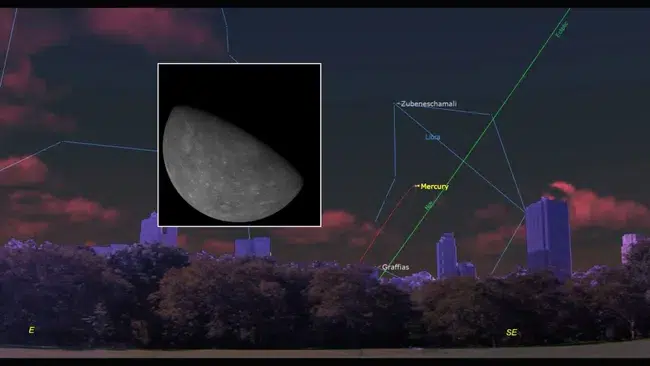 Image credit: Chris Vaughan/Starry Night
The Best Time to See Mercury: December 7
According to Space.com, the greatest elongation of Mercury happens on December 7, when the planet will be at its furthest distance from the Sun. This is when the planet is most visible to stargazers. Even though Mercury will only be 21 degrees away from the Sun, it will still be bright enough to see, shining at magnitude -0.4. This is one of the best moments to observe the planet, as it will rise almost two hours before the Sun, allowing ample time for skywatchers to spot it.
For those hoping to catch Mercury, the best time to look will be about 80 minutes before sunrise. This early viewing time ensures a darker sky, allowing Mercury to shine brightly without the interference of the rising Sun. Observers in the Northern Hemisphere will have the clearest views of the planet, making this a rare and unmissable event.
Mercury’s Brightness and Visibility
On December 7, Mercury will be at its brightest for the year, appearing as a yellowish-orange “star” in the pre-dawn sky. Unlike its usual faint appearance, this December, the planet will shine brightly enough to be visible to the naked eye. Those looking with binoculars or telescopes will also be able to view Mercury’s phases, similar to the Moon, as it shifts from a crescent to a half-illuminated shape.
The planet’s rapid movement through the sky means it won’t be visible for long, but for a few weeks in December, it will be bright enough to spot. After December 7, Mercury will slowly begin to move closer to the Sun again, making it harder to see as it fades into the Sun’s glare. Therefore, skywatchers will need to act quickly to catch it in all its glory.
The Science of Mercury’s Orbital Dance
Mercury’s proximity to the Sun plays a big part in its rapid orbital motion. It moves around the Sun faster than any other planet in our Solar System, reaching speeds of about 30 miles per second. This speed means that its position changes dramatically, and it doesn’t remain in one part of the sky for long. The orbit of Mercury is tilted slightly, so it appears to oscillate between the morning and evening sky, switching its “phase” as it orbits around the Sun.
Mercury’s closest point to the Sun, called perihelion, occurred on November 23. This marks the time when the planet is closest to our star and moving at its fastest speed. As it shifts toward its greatest elongation in early December, its visibility increases, and it grows brighter, making it the perfect time for observers to spot it.