
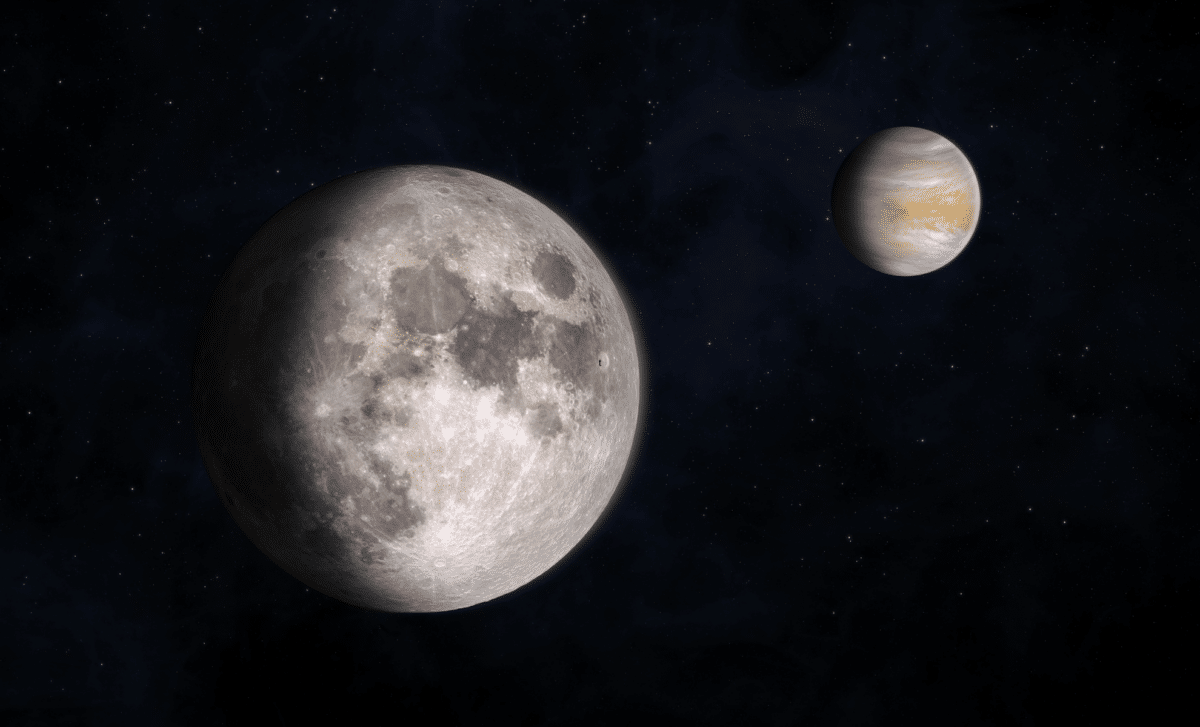
On December 7th, skywatchers are in for a treat as the Moon will travel across the sky accompanied by the brilliant planet Jupiter in a stunning conjunction. According to NASA’s skywatching tips for December 2025, this rare celestial event promises to be a highlight for stargazers. This article explores what you can expect from this phenomenon and how you can best view it.
The Moon-Jupiter Conjunction: A Celestial Show of Brightness
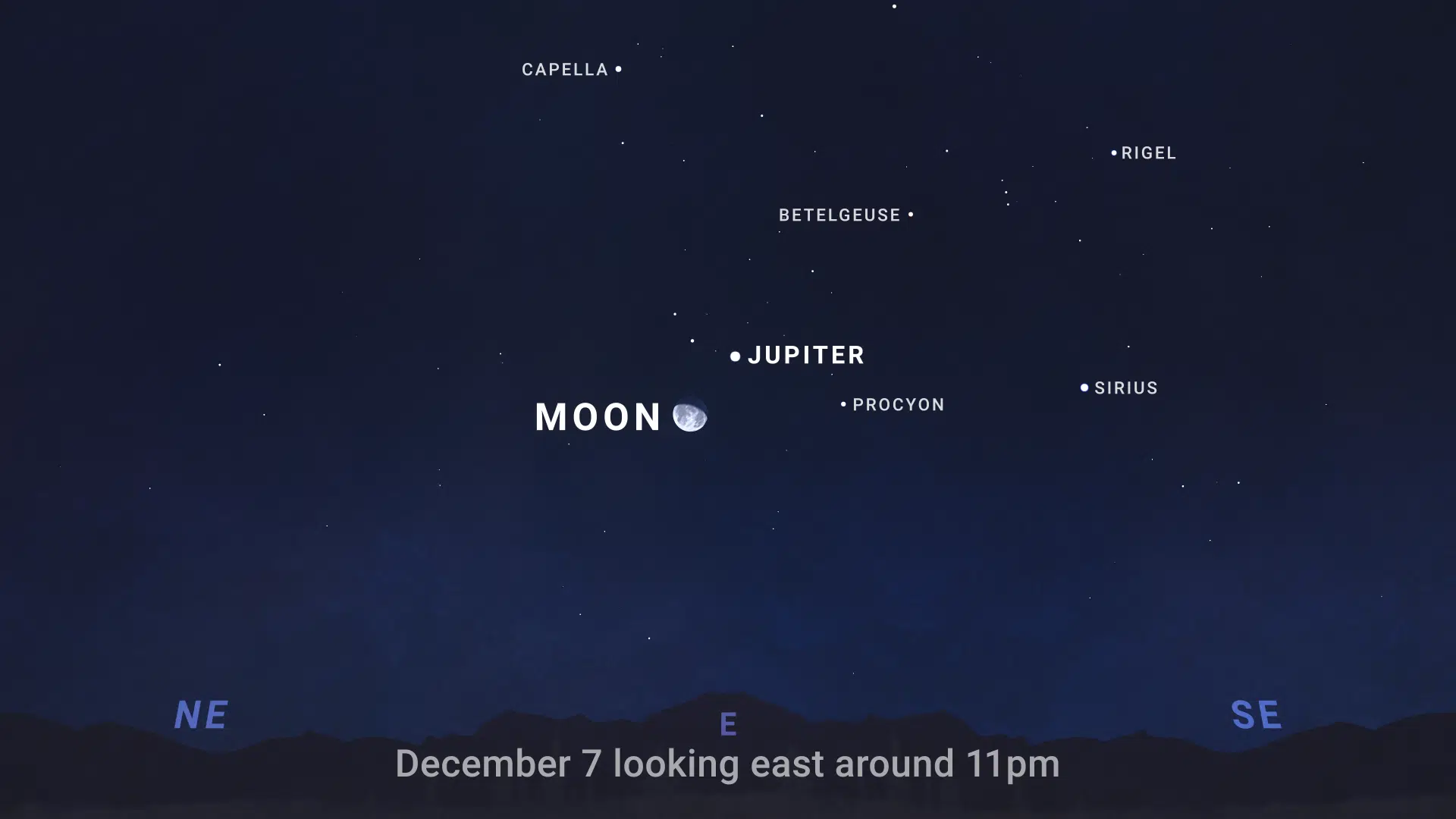
On December 7th, the night sky will present a spectacular celestial display that will capture the attention of both casual observers and seasoned astronomers alike. A conjunction occurs when two celestial bodies, in this case, the Moon and Jupiter, appear to be close to each other from our vantage point on Earth, even though they are actually separated by vast distances in space. On this particular evening, the Moon will rise in the eastern sky, gradually making its way across the heavens, with the bright planet Jupiter following closely behind.
The conjunction will be visible to the naked eye, making it an ideal event for those who do not have access to telescopes or advanced equipment. As the Moon and Jupiter move together across the sky, they will shine brightly, offering an unforgettable sight. Jupiter’s immense brightness, often outshining stars, will make it easy to spot even from the heart of a city. This celestial pairing will be visible throughout the night, offering stargazers ample time to catch the spectacle.
 NASA/JPL-Caltech
Why Does the Conjunction Happen?
Though the event may appear to be a rare alignment of the Moon and Jupiter, this phenomenon is actually quite common. Conjunctions are the result of the orbital mechanics of the Moon and Jupiter, which allow for periodic alignments. Jupiter orbits the Sun at a much slower pace than the Moon, which means that from our perspective, the Moon and Jupiter regularly come into close proximity. While this event occurs several times each year, December 7th’s conjunction is special due to the proximity and brightness of both celestial bodies on that particular night.
In astronomical terms, a conjunction like this is known as a “syzygy,” where three celestial bodies—such as the Sun, Moon, and a planet—are aligned in the sky. This December 7th event, however, is a conjunction of just two bodies: the Moon and Jupiter. Despite being millions of kilometers apart, these two bodies will appear as if they are side by side, creating a spectacular view for observers on Earth.
Viewing Tips for the Best Experience
One of the unique aspects of this conjunction is that it can be observed without any special equipment. All you need is a clear sky and a bit of patience. Whether you’re in a bustling city or a rural area, the bright light of both the Moon and Jupiter will make them easy to spot. For those with binoculars or a small telescope, there is an added bonus: you may be able to catch a glimpse of Jupiter’s Galilean moons—Io, Europa, Ganymede, and Callisto. These moons orbit Jupiter and can be seen as tiny points of light surrounding the planet.
The Moon itself will also provide an interesting sight, with its surface details visible through binoculars or telescopes. The terminator line, which is the boundary between the illuminated and shadowed parts of the Moon, will offer a dramatic view of lunar mountains and valleys. According to NASA’s skywatching guide for December 2025, even a small telescope could reveal these fascinating features of the Moon’s surface.
When and Where to See It
The Moon-Jupiter conjunction will be visible across the world, with times varying depending on your location. In the Northern Hemisphere, the conjunction will rise in the east around sunset, and both the Moon and Jupiter will be visible throughout the night. The best time to observe will be after sunset but before the Moon moves too far across the sky, making it easier to spot the two bodies next to each other.
For skywatchers in the Southern Hemisphere, the view will be similarly spectacular. However, keep in mind that the sky’s orientation and timing will differ slightly depending on your location. The Moon and Jupiter will be high in the sky by the time evening falls, making for an ideal viewing experience.