
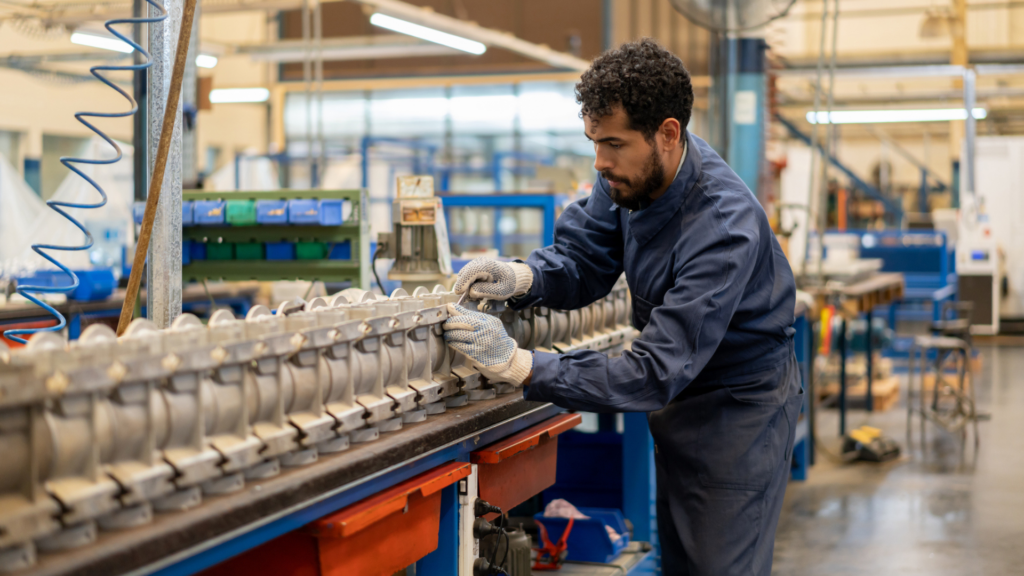
It cost US$52 million and was the “most modern of its kind, worldwide, with cutting-edge sustainable technology,” according to the official announcement. In October 2022, Whirlpool, a multinational home appliance manufacturer, opened a new washing machine factory in Pilar, Argentina. Last week, just over three years later — and two years into libertarian economist Javier Milei’s presidency — the company shut it down and fired its 220 workers.
Weeks before, Paolo Rocca, one of the country’s industrial leaders and provider of the Whirlpool factory, had warned about the situation without naming the company. At an industry event, he said that washing machine imports had risen from 5,000 to 87,000 per month and refrigerator imports from 10,000 to 80,000.
“This leads many to choose between continuing to produce or closing down and using the commercial chain to distribute imported goods,” he said.
Whirlpool’s closure is far from an anomaly. Amid a drop in consumption, import liberalization, and an exchange rate lag, Argentina’s manufacturing industry is facing a crisis that some are calling the worst in its history.
In 2024, the first year of Milei’s presidency, the industry fell by a whopping 9.2%, according to the INDEC, the government’s statistics agency. 2025 fared no better, with the manufacturing industry steadily declining year-on-year since July.
Since Milei took office, 47,000 jobs in manufacturing have been lost.
Large players made headlines in the last few days. This week, a Pacheco-based Mondelez factory, a multinational food manufacturer, suspended 2,300 workers for 21 days. Last week, Essen, an aluminum pan company founded in 1954, fired 30 workers from its factory in the town of Venado Tuerto and will start importing part of its goods from China. Three weeks ago, Mauro Sergio, a textile company from Mar del Plata that started its operations in the 70s, suspended 175 workers in a factory that employs 250 people.
“There is a political decision to move forward with opening up imports with low tariffs, and this will undoubtedly continue to affect the entire domestic industry, especially small and medium-sized enterprises (SMEs), which do not have the economic resources to carry out this transition, this transformation,” Daniel Rosato, president of Argentine SME Industrialists (IPA), told the Herald.
More imports, less production
Over his two years in the Casa Rosada, Milei took a series of measures that made it cheaper and easier for companies to import merchandise and for individuals to purchase products abroad.
He reduced tariffs and taxes on imports, increased caps, and simplified paperwork. Industry leaders complain that, meanwhile, there was no similar decision to make the Argentine industry more competitive.
Some have also pointed out that while Donald Trump, Milei’s main international ally, proposed a surge in tariffs, the libertarian economist’s administration favored their reduction or outright elimination.
Rosato said that comparatively high costs, due to the tax burden and overappreciated currency, make the country’s industry less competitive against Chinese imports. He added that the textile and the metallurgical sectors have taken the biggest toll.
According to a report by the Federation of Argentine Textile Industries (FITA), activity in the sector saw a 20.5% year-on-year drop in September 2025 — both the worst drop and the lowest level in the last decade.
Formal employment in the sector reduced to 107,000 jobs — 7,000 fewer than last year and 14,000 less than in December 2023, when Milei took office. Moreover, factories nationwide are working at 37% of their capacity.
“It’s a situation that demands reacting with clarity and pushing concrete measures in the short and medium term,” said Luis Tendlarz, FITA’s president.
FITA presented a proposal to the government that includes taking employer social security contributions as a credit against value-added tax (VAT) to encourage job formalization, further integrating the sector with the region, and monitoring import prices. However, the plan hasn’t been adopted yet.
Aldo Lo Russo, a partner in Baigorria, a 62-year-old company with 50 employees that manufactures bolts and screws used as auto parts, told the Herald that the situation is “very stressful.”
“It’s a very bad sign that the president and his officials don’t see the need to develop public policies for the industrial sector, as they did for the oil industry, the mining industry, or agriculture,” Lo Russo said.
He also highlighted that these measures are especially necessary as “the manufacturing industry represents the largest amount of employed labor.”
‘An unprecedented avalanche’
Every sector in the industry is struggling. Between January and October, toy imports saw a 60% year-on-year increase in value and 94% in volume. In a statement, the president of Argentina’s Toy Industry Chamber, Matías Furió, said that “in one year, we went from 199 to 530 toy importers, from 9 million to 17.5 million kilos imported, and with consumption falling.”
He called the situation “an unprecedented avalanche.”
“Despite [the government’s] alignment with the West, China now accounts for almost 95% of the volume imported. This is the highest concentration in the last 20 years,” he said.
Last week, the INDEC statistics institute revealed that Argentina’s economic activity increased by 0.5% in September compared to August. However, the manufacturing industry fell, and the sector with the greatest positive impact on the index was finance.
Carlos Rodríguez, who was on President Javier Milei’s team of economic advisors before the leader took office, wrote on X that “productive Argentina lags far behind financial Argentina,” adding, “That’s no way to build a country.”