
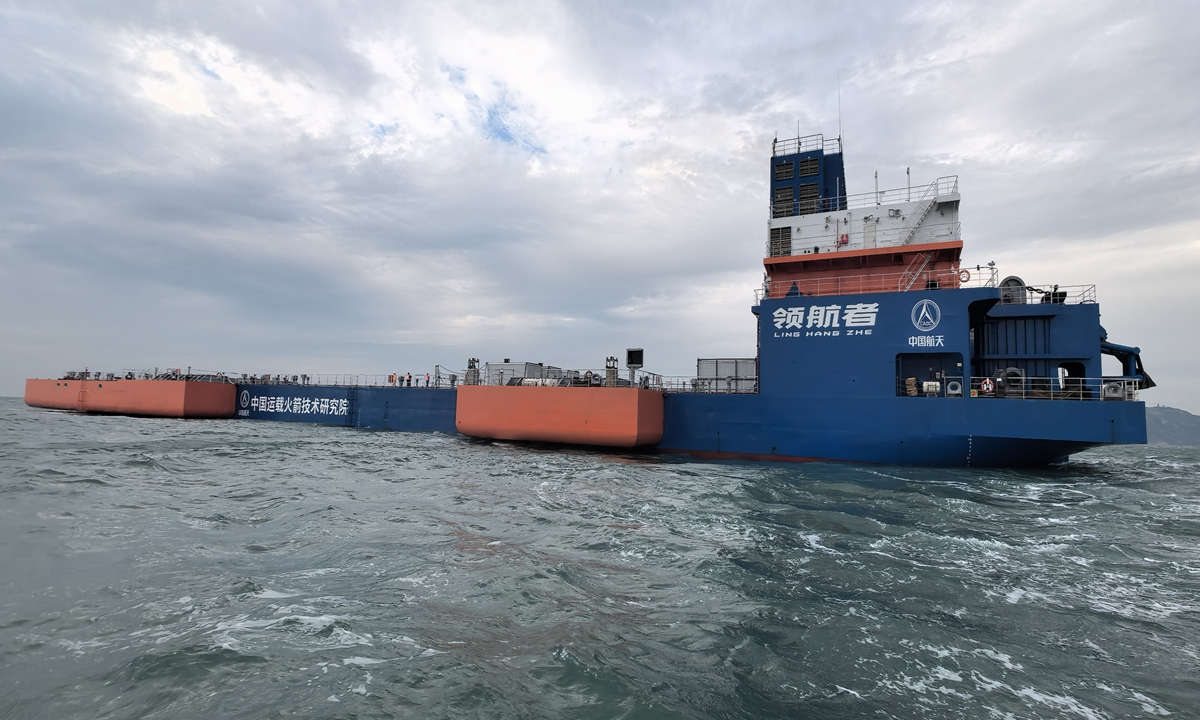
The Ling Hang Zhe rocket net recovery platform Photo: Courtesy of CALT
China’s first sea-based platform dedicated to rocket net recovery was recently delivered. According to its developer the China Academy of Launch Vehicle Technology (CALT), it marked the completion of a crucial link in the reusable launch vehicle technology chain, advancing its transition from technological verification to engineering application.
CALT,the leading rocket designer and manufacturer under the state-owned space giant China Aerospace Science and Technology Corp (CASC), highlighted in a release over the milestone event that the offshore platform, codenamed Ling Hang Zhe (meaning pioneer or navigator), “represents another important step in advancing the development of China’s manned space-ground transportation system.” CALT said the platform will further promote the “dual improvement” in the efficiency and effectiveness of key technologies for the sea-based recovery of reusable launch vehicles and strongly safeguard China’s core competitiveness in cutting-edge fields such as rapid launch and low-cost access to space, the CALT said.
In September, the country’s new-generation manned carrier rocket Long March-10 successfully conducted a second static fire test, Xinhua reported. The tests aimed to verify the performance of the rocket’s first-stage propulsion system and to verify its recovery and reuse capabilities.
The Long March-10 carrier rocket series is developed to serve China’s manned lunar exploration missions, which are scheduled to begin before 2030.
When asked to explain rocket net recovery technology, Xu Xuelei of CASC told the Global Times on Tuesday that at present, the world’s mainstream rocket recovery technology adopts the vertical take-off and landing (VTOL) recovery mode. Compared with expendable rockets, it is equipped with additional grid fins and landing legs. The grid fins deploy during the re-entry phase to precisely control the attitude and landing point of the rocket; the landing legs deploy just before touching the ground to achieve a smooth soft landing.
Xu explained that net recovery is a type of VTOL recovery method and works similarly to the arresting-cable system used when carrier-based aircraft land on an aircraft carrier.
The difference, he said, is that recovering a vertically landing rocket requires setting arresting cables at a specific altitude. When the rocket descends to a specific altitude, the hooks installed on the rocket will catch onto cables, thereby completing the capture and recovery process.
Xu noted that through close collaboration between this system and the rocket’s on-board recovery device improves the success rate of capture and buffering. This includes frequent interactions between the recovery vessel and the rocket to enable the rocket to locate the vessel; the implementation of multiple shutdown strategies for the rocket to ensure the relative geometric relationship between the hooks and the net surface; and the matching of multiple damping characteristics between the on-board hooks and the buffer cables, buffer cylinders, among others, so as to achieve a smooth connection of the rocket.
Compared with the current mainstream recovery mode, net recovery is more forgiving of landing requirements, Xu said. This is mainly because when the rocket is connected to the net, most of its kinetic energy and potential energy are absorbed by the ground buffer mechanism, which significantly reduces the design requirements for the onboard buffer structure.
The recovery system is also highly adaptable to landing-point deviations, Xu said. It can adapt to a wider range of landing point deviations by simply and efficiently adjusting the size and scale of the ground equipment, which in turn reduces the thrust-adjustment requirements on the rocket engine, the CASC expert said.
In the current mainstream recovery mode, devices such as landing legs need to be customized for the rocket and fly with it. However, the net recovery system helps simplify the rocket structure and improve efficiency and effectiveness. Through serialized design of certain parameters, the system can also accommodate rockets of different sizes, he said.
According to CALT, Ling Hang Zhe is China’s first sea-based rocket recovery platform to obtain classification-society registration and certification to be officially delivered. The vessel has a length of 144 meters, an outer width of 50 meters, a draft of 5.5 meters, and a full-load displacement of 25,000 tons, and is equipped with DP2 dynamic positioning capability.