
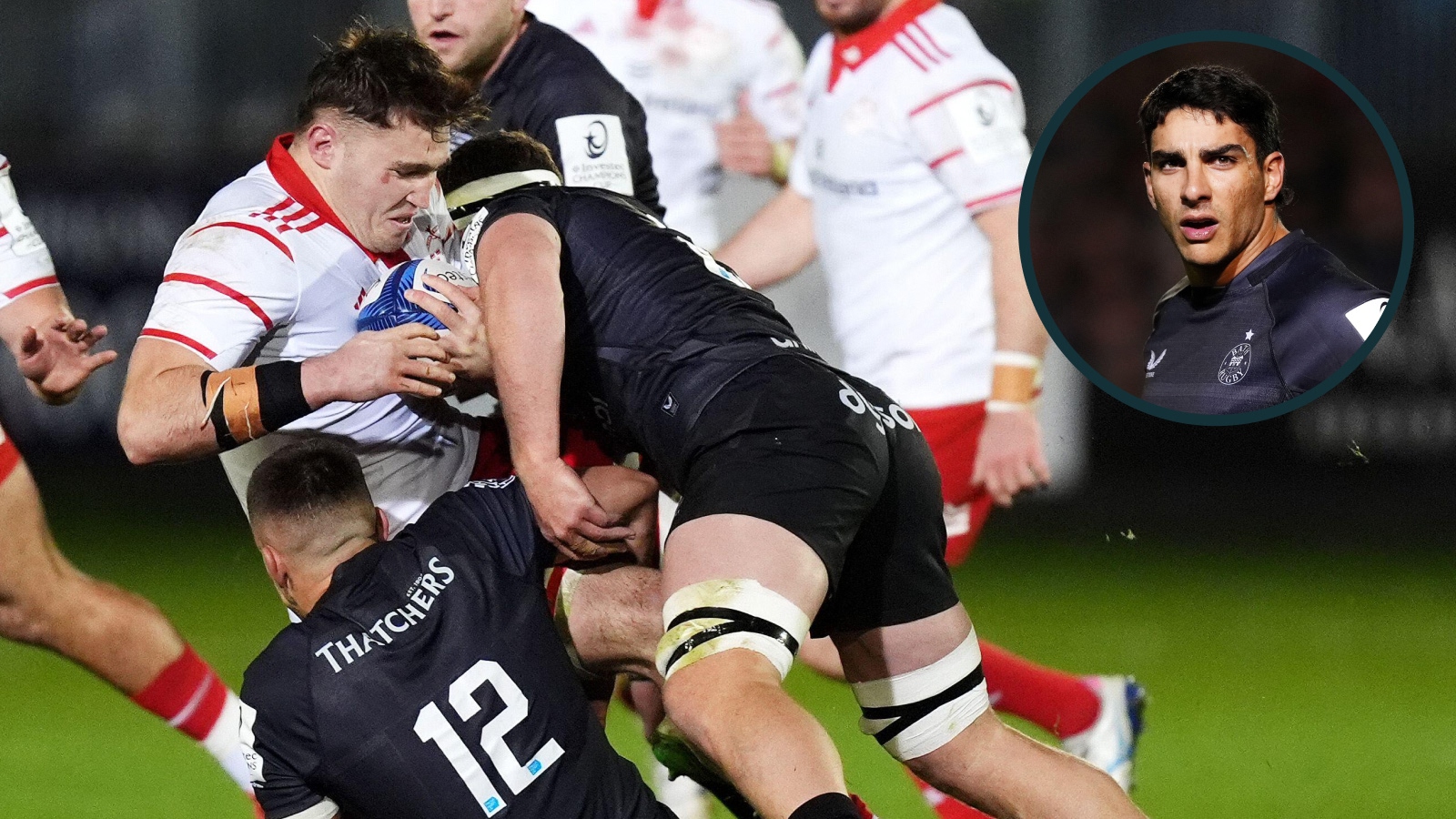
Bath defeated Munster 40-14 in a confident display at the Recreation Ground on Saturday, in their opening match of this year’s Investec Champions Cup.
Here are our five takeaways from the match:
The top line
Torrential rain lashed The Rec, but Bath lit up the gloom with a blistering opening salvo that stunned Munster and set the tone for a statement win. Inside 19 minutes, the hosts had raced to 28 points, powered by ruthless efficiency and Finn Russell’s orchestration in the wet. A penalty try opened the floodgates before Miles Reid crashed over, Henry Arundell finished wide, and Tom Dunn drove through from close range – all converted by Russell with metronomic calm.
Munster, shell-shocked yet stubborn, clawed back through Edwin Edogbo’s score and JJ Hanrahan’s extras, then threatened again when Craig Casey darted over to make it 28-14. But Beno Obano’s muscular finish before the break killed any Irish resurgence, restoring Bath’s grip on a contest they refused to loosen.
The second half was attritional, Munster hogging possession and territory yet finding no way through Bath’s defensive wall. Ted Hill’s late try added gloss to a performance built on ferocity without the ball and precision when chances came. Six tries in a storm, 40 points against a side famed for their grit – this was Bath announcing themselves as serious contenders in Europe, and doing it with a swagger that defied the downpour.
Beirne yellow turns game
In a contest already leaning Bath’s way, Tadhg Beirne’s yellow card was the tipping point that turned pressure into punishment. His infringement at the maul – collapsing under Bath’s relentless drive – gifted the hosts a penalty try and a man advantage at the worst possible time, adding unexpected oxygen to Bath’s fire.
The timing could not have been more brutal. Torrential rain hammering down, Munster pinned deep, and Bath smelling blood. Reduced to 14, Munster’s defensive shape fractured, their lineout wobbled, and Bath exploited every inch. Reid’s try followed almost immediately, then Arundell streaked in wide, gassing all to chase down a speculative kick, and Dunn, predictably, the man of mud and blood, finished from close range. In the space of Beirne’s absence, Bath stacked 21 unanswered points, ripping the contest from Munster’s grasp before it had even settled.
Beirne returned to restore parity, but the damage was irreparable. Munster chased shadows thereafter, their possession and territory dominance rendered meaningless against a scoreboard screaming 28-0. They had 63% of the ball and 67% territory across the match, yet never recovered from that ten-minute implosion. In European rugby, big moments matter and this was the moment. A single lapse, a single card, and a side famed for resilience was left chasing a game that had already gone. Bath didn’t just punish their hosts; like the impressive side they are, they buried Munster in that window, and Beirne’s absence will haunt their review.
The ‘genuinely freakish’ talent England greats claim is a ‘cheat code’
The nines and the engine room
In a game dominated by set pieces and storm-soaked collisions, both scrum-halves were outstanding in contrasting ways. Ben Spencer was Bath’s metronome, his box-kicking immaculate under pressure, pinning Munster deep and forcing them to play from areas they didn’t want to. His tempo control was razor-sharp; quick ball when Bath sniffed space, slow and structured when the rain demanded pragmatism. Spencer’s ability to marry speed with precision gave Russell the platform to dictate, and Bath’s attack thrived on that rhythm.
Craig Casey, for Munster, was a livewire, nothing better illustrated by his dart for their second try – pure scrum halves’ instinct, and his energy around the fringes kept Bath honest even as the scoreboard screamed trouble. Casey’s urgency injected life into Munster’s possession-heavy game, but without dominance up front, his spark flickered rather than burned.
That dominance belonged to Bath’s set-piece and back row. The scrum was rock-solid, the maul destructive, and the lineout clinical after early Munster wobbles. Obano and Dunn were relentless, while Hill and Reid hunted breakdowns with ferocity, turning Munster’s 63% possession into empty calories. Bath’s back row suffocated, hammering carriers and forcing errors in the wet, a hallmark Rec performance in hallmark Rec rain. Every turnover felt like a dagger, every carry a statement. In conditions that demanded muscle and on-the-floor precision, Bath’s pack delivered both, and their halfbacks turned that grunt into gold with a pinpoint aerial assault.
Scrum power and Stuart’s blow
Bath’s scrum was a weapon all night, and nowhere was that dominance clearer than Obano’s demolition job on John Ryan. One surge in the first half summed it up: Obano hit, chased, and lifted Ryan clean out of the contest – “gave him his wings” as the old front-row saying goes. In conditions where every metre mattered, that moment was more than theatre; it was psychologically and reputationally crippling. Munster’s platform cracked as Bath’s confidence soared, and the penalty count mounted as the visitors scrambled to contain a set-piece that refused to yield.
Behind that power sat a pack brimming with intent. Dunn’s accuracy, Obano’s torque, and Will Stuart’s anchor role gave Bath a launchpad for everything that followed, and when they went off, so Thomas du Toit and Francois van Wyk simply gave Munster more of the same, with du Toit in sparking form. Which makes Stuart’s injury all the more significant; a ruptured Achilles is cruel in any context, but for Bath and England it’s seismic. Stuart has become the cornerstone of both scrums, a Lion and a technician with the grunt to match, and his absence will stretch depth charts to breaking point. For Bath, chasing Europe, it’s a hole that changes their season; for England, with a Six Nations looming, it’s a tactical headache that Steve Borthwick could do without. Obano stole the headlines, but Stuart’s loss may prove the bigger story.
What’s next and what it means
Bath’s win launches them to the front of Pool 2 and sets up a fascinating run of fixtures. Toulon at Stade Félix Mayol comes first on December 14, a clash that pits Bath’s power game against French muscle in one of Europe’s toughest arenas. Castres away follows on January 9, before Edinburgh return to The Rec on January 16 in a rematch of last season’s Challenge Cup semi-final. Munster’s route is equally compelling: Gloucester at Páirc Uí Chaoimh, then Toulon and Castres in back-to-back tests of resolve.
The outlook is clear. Bath have momentum, two home games still to come, and a realistic shot at a top seeding. Bonus points are in play, and knockout rugby is firmly within reach. Munster remain in the mix, but their path demands precision, luck and big performances in hostile territory.
Beyond the numbers, this was a statement of intent. Bath’s Challenge Cup triumph last season ended a 17-year European drought and sparked a domestic surge. That was the second tier. This is the summit. 40 points in a storm against Munster’s pedigree signals Bath’s arrival among Europe’s elite. They’ve set the standard, and the campaign ahead promises more of the same.
READ MORE: Leinster sweat over RG Snyman and Ireland duo while Caelan Doris issues Reiko Ioane verdict