
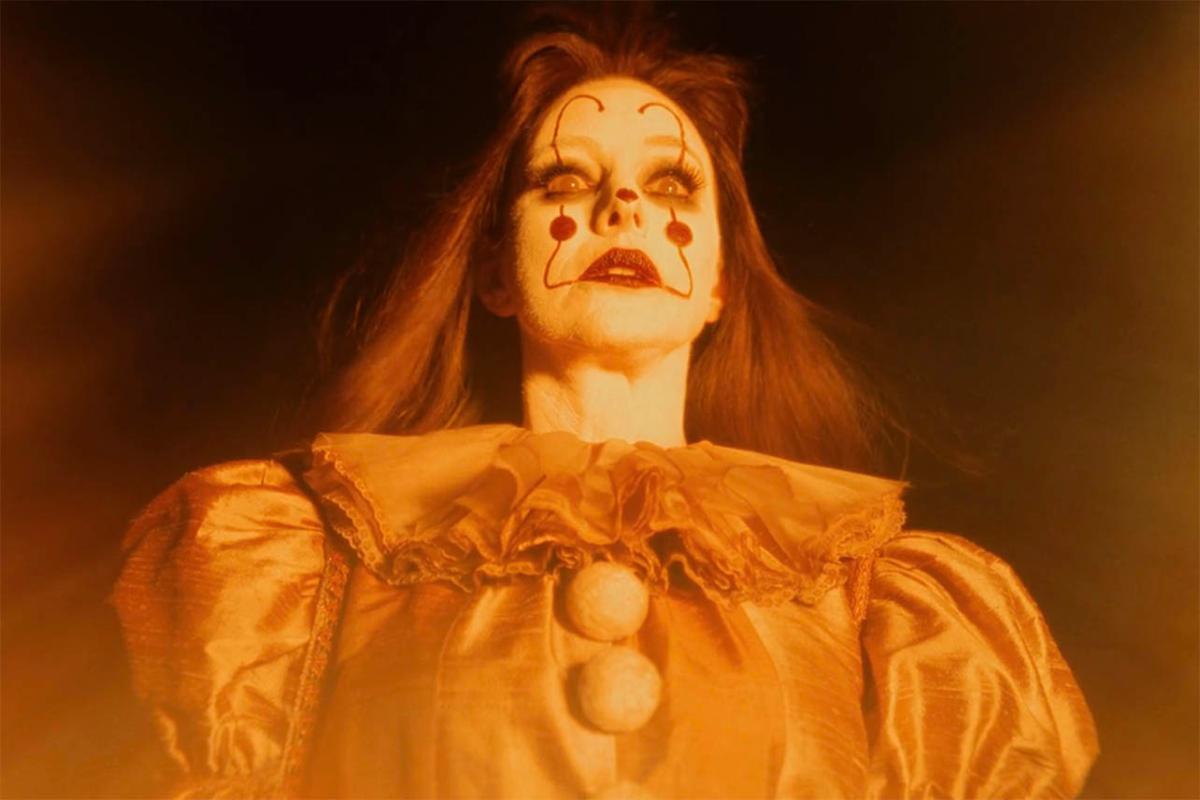
Our penultimate trip to Derry—for this season of IT: Welcome To Derry, at least—starts back in 1908 with Pennywise’s origin story, right off the rip. Turns out Robert “Bob” Gray is a clown kids actually like, one they laugh at, one who has a whole fancy act that appears, size-wise, to be one of this carnival’s biggest attractions. He takes the stage with a huge smile and tries plucking some disappearing flowers, children giggling every time he fails. Balding Bob’s makeup is familiar, although he’s got a bandage instead of an actual painted forehead, and what’s left of his brown hair pokes out from under his orange wig.
Gray’s grief for his wife and partner in clownery becomes the thrust of his show. He breaks down over her deathbed, dances with her empty costume, and weeps at her grave. Not the most kid-friendly journey, but that’s of little concern, since it wraps with the moment they’ve all been waiting for: rush the stage as Pennywise the Dancing Clown starts his jig. (Andy Muschietti—who directs these final two episodes after helming the first two—is back in his 1908 cameo role as a smoking musician.) The youngsters imitate Bob’s moves and try stealing his wig. In a shot reminiscent of HBO’s adaptation of Stephen King’s The Outsider, a strange boy watches intently from afar.
In the evening, Bob’s in his quarters working on his makeup, similarly to the Gray vision the monster gave Bev in IT: Chapter Two—he’s got less hair here, but the same hunched stance, forehead vein, and old-timey voice. Ingrid, established last week as his daughter, debuts her clown getup for a proud papa, who heralds “the first father and daughter act” in the carnival’s history, “the Pennywise and Periwinkle Show.” Ingrid takes pause at the name—Periwinkle was her mother’s stage moniker—but says she loves it. Bob admits he misses the large crowds of the circus; the carnival has evidently been a downgrade. “One day, the big tent will come a-calling’ again, you’ll see,” he says, excited that Periwinkle will add an element “no one’s ever seen before.” The love between them is sweet; you can see why she misses her father, whom she admired so much, in the present timeline. “I wish you could hear the way they talk about you, papa—papa, you make them so happy,” she says of his young fans.
Smoking and drinking by his lonesome as he steels himself for the night show, Bob is approached by It in the form of the boy who watched his act from the barn. Last week Ingrid referenced “that awful day” she lost her dad, and it seemed like something we’d have to wait a season or two to see. Nope! “The children seem drawn to you,” the kid says in an odd voice that sounds unaccustomed to speaking. Bob gruffly declines to help the boy, who can’t find his parents. “Me neither—they’re dead,” Gray grumbles. A shriek comes from the woods, and the untroubled little urchin says it’s his mother. Bob decides he’ll take a look after all, and the kid takes his hand.
This, we can assume, was Bob Gray’s last act in life. His bloody handkerchief is discovered, and the carnival barker is honest with Ingrid about the likely tragedy. “Wolves, maybe?” he guesses. “They roam these parts.” We fade out with an iris wipe—that Looney Tunes staple—on Ingrid’s devastated face.
Unfortunately we can’t stay in 1908 and ponder the mysteries of Pennywise forever, because the tragedy and horror of the Black Spot awaits. Last week the white mob drove up to the spruced-up requisition shed with their plastic monster masks and guns and the credits rolled. This time, five waltz their smug asses inside, weapons psychotically aimed and ready, and demand the revelers give them Hank Grogan. “You hand him over and you can get back to your party,” says newly ousted police chief Clint Bowers, leading the pack. Hank—who promised his daughter they’d never be separated again—volunteers himself as Ronnie screams in protest. He’s unwilling to see blood spilled in his name. “I’ll go, just leave these good people alone,” Hank says.
Jax, one of the airmen we’ve seen spending time with Hallorann this season, holds Hank back, trying to protect him from being lynched and ultimately making Grogan’s decision for him. The servicemen making up the majority of this opening night party at the Black Spot are forced to point their own firearms back—these are five consequence-free men with evil intent, backed by a bunch more outside, and there are four children standing right there. The situation is fucked. Jax unflappably says, “Now would you look at that? We got guns, too. Ours just happen to be government issue.”
Bowers orders his men to put their weapons down, acting like he’s realized “this isn’t the way.” Within seconds of the posse exiting, they’ve chained the door shut and cut the power. They were never going to just walk away. They can act like they only want Hank, a wrongfully accused man, and to protect their children, which they’re actively not doing. But Bowers, butcher/abusive husband Stan Kersh, Mr. “This Ain’t America, This Is Derry,” and their brethren—these men were never leaving without blood.
Before anyone’s got a chance to do a single thing, bullets and molotov cocktails are flying inside. Various military men try firing back through the windows and are mercilessly gunned down, along with unarmed women. It’s relentlessly violent and deeply upsetting, and offers zero respite, starting as a three-minute one-take. (Or, as is often the case, the convincing appearance of a oner.) Hank tries to protect the kids in the middle of the chaos.
Dick pointed out Chekhov’s rotten floorboards last week, telling the guys to fix the leaky fridge. Now he’s got an escape hatch for the very few souls who’ll make it out alive. He’s distracted by his shine, which reveals the ancient Sqoteawapskot war chief Sesqui, and he calls out to her. Last week he told Leroy if he doesn’t speak to the ghosts, they ignore him, but if Hallorann acknowledges them, “the voices, they don’t ever stop.”
Then Pennywise is back, with an even bigger bang than his long-delayed return in episode five. Fans have wondered if It’s big black bird form would hover over the chaos here like it did in the novel. No, no, no: the clown’s in town, and he’s not sharing the spotlight tonight. He dances over to a woman gasping for air, using the exact same strut Bob Gray took the stage with. Ronnie discovers him devouring the woman’s head, and we get the clunker, “What’s the matter? Do I have face on my face?” Dick catches up to Ronnie, and now they’re both staring down Pennywise, who has a big giggle at the fact that Hallorann’s also facing a crowd of ghosts zombie-walking toward him. He begs Sesqui to help him find the other kids and is able to get Hank, Ronnie, and Will out.
Margie and Rich have to fend for themselves when the ceiling starts collapsing. They see a tipped-over fridge and Rich pretends it’s salvation for them both. “Let’s get in here, it’s the only way we’re gonna make it out,” he insists. Margie only realizes there’s not enough room once she’s inside, and panics when she sees Rich’s final meaningful look. He lays on the door to keep her in, and tries to share some of his calm acceptance with her. He hearkens back to Margie comparing him to a knight protecting fair maidens, then to the first time he saw her, how beautiful she looked. The way Arian S. Cartaya softly kisses the fridge, the way a weeping Matilda Lawler says she loves him—these kids truly met the moment. (Which, for me at least, is giving end-of-Titanic, thanks especially to the ethereal music.)
The homicidal white devils outside—Phil and Suzie’s dad among them—decide to leave after getting their fill of watching people burn alive and scream for their lives. Stanley is left behind when his car won’t start. Could his wife have run some sabotage, the same way she set this massacre in motion with an anonymous tip to Bowers? Not sure, but Ingrid’s here either way, back in her jingly Periwinkle costume, pointy white wig, and mime-ish makeup, down to the little heart on her nose. She tells Mr. Kersh this is the real her, and he can’t believe his eyes, ordering her home with threats of a beating.
Pennywise pops up once again, wielding a cleaver the size of a MacBook. And then, something brand new in the horror genre: the clown grabs Stanley by the bit of hair he’s got left, cleaves his head straight across the middle, and sinks his teeth into the butcher’s bisected noggin. Fuck! Ingrid watches in a daze, trying to square this hungry beast with her papa. She says she knew he wouldn’t be able to resist the feast of “blood and pain and fear,” that he’d come back and “tell me that I was good.” In a 1908 callback, he commands, “Show me the bow.” Ingrid does, including the toot on her horn, and goes in for an embrace.
Pennywise drools over her shoulder but pointedly doesn’t eat her. There’s something unique happening here, a successor to the 1935 moment when he realized Ingrid thinks he’s her actual dad, sensing all the fun he could have with this. He seems to enjoy the novelty of parroting her father’s lines, and even the hug. “You did good—you did very, very good. Now, I’m going to sleep,” he says.
“Don’t leave me, please, no, don’t abandon me!” begs a shocked Ingrid. A slow turn of his gore-streaked face finally rams it home for Mrs. Kersh: this is not Bob Gray. “I’m Pennywise, your dancing daddy!” he chirps, then admits he ate old Bob. “But he still lives inside of me!” Ingrid hears one final “come to papa” and the monster’s head unfolds to reveal the eldritch deadlights swirling inside, sending Periwinkle floating into the air. Pennywise is probably scarier here than he’s ever been, not just what he’s doing and how he’s doing it, but where he’s doing it—in the middle of a racist massacre of innocents.
In the charred aftermath, a fireman gets Margie out of the fridge and inexplicably walks away while she goes to Rich’s dead body, sitting upright, eyes open—a disturbing sight. Ronnie and Will show up to mourn beside her. It’s immensely heavy, and our boy Rich deserved to live. We’ll get multiple scenes of the kids processing Rich’s death, but hardly anything for the Black men and women among at least 23—twenty-three!—murdered that night.
Day has broken by the time Leroy and Charlotte Hanlon arrive to be with Will—what’s going on there? Leroy gets one thought in—“you could’ve gotten yourself killed”—before walking away to answer Colonel Fuller. Some of these characters’ choices make very little sense right now. Hallorann, struggling to hold onto his sanity as he’s swarmed by whispering ghosts, tells Hanlon and Fuller that It’s gone to sleep, but Sesqui can still point them to one of the pillars.
A Derry radio broadcast immediately whitewashes the unforgivable crime at the Black Spot, quoting the fire department’s claim that an electrical fire happened at “an illegal colored speakeasy.” The DJ blathers, “The blaze claimed scores of lives, among them the Negro patrons responsible for the the tragedy, along with several citizens who showed up to help treat the wounded—including beloved local butcher Stanley Kersh.” Fucking hell. Charlotte planted Hank’s clothes in the wreckage and he’s been taken for dead.
At a Sqoteawapskot Tribe meeting, a somber Rose says “the Augury has passed, It’s feeding cycle is complete, It sleeps.” We learn that 17 children died this time. Just think what this portends for the next two seasons, recalling that a former meeting described 1962’s cycle as “a lot milder than ’35 and ’08.” The woman previously described as the tribe’s “prospective keeper” is desolate, saying that standing by and watching “feels wrong.” Rose tells her, “We do as much as we can, for as many as we can. Focus on the lives saved, the ones protected because we keep this thing in its cage.” There’s a token effort to depict despair and heartbreak among the indigenous folks, but the script doesn’t do enough.
Leroy helps Charlotte figure out how to get Hank out of town safely, telling her to give Grogan one of his uniforms and take him to their house in town. “Leroy, whoever did this needs to pay. How are you so calm?” Charlotte says through tears. “People have died. Our son saw dead bodies, Leroy.” He tells her after the mission’s over, “we take our family and get out of this town, to safety. The worst of all this shit is behind us, I promise you.”
Will asks his mom if he can join Ronnie and Margie in telling Lilly about Rich’s death. She says whether “the thing” is asleep or not, he needs to stay safe in the house. “It wasn’t that thing that lit the fire last night—this town is the monster!” Charlotte says. She and Hank drive to Rose’s; Charlotte has friends in Montreal, and Rose is willing to help.
We find Lilly looking haggard and gripping the magic dagger as she sits on her bed, staring into space. Ronnie and Margie deliver the crushing news about Rich, and they head to the standpipe clubhouse to box up his things. These three girls are still giving some of the best performances on IT: Welcome to Derry.
The military finally finds a pillar, the one buried in the turtle shell, and Fuller tells Leroy to stand down, claiming they’ve got time to analyze the artifact’s properties. Just as I’m getting all worked up to say they can’t analyze the power of belief, we see they don’t give a damn about that. They’re gonna melt it. Just when we think they couldn’t possibly be any dumber, they go and do something like this and totally outdo themselves. Major Hanlon levels his pistol at everyone involved—also dumb!—and orders them to stop, which they do, but not without pointing a bunch of their own guns back.
General Shaw orders his men to cut the shit and calls in Hanlon to hit him with a final truth bomb: Operation Precept isn’t even about beating Russia in the Cold War—it’s about stopping “anarchy” in America? This doesn’t change the Derry Air Force contingent’s level of stupidity and hubris, but it does exceed the original plan’s cruelty and nihilism. Here’s Shaw’s speech, not because it’s the most sterling writing, but because this insanity deserves to be inspected in full:
“The greatest threat to this nation is not from without, Major. It’s from within. You see what’s happening out there, Leroy—Americans are at each other’s throats, and it’s only getting worse. Anti-nuke crazies, the women’s movement, race riots: this country is slowly fracturing into a thousand jagged, ill-fitting pieces. I am only trying to prevent another civil war. Americans have stopped hearing one another. They only want to fight over who gets which piece of the damn pie while the rest of the world eats us alive. And the one thing that makes people really listen is fear. … Look at this town. What happened last night, horrific. But guess what? The streets are calm today. No rioting, no looting, no unrest. The fear—it settles on every living person it touches like a fog, like a goddamn anesthetic.”
Shaw orders the pillar to be melted, and chillingly tells the “hero” Hanlon his work “may very well have saved this country.”
The entity is indeed resting, as the clown, in a pool of blood and bodies and organs. Did it forget it doesn’t need a costume anymore? Composer Benjamin Wallfisch does one of his creepiest moves here, a cacophony of singsongy voices crescendoing to screams as we settle on Pennywise’s face. It’s eyes open; the work’s not done.
It places a call to Will in the guise of Ronnie. Our guy realizes he’s talking to the monster as the friendly voice starts luxuriating in the details of Rich’s death and how It can “smell his stinky, little, broken boy body.” Will fights back, shouting that he’s “done being scared.” Unfortunately Pennywise is right behind him, drenched in blood, and the toothy maw of the deadlights opens again, binding Will.
QUESTION CORNER
Why would Dick willingly go to the Overlook, a place of murders and ghosts? Suddenly I really want them to get back to work on that tabled, Hallorann-centric Overlook show.
The Black Spot has been burned and we’ve got a full episode left. Could we visit the future in the finale, return to some of our 1989/2016 Losers?
Is “Happy-Go-Lucky-Me” by Paul Evans one of the creepiest confectionary songs we’ve gotten in the show? Especially since it’s heard alongside the radio broadcast completely writing the Black Spot massacre out of history in real time.
STEPHEN KING TRIVIA CORNER
Clint Bowers says, “Give us what we want, and we go away.” In 1999’s Storm of the Century, villain Andre Linoge famously says, “Give me what I want, and I’ll go away.” (Hat-tip to The Year of Underrated Stephen King‘s Kim C, co-hosting Kingslingers, for that one.)
In the 1986 novel, Mike Hanlon’s father recounts the story of the Black Spot, which actually had “two hundred people there, maybe three,” and resulted in the death of about 80 people. Rather than a lynch mob looking for a wrongfully accused murderer, the establishment was burned by the fictional “Legion of White Decency” out of pure hatred. Here’s the lowdown:
Rich saves Margie’s life with a fridge. In the novel, refrigerators are never a good thing—a dead friend’s head pops out of one, and the sociopathic teenager Patrick Hockstetter uses one to torture animals before his own doom comes out in the form of flying murder-leeches.
Zach Dionne is a Mainer writing in Tennessee; he makes Stephen King things on Patreon.