
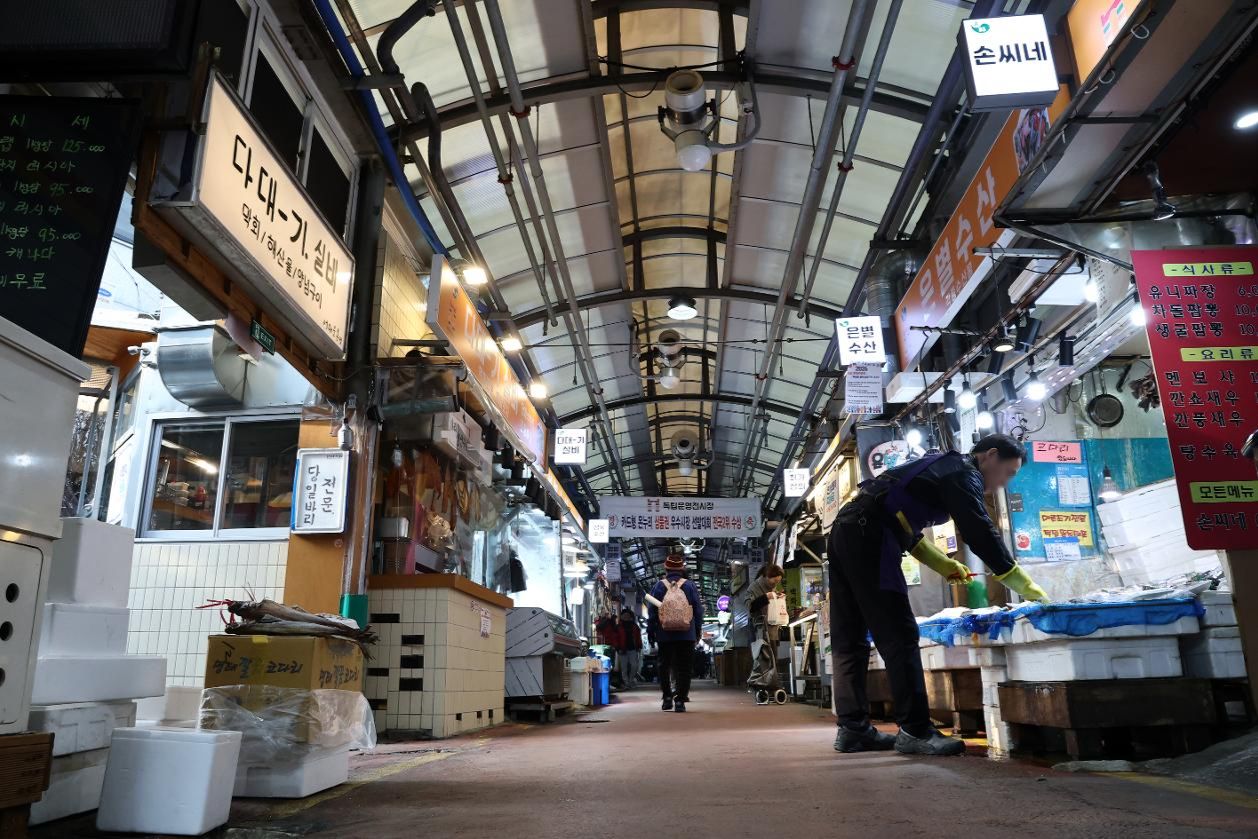
A traditional market in Seoul / Yonhap
Kim Mee-jin, 35, a part-time cashier and mother of two, said she is afraid to go grocery shopping these days.
“Imported beef and even frozen chicken have become more expensive,” she said. “I try to buy whatever is on sale, but even those prices are rising. My children ask why we don’t have their favorite meals as often. I don’t want them to feel the pressure, but I worry every time I go to the mall.”
Both she and her husband work, but the cost of living keeps rising, and she is constantly worried about how to spend her money and what expenses are truly necessary.
“When prices of everyday items like food go up, I feel the pinch.”
Similarly, Jun In-soo, 46, a delivery worker, stated that his paycheck has decreased while the cost of living has risen.
“I used to make just enough to cover rent and food, but recently my hours were cut,” he said. “My income dropped, and rice, vegetables, even instant noodles cost more every month. I’m working the same job, but it feels like I’m finding it harder every day, no matter how hard I try.”
He is particularly concerned about the gas bill this winter.
“I heard on the news that the Korean currency is weakening, and heating costs are expected to go up due to rising import costs. I turn the heating on only at night for a few hours. I hope this winter has fewer cold snaps,” Jun said.
Kim and Jun represent just two of the many vulnerable households in Korea struggling under mounting financial pressures amid widening income inequality and rising inflation.
Data from the Ministry of Data and Statistics showed that earned income for the lowest 20 percent of households declined last year for the first time in five years.
The annual average earned income for these households fell 1.3 percent, reaching 4.01 million won ($2,700).
This contrasts sharply with the top 20 percent, whose earned income rose 3.7 percent to more than 120 million won per year.
The top 20 percent of households earned 30 times more than the bottom 20 percent, with the figure increasing for the second consecutive year.
Total income for the top 20 percent of households rose 4.4 percent, outpacing the nationwide average.
However, the bottom 20 percent saw only a 3.1 percent increase, supported primarily by public transfer payments — government cash handouts or vouchers — rather than income from labor or business.
Asset inequality also reached a record high.
The top 20 percent now hold assets about 68 times larger than those of the bottom 20 percent.
About 40 percent of spending by low-income households went to essential items such as food, housing, and utilities — double the amount spent by top-income households.
Prices of imported food, electricity and gas continue to climb.
Prices of agricultural and seafood products rose 5.6 percent last month. Petrochemical product prices have also increased 2.1 percent so far this year, reversing declines over the past two years.