
Illustration: Olivier Heiligers
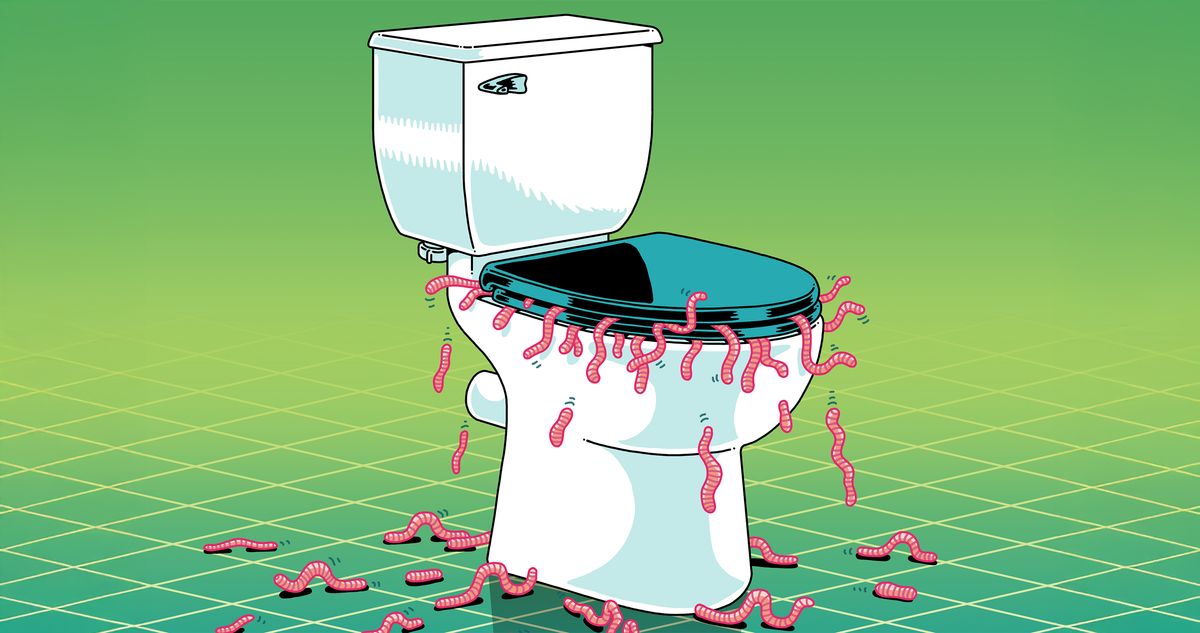
How many photos of human excrement have you seen on social media this week? One, two, a few, several? If you’ve taught your algorithm that you’re open to alternative wellness solutions, the answer is likely more than zero. Perhaps you’ve been made to bear witness to long, gnarly, brown ropes laid out on paper towels. Maybe you’ve seen a pile of what looks like spaghetti squash floating in a toilet. You may have been treated to pics of shriveled, dried-apricot–like bits harvested from a stranger’s feces. Given the many poop posts, you’d be forgiven for believing that the entire internet-using population is teeming with intestinal worms, which these posters say they’ve expelled with “parasite cleanses” before snapping a pic and slapping up a Reel or TikTok to prove it.
Over the summer, supermodel Heidi Klum unwittingly stoked parasite panic by telling The Wall Street Journal she was undertaking her first cleanse. “Everything I’m getting on my Instagram feed at the moment is about worms and parasites,” Klum said in the interview. “I heard that you’re supposed to do this once a year, and I’ve never done it. So I feel like I’m really behind. I don’t know what the heck is going to come out.” By November, Klum had cleansed, but the results were unclear. “So many people asked me, too, like, ‘What happened?’” she told People. “I’m like, ‘I don’t even know if anything happened!’” There had been no smoking gun, no writhing toilet of expelled creatures — but also no statement of regret. In fact, Klum exclaimed that “it just felt good,” since any parasites that might have been there “were leaving the body.”
Klum had embarked on the endeavor repeating an adage often spouted by those in the cleanse community: Everyone has parasites, and they just don’t know it. A common stat bandied about is 90 percent of the population. Wild as the figure may sound, the notion has just enough plausibility to pass many folks’ b.s. detectors. Don’t tiny, imperceptible mites live on our eyelashes? Don’t dogs get worms, scooting their butts on the carpet for relief? Is it then so crazy to think that wriggling menaces may have colonized our colons, too? Toss in the ardent proselytizing of online “experts” and those eye-popping photos, and you can see how someone might be swayed. It also doesn’t hurt that cleanses are made to seem “natural,” almost spa-like, consisting of earthy stuff like black walnut, wormwood, clove, burdock root, or garlic.
Nearly every medical association and traditional doctor unambiguously rejects the everyone-has-worms decrees and sees little value in cleanses: No, they’re happy to assure you, you likely do not have intestinal parasites, and eating ground papaya seeds for a week probably wouldn’t help if you did. But trying to dissuade cleanse believers often only deepens their conviction. Disavowal by the medical community is viewed not as scientific sensemaking but as, at best, dogmatic myopia, and at worst, evidence of a shady allegiance to Big Pharma — a desire to keep you sick so they can sell you bogus cures. As is true of many facets of American life these days, parasite mania seems to be a disagreement between two realities: one in which the medical Establishment is the utmost health authority (or at least it was until recently), and one in which real care is purveyed by the truth tellers this same Establishment shuns.
It would be simpler if there were zero truth to the rampant parasite concerns. But it’s more complicated than, say, vaccine hesitancy, in which one side is demonstrably correct and the other side refuses to believe it. With intestinal worms, we face a paradoxical truth: They are both less common and more common than we think.
“A lot of the people who feel they are infected with parasites are not,” says Dr. Daniel Griffin, a clinical instructor of medicine and infectious-disease specialist at Columbia and president of Parasites Without Borders, an advocacy organization dedicated to addressing global parasitic illness. “But the other side,” he continues, “is that people out there actually are having issues related to parasites but are not being diagnosed.” The double-edged sword of parasitic infection is that its symptoms — diarrhea, bloating, nausea, gas — are common enough that one could attribute them to anything from indigestion to a hangover, but these symptoms are also common enough that, if someone told you everyone has worms and you believed them, those symptoms might be enough to convince you that you have them, too. Ask a roomful of people if they’ve had diarrhea, bloating, nausea, or gas in the last month, and 90 percent are likely to raise their hand.
Parasites Without Borders’ work makes clear that the scope of the problem varies by region. A quarter of the global population has some form of intestinal worm, known as a helminth, though that jumps to as high as 50 percent in tropical and subtropical regions. Most helminths spread via human feces, especially in places where people defecate outside; when feces contains worm eggs, the soil it touches becomes contaminated, and if that soil is used to grow food, the parasite spreads. Hookworms and strongyloides, however, can latch onto a host through the soles of their feet if walked on barefoot; tapeworms and trichinella can enter your body through undercooked meat; and flukes can be caught by ingesting contaminated water or fish. The most common global helminth is Ascaris lumbricoides, a roundworm that affects 1 billion people worldwide. While helminths are generally not deadly, if allowed to proliferate, some can cause bowel obstruction, inflammation, and chronic malnutrition in children; if the host is pregnant, some worms can be detrimental to the fetus.
In the United States, however, intestinal parasites are less common and less dangerous. “The classic example,” Griffin says, “is pinworm, which we have a fair amount of in the U.S. and which often goes undiagnosed.” Pinworm does not pose much threat beyond an itchy anus, but it does affect 40 million Americans — mostly kids, who tend to pass it around by failing to wash their hands after scratching said anus. Pinworms live in the digestive tract and can be diagnosed using the “tape test”: After the suspected host falls asleep, pinworms venture out to lay eggs, and a piece of tape is placed on the anus to capture them. Two doses of an anti-parasitic and a load of laundry later (to rid bedsheets and clothes of eggs), the host is cured. But treatment requires diagnosis, and hosts don’t always know they have pinworms — around 40 percent of cases are asymptomatic. Even if symptoms are present, children and adults may be too embarrassed to speak up.
Another paradox: While you’d think the panic over ubiquitous parasites would help more people with actual worms get proper care, the trendy nature of the topic may be worsening the problem of underdiagnosis. “A lot of people self-diagnose with parasites, then come to a doctor with a little container of their feces not for us to make a diagnosis, but to confirm their conviction,” Griffin says. “They can be difficult. They can be hostile. Most doctors, to be honest, will put delusional parasitosis at the top of their differential, and things just go south from there.” In other words, even if you’re right, telling a GP you have worms and refusing to entertain other possibilities might get you written off as just another internet faddist or maybe even someone with a mental-health disorder.
Delusional parasitosis is usually secondary to another psychiatric condition, like schizophrenia or bipolar disorder, and while recorded cases are exceedingly rare, it’s estimated that many people with the condition go undiagnosed since they don’t visit a mental-health professional to discuss it. Instead, because they are certain they have a parasite, they see a medical doctor. “You can imagine how challenging that can be for many physicians,” says Paul Greene, the director of the Manhattan Center for Cognitive Behavioral Therapy, who has expertise in health anxiety. “They have to rule out the presence of parasites, but they’re really dealing with a psychiatric condition.”
If a patient is dismissed by medical doctors, where might they turn? To the wide, unregulated, FDA-unapproved world of parasite cleanses, sold on Amazon, on Etsy, and by countless independent cleanse purveyors. While it’s difficult to gauge exactly how many people use them, Amazon reviews give some indication: ParaGuard ($29.90), one of the most popular options, had 30,451 reviews at press time. Interestingly, some of these clearly parasite-invoking options don’t actually use the word parasite in their product descriptions, most likely because the FDA prohibits supplement manufacturers from making medical claims related to treating disease. Many people, however, opt for cleanses they read about in online testimonials or hear about via word of mouth — which is precisely how Shannon Nesbitt, of Kauai, found her favorite cleanse, Sanctuary Holistic Wellness ($377). “My friend did it,” says Nesbitt, who is 55, “and she’s vegan, and she had all these worms come out — so I figured if she has them, I definitely have them.” Nesbitt suffered from constipation and, after her friend’s experience, wondered if parasites might be the cause.
The cleanse took a week and consisted of once- or twice-daily enemas, unlimited fruit and puréed soup (but no other solid foods), various teas and tinctures, green shakes, probiotics, prebiotics, psyllium husk, and bentonite clay dissolved in water. It was recommended that the cleanse be conducted around the time of a full moon. The psyllium husk was to be taken only with Concord grape juice. One day, Nesbitt ingested a mixture of olive oil, ruby-red grapefruit juice, and Epsom salts before lying on one side, per the instructions; this was to purge gallstones, and she says she passed hundreds the following day. Then there were the worms: “I was surprised,” Nesbitt says. “There were these big, long, white worms, and a lot of liver flukes.”
“Were any of them alive?” I ask. “Were they moving?”
“No,” Nesbitt says. “They were all dead.”
She’s planning to do the cleanse again in a few months — because, as cleanse purveyors are quick to mention, parasites always come back. A cleanse isn’t a onetime medical treatment so much as a long-term self-care routine.
In poking around the vast array of cleanse-related Instagram posts, I saw a comment a woman had left about one she liked. I messaged her to talk. She replied, but I was confused when she referred me to her husband, Christian — until it turned out that he isn’t just a fellow fan of parasite cleanses but actually recommends them as part of his health-coaching business, Healing United, which he runs alongside his business partner, a primary-care doctor in Missouri.
“We’re all growing more toxic by the year,” Christian Elliot says over Zoom. “There’s a reason why worms find a home inside of us.” Certified as a nutritionist and personal trainer, he first came to parasite cleanses as a patient who wanted to know what he’d found in his poop. “In about 2013,” he says, “I was on a cruise, and I passed a foot-long worm as thick as a No. 2 pencil. And you kind of go, If that’s in me, maybe it’s not the only one.” Elliot went to a naturopath, where he underwent two stool tests that came back negative for parasites; still, he tried her worm protocol. “I couldn’t make it all the way,” he says. “It was two weeks of suffering. I was in so much pain from the die-off.” (In the cleanse world, this refers to an extinction burst of toxins released as parasites and bacteria gradually die inside of you.) Another cleanse he tried induced “one hot-fire bowel movement, but no worms came out that I could see.”
I just passed what looked like a bowl full of angel-hair pasta.
“I thought, I’ve got to figure this out,” Elliot says. He turned to the practitioners he’d been working with at Healing United, which, he says, was initially founded as a means of detoxing people injured by COVID vaccines. (Other topics Elliot touched on during our chat: chemtrails, changing the MMR vaccine schedule, and the potential dangers of fluoride.) Ultimately, Elliot and his team landed on a complex program of tinctures, herbs, fiber, “binders” (a material that attaches to dying parasites’ toxins to help flush them out, like clay), and three weeks of daily enemas. He says the results are startling. “I had a client two weeks ago who told me, ‘I just passed what looked like a bowl full of angel-hair pasta.’” Elliot says he himself passed “a bowlful” of pinworms (is a bowl the standard unit of worm measurement?), along with many red, marble-size liver flukes.
Healing United recommends numerous parasite-curing enemas; I ask Elliot what they contain. “Things like salt and baking soda are profound,” Elliot says. “Garlic is profound. Turpentine, castor oil, these are wildly effective at poisoning. Tapeworms especially don’t like turpentine; they hate it.” He also mentions the benefits of clay, charcoal, and a half-dozen essential oils.
“When you were ill, did you consider going to a doctor for an anti-parasitic?” I ask.
“I have an aversion to the medical system,” Elliot says. While he concedes that emergency services and trauma care are worthwhile uses of traditional medicine, he’s philosophically opposed to its other applications. “It sounds hyperbolic, but it’s anti-human. It’s symptom, symptom, symptom. ‘Don’t bother me with why this is happening, I just want to treat your symptom,’ which leads to another symptom and another. The model of pharmaceuticals is chemical intervention, and they’re trying to figure out how much poison they can give you without giving you a side effect or killing you.”
What does he say to parasite-cleanse skeptics? What does he say to people who are worried about filling their colons with clay and garlic and flammable solvents?
“I’ve had to get used to the fact that if somebody goes and searches this,” he says, “they’re going to be scared — like, Oh my gosh, the internet says this could hurt me.”
Dr. Katrine Wallace is an epidemiologist at the University of Illinois Chicago who posts about parasite cleanses under the Instagram handle @epidemiologistkat. (A recent example was titled “Parasite Cleanses are Not a Real Thing,” with the caption, “I cannot believe how y’all want to waste your money with these online grifters.”) When we speak, I tell her about turpentine enemas.
“Oh, lovely,” Wallace says witheringly. “And so often the people selling these cleanses are laypersons — like, I already roll my eyes at naturopaths and chiropractors, but this isn’t even that, you know? And if I did that cleanse and got really sick, that person is not going to take any responsibility for me because they’re not a medical professional. They don’t see the end result of what they’re doing.” (The website of Elliot’s company mentions that “a doctor and a coach” are available for “Code Red” calls should any unpleasant symptoms arise — but nowhere does it recommend simply going to the ER if a Code Red situation should occur.)
But what accounts for all the positive reviews for cleanses — what exactly are folks seeing when “worms” come out of them by the bowlful?
“Mucus,” Wallace says. “Undigested food. Intestinal lining. You ever notice how none of the ‘worms’ are moving?” Dr. Griffin told me something similar — that sloughed-off bits of intestine and fibrous vegetables that don’t get fully broken down can look like worms, provided you don’t know what worms look like. None of the photos he’s seen online or unsolicited specimens he’s viewed in person show segments on the worms, which is characteristic of tapeworms, and he’s yet to see any that are moving, the way pinworms would be. The Mayo Clinic also has an answer for those hundreds of “gallstones” Nesbitt passed: Because most gallstone cleanses involve olive oil, what cleansers are seeing is just globs of “oil, juice, and other materials.” Wallace continues, “Normal people are not passing these things; it’s likely a result of the cleanse — just not in the way they think. Not to mention that half the time online they don’t show a picture of what came out; they just say it came out.”
But why do they feel better? Why did Shannon Nesbitt’s constipation go away?
Griffin had an answer for this: “Possibly because the cleanse has accidentally corrected a dysbiosis,” he says, referring to an imbalance of microorganisms in the gut. “In their head, they think, I feel better because I treated my parasite. The reality is they might feel better because they’ve improved their microbiome.”
“What gets me,” Wallace says, “is that ivermectin is an anti-parasitic, but they want to use it for everything but parasites. They want to use it for COVID, for cancer. It’s like, this is its time to shine, people.” (Ivermectin’s star turn began during the pandemic, when a rash of skeptics began using the dewormer, which is generally used in livestock, to treat COVID against the advice of doctors.) When Wallace says “they,” she seems to mean some variation on people who don’t trust science. Without ever mentioning them by name, I get the feeling that we’re talking about adherents to and peddlers within the MAHA movement, who, alongside their own legitimately worm-bedeviled leader, Robert F. Kennedy Jr., believe they’ll Make America Healthy Again.
“There’s never been studies on these cleanses,” Wallace says. “There’s no data, absolutely no science behind it, other than the reports we’ve seen of people with liver damage from taking supplements because they don’t know what’s in them. But that really doesn’t matter to these people. They go off personal narrative and appeal to emotion. And that’s effective.”
Maybe all parasite-cleanse purveyors are “grifters.” But it seems equally likely to me that some are merely gullible; after they saw their “worms” in the toilet, they decided to “help” others, too. Surely others are fed up with America’s exploitive medical industrial complex and are looking for a way around it.
“I think some of it is distrust of the health-care system,” says Wallace, seeming to intuit my thoughts, “and this idea that doctors just want to make money by peddling pharmaceuticals. But if you see a doctor for an anti-parasitic, yes, the visit might cost money, but you’d take a couple doses of generic medication. Whereas if you go on Instagram and buy months of this regimen, that’s way more money.” Wallace also acknowledges that internet medicine may be the only kind some people can access: “Maybe they don’t have insurance, so these wellness fads are something they do in lieu of going to the doctor. They think they’re really doing something good.” Or maybe there are, as she says, “just a lot of fringe ideas online. I mean, there’s a whole Facebook group for people who drink urine for health reasons.”
The parasite-cleanse trend could be a product of simple fear — a collective psychological response to a world that feels like it’s invading us. We’re told constantly that our bodies are full of things we can’t see: forever chemicals, microplastics, phthalates, Bisphenol A, mercury, lead. We don’t know where our food comes from; it just shows up in the grocery store in a way that feels both mundane and sinister. Who touched it on its way there? What touched it? I ask Griffin what he thinks about it all. What would possess someone to believe they were crawling with worms?
He thinks it might be that no one has helped them feel better — that they’re sick and suffering, and seeing a doctor hasn’t helped. “If a person isn’t feeling well, and they’re searching for answers,” says Griffin, “and they find something that might give them one, they don’t want that taken away.”
This article is for informational purposes only and is not intended to serve as medical advice. Consult your doctor before undergoing medical treatment.
Stay in touch.
Get the Cut newsletter delivered daily
Vox Media, LLC Terms and Privacy Notice