
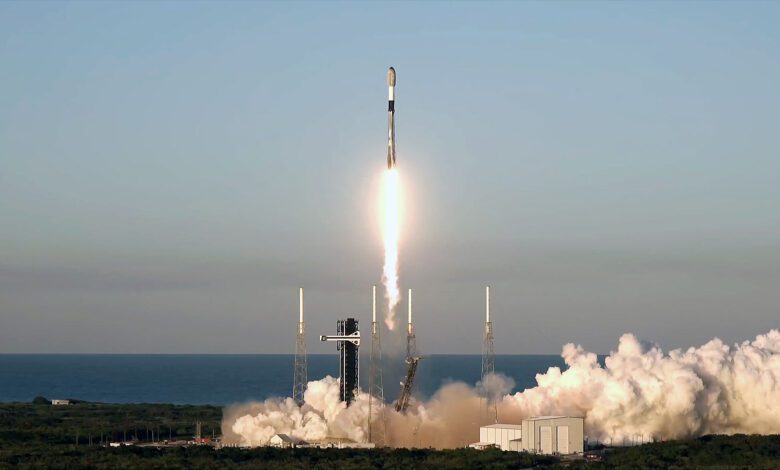
On Thursday, December 11, a Falcon 9 rocket lifted off from Cape Canaveral in Florida, carrying 29 Starlink satellites. Not only did this launch mark another step in the development of the global internet network, but it also entered the record books as the 300th orbital launch attempt worldwide in 2025. The rocket launched from SLC-40 at 5:01 p.m. Eastern (22:01 GMT), and just over eight minutes later, the satellites were already in Earth’s orbit.
The Starlink 6-90 satellite group has joined SpaceX’s rapidly expanding megaconstellation in orbit, which continues to grow each month. Roughly an hour after launch, the spacecraft were expected to reach their designated positions, delivering internet access to even the most remote parts of the globe.
Mission Success
The Falcon 9 first stage, known as Booster 1083, successfully completed its 16th mission. After separation, it landed smoothly on the drone ship ‘Just Read the Instructions’ stationed in the Atlantic Ocean. This maneuver has become routine for SpaceX, yet each time it demonstrates the company’s advanced engineering and reliability.
The Starlink network now includes more than 10,000 satellites, over 9,100 of which are operational and providing connectivity. Thanks to the project, millions around the world have gained access to high-speed internet, including areas where traditional providers cannot deliver a stable connection. In addition, Starlink is rolling out new services like direct satellite-to-mobile connectivity and onboard WiFi for airlines.
Records and Scale
The launch in Florida marked the 161st Falcon 9 mission this year and the 606th in the company’s history. For the global space industry, this launch represented a milestone: 300 orbital attempts in 2025 alone. This pace highlights the growing role of private companies in space exploration and the advancement of new communication technologies.
SpaceX continues to lead in the number of launches, with its rockets becoming increasingly reliable and reusable. Each new launch is not only another batch of satellites, but also a step toward more affordable internet access across different continents.
Technology and the future
The large-scale Starlink constellation has already transformed perceptions of satellite communications. The service is popular not only in rural and remote areas, but also among airlines, maritime carriers, and even military institutions. In the coming years, SpaceX plans to increase the number of satellites, expand coverage, and introduce new features—including direct connectivity between smartphones and orbiting satellites.
At the same time, the company is working to improve rocket technologies, reducing the cost of launches and increasing their frequency. This opens up new opportunities for commercial and scientific missions, as well as for the development of global communications infrastructure.
In case you didn’t know, SpaceX is an American aerospace company founded by Elon Musk in 2002. It became the first private firm to successfully launch a rocket into orbit and then return its first stage to Earth for reuse. The Starlink project launched in 2019 and has already become the world’s largest satellite network, providing internet services in dozens of countries. The company is also developing the super-heavy Starship rocket for interplanetary missions and is actively involved in NASA programs focused on exploring the Moon and Mars.