
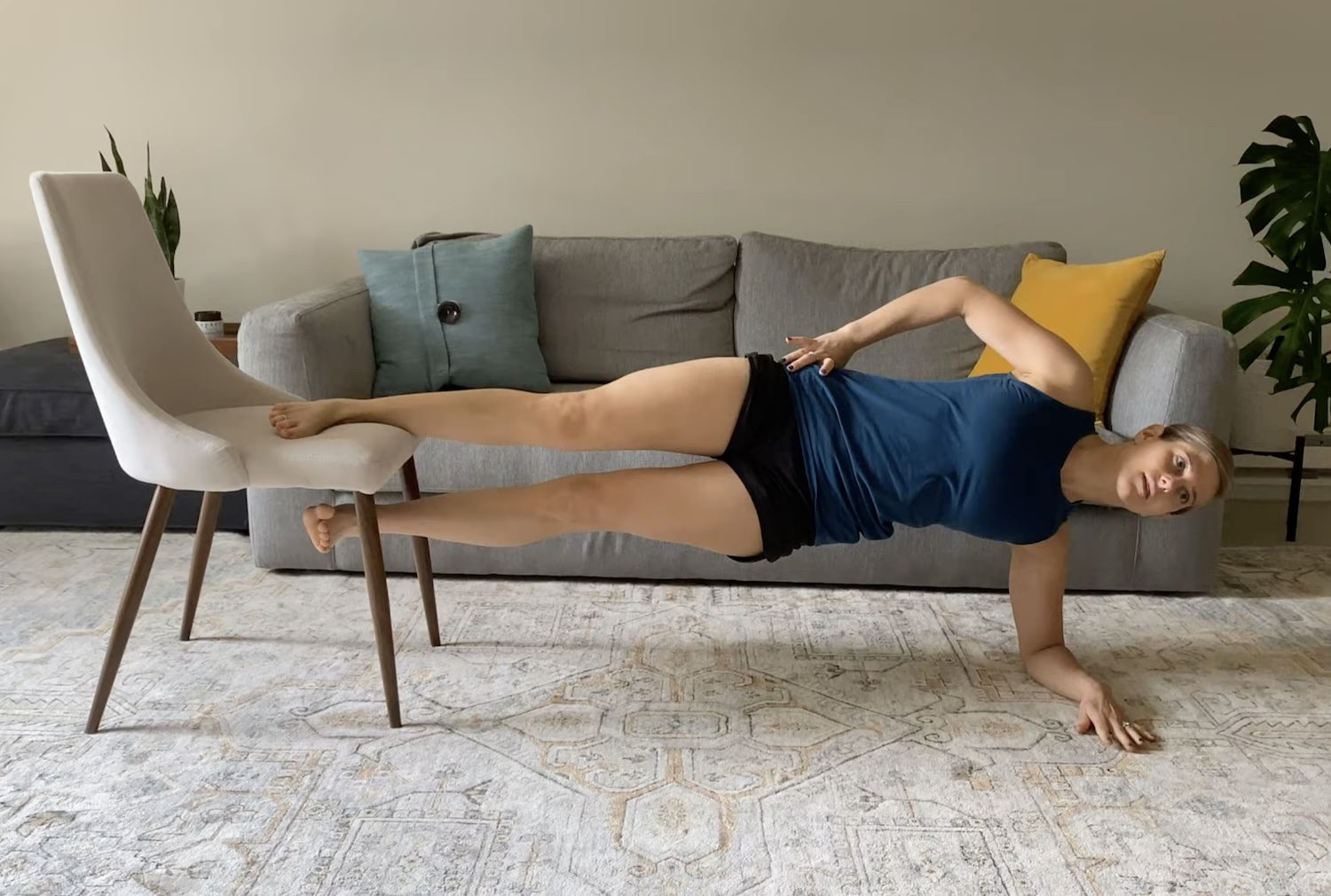
Most runners can breeze through their daily mileage, but ask them to hold a Copenhagen plank and the wobbling starts instantly. For Belleville, Ont., physical therapist and runner Kiana Cowger, that’s a clear indication that is a runner is at risk for injury.
The Copenhagen plank is a side plank variation where the upper thigh/foot rests on an elevated surface to lift the body. The exercise targets the adductors (the inner thigh/groin muscles), which are key contributors to hip stability, power and control while running, especially on trails or uneven terrain. If the adductors aren’t working during your Copenhagen plank, they sure aren’t working during your runs.
The role of the adductors
The adductors work hard during the single-leg loading phase of running, and when they’re weak, it can affect the entire kinetic chain. Weak adductors can increase the risk of hip or groin injuries, force other muscles to compensate or place extra stress on the knees, ultimately leading to a range of issues throughout the body.
The Copenhagen plank isolates the adductors effectively, so when the movement is difficult, it’s easy to attribute to adductor weakness. “[If you can’t do it], your lateral hip stability is compromised and your body is finding other (painful) ways to handle the load,” Cowger says. “Here’s the thing: stretching won’t fix it. Your ‘tight’ hips are actually weak hips.”
How to do the Copenhagen plank?
Lie on your side with your top leg bent at the knee, and resting on an elevated surface such as a bench or chair. (This is the short-lever version of the exercise). Support yourself on your forearm. Lift your bottom leg up so it hovers under the top leg.
Cowger recommends holding for 20 to 30 seconds per side, repeating for three rounds, twice a week.
Whether or not you show obvious weakness, the exercise is valuable to any routine to build and/or maintain strength. It’s also easy to progress: extend your top leg into a long lever so your foot rests on the bench, increase hold time or add reps by lowering and raising your hips. You can also place your elbow or knee on an uneven surface (such as a foam mat or a yoga ball) to increase the demand on your core and adductors.
Other adductor strength moves
Other ways to strengthen the adductors include yoga-ball adduction (sitting on a bench and squeezing a yoga ball between your legs) and lateral lunges. Another easy way to isolate the muscles is using the adductor machine at your local gym.
Glutes and abdominal muscles also play a major role in hip stability. For the adductors to function properly, runners should also be targeting those areas during strength workouts.
Stop stretching your hip flexors–try these strength moves instead