
Mars has always been a curious planet, often overshadowed by its larger neighbors, but recent research suggests that the Red Planet plays an unexpected role in shaping Earth’s climate. According to a study published on ArXiv and led by astronomer Stephen Kane, its gravitational pull has a surprising impact on Earth’s climate rhythms, affecting everything from the timing of ice ages to the length of the seasons. It turns out that our neighboring planet is more involved in the delicate balance of Earth’s climate than we ever realized.
How Mars’s Orbit Affects Earth’s Climate System
At first glance, Mars may not seem like a major factor in Earth’s climate. It’s smaller, colder, and far less massive than giants like Jupiter. But recent simulations conducted by Stephen Kane’s team show that the planet’s gravitational pull is anything but insignificant. By adjusting Mars’s mass and observing how it affected Earth’s orbital variations over millions of years, the team discovered that its size plays a pivotal role in Earth’s climate cycles.
The study, available on ArXiv, revealed that the presence of Mars is critical for the 100,000-year cycles that are tied to ice ages. These cycles, which drive the transitions between glacial and interglacial periods, become more pronounced when Mars is larger. In simulations where The Red Planet’s mass was reduced, this important cycle completely vanished.
It’s fascinating to think that Earth’s climate, which we often attribute solely to our relationship with the Sun, is actually shaped by the gravitational forces of neighboring planets. Without Mars, our planet’s climate might look quite different.
Mars, our neighboring planetary body, offers crucial insights into planetary evolution and potential future challenges for Earth. Although extensive robotic exploration has deepened our understanding, a human landing on Mars would be transformative.
Mars is approximately 140… pic.twitter.com/avfbXAB3oL
— Erika (@ExploreCosmos_) June 21, 2024
The Role of Milankovitch Cycles
Based on Science Alert, the Milankovitch cycles are the cornerstone of our understanding of long-term climate variations. These cycles, which include changes in Earth’s orbit, axial tilt, and precession, influence the distribution of solar energy that reaches our planet. While the 405,000-year eccentricity cycle, which is primarily driven by Venus and Jupiter’s interactions, remains relatively stable, the shorter, the fourth planet directly impacts more dramatic cycles.
Kane’s team found that as its mass increases, the 100,000-year cycles become stronger and more powerful. This means that Mars’s gravitational influence amplifies these climate shifts, potentially contributing to the timing of ice ages. In contrast, when the Earth’s Neighbor’s mass decreases in simulations, these cycles fade away entirely.
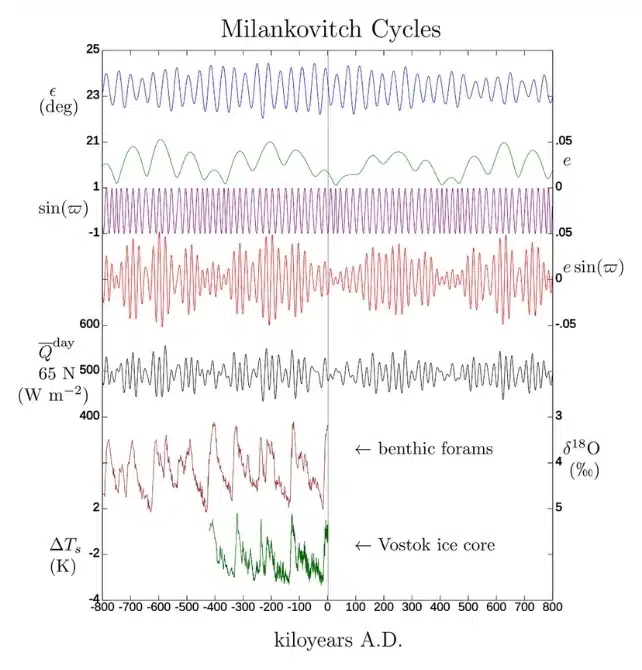 A visual breakdown of milankovitch cycles and their impact on orbital elements. Credit: Incredio
The Red Planet and the Changing Length of Seasons
Another intriguing result from the study is Mars’s influence on Earth’s axial tilt, or obliquity. This tilt is what gives us our seasons, and it changes on a roughly 41,000-year cycle. Kane’s team found that this cycle could stretch if Mars’s mass increased. If the rust-colored world were ten times more massive than it is now, the obliquity cycle would shift to a dominant period of 45,000 to 55,000 years.
This shift in the axial tilt would have significant implications for Earth’s climate. A longer cycle could affect the timing of ice sheet growth and retreat, potentially making our climate more unpredictable. It’s a clear example of how small changes in Mars’s mass could ripple out and have a big impact on our planet’s weather patterns.