
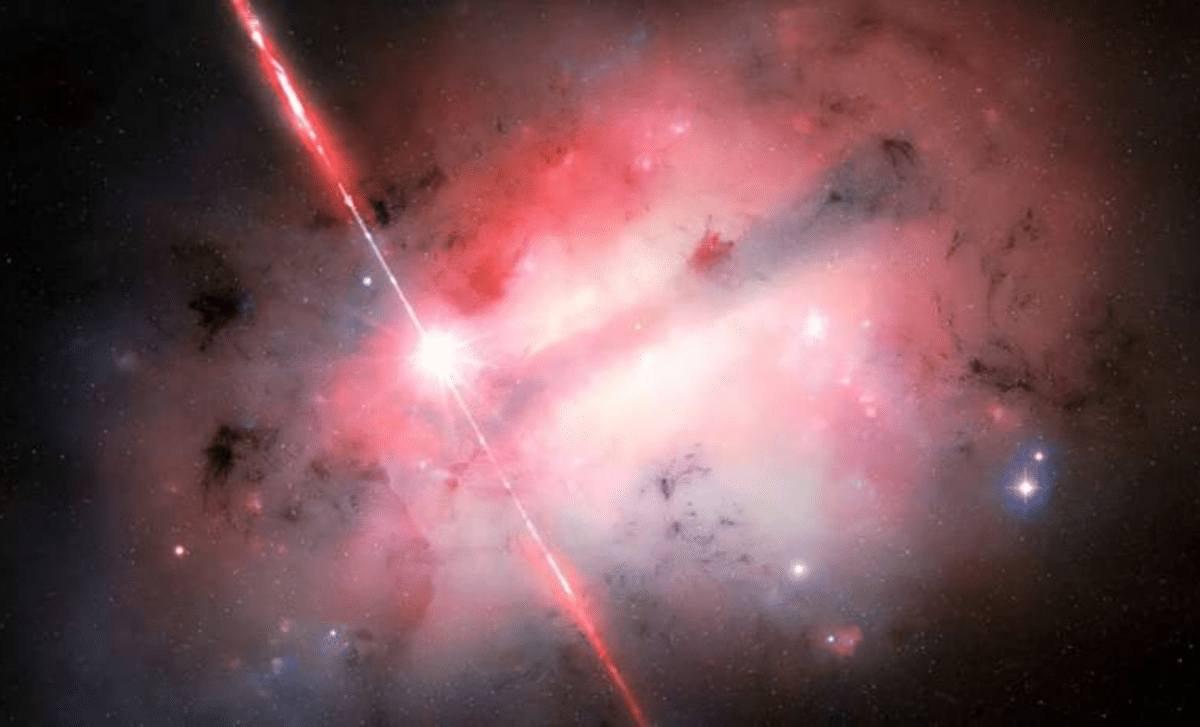
A new breakthrough study from Rutgers University is offering insights into one of the universe’s most extraordinary phenomena—an enigmatic cosmic explosion that has left scientists in awe. This event, known as GRB 250702B, has baffled astronomers due to its intense and prolonged activity, which defies traditional explanations for similar occurrences. A team of astrophysicists, including researchers from Rutgers University, is at the forefront of this investigation, leveraging cutting-edge space-based tools to understand the intricacies of this unprecedented explosion.
A Cosmic Puzzle Unfolds
Gamma-ray bursts (GRBs) are among the most powerful and fleeting explosions observed in the universe, typically lasting for mere moments before fading away. But GRB 250702B has broken the mold, lasting several hours and even exhibiting unexpected X-ray activity a day prior to the event. This anomaly has sparked a wave of questions regarding its origins and the physics involved.
“This object shows extreme properties that are difficult to explain,” said Huei Sears, a postdoctoral researcher at the Rutgers Department of Physics and Astronomy, who is leading the study.
Scientists have long observed GRBs, but this particular event has stretched the boundaries of what’s previously understood about these bursts. What sets GRB 250702B apart is its unusual duration and its sustained, energetic activity, unlike the typical brief flashes scientists expect. The team’s investigation is focusing on understanding why this burst behaves so differently, raising the possibility that there might be new, as-yet-unknown factors at play in the formation and evolution of such powerful cosmic phenomena.
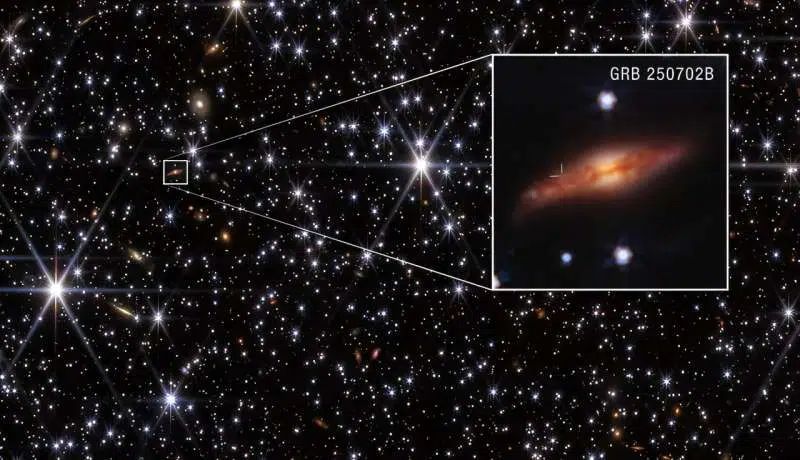 On Oct. 5, NASA’s James Webb Space Telescope gave astronomers their clearest view of the host galaxy of a powerful explosion called GRB 250702. The galaxy is so far away its light takes about 8 billion years to reach the Earth. It appears within a star field in the densely packed central plane of our own Milky Way galaxy. In the zoomed inset, tick marks indicate the burst’s position near the top edge of the galaxy’s dark dust lane. This location eliminates the possibility that the burst was associated with the supermassive black hole at the galaxy’s core. Credit: NASA, ESA, CSA, H. Sears (Rutgers). A. Pagan (STScI)
The Pioneering Research of GRB 250702B
The study of GRB 250702B required an unprecedented collaboration between different space missions and observatories, each contributing unique data to help unlock the secrets of this explosion.
“Usually, these bursts are over in less than a minute, but GRB 250702B lasted for hours and even showed signs of X-ray activity a day prior,” explained Eliza Neights, an astronomer at NASA’s Goddard Space Flight Center, underscoring the unusual nature of this event.
The findings of this study have challenged existing models of gamma-ray bursts and could have profound implications for astrophysical theories concerning the lifecycle of stars and black holes.
By studying GRB 250702B, researchers are not only questioning long-standing assumptions about gamma-ray bursts but are also opening new doors to understanding the extreme environments where these events occur. In particular, the event is offering unprecedented insights into how stars and black holes interact and evolve, potentially changing how scientists look at these cosmic objects in the future. This marks an exciting moment in astrophysics, where new questions are emerging, and old assumptions are being reevaluated.
Tidal Disruption Events: A New Chapter in Stellar Evolution
GRBs are typically linked to the death throes of massive stars or the collisions of neutron stars. However, GRB 250702B’s unusual characteristics have prompted researchers to consider new possibilities, such as tidal disruption events, in which a star is torn apart by the intense gravitational pull of a black hole. “We have only seen a few tidal disruption events of this type, so we don’t know for sure how they’re supposed to evolve,” said Sears, hinting that GRB 250702B could provide the key to understanding these mysterious and catastrophic events.
These events are rarely observed, and their study could reveal new aspects of how black holes interact with stars. Unlike other GRBs, which are more easily explained by traditional models, GRB 250702B presents an opportunity to explore the boundaries of stellar death and black hole formation in greater detail. The complexity of this event suggests that there might be more to discover, and it is prompting scientists to reexamine what they know about cosmic explosions and their aftermath.
A Rare Cosmic Phenomenon Captured in Unprecedented Detail
The uniqueness of GRB 250702B is also underscored by the level of detail in which it has been captured by scientists. “In such vibrant and unprecedented detail, we see just one very large galaxy with a dust lane,” said Sears. The observation revealed a complex galaxy structure that defied expectations, raising new questions about the interplay between galaxies and the cosmic phenomena occurring within them. This level of observation is rare, and researchers are excited by the potential for further discoveries that could follow.
As data pours in from various space telescopes and ground-based observatories, the team is piecing together a clearer picture of the explosion’s origin. However, the complexity of the event means that some aspects remain uncertain. “The galaxy has such a complex structure that it’s not 100% clear if there’s anything left to see of the explosion, but if there is, it’s really faint,” said Sears, suggesting that the true extent of the explosion’s effects may be much more subtle than previously thought.
Implications for the Future of Astrophysics
Despite the uncertainties surrounding GRB 250702B, the data gathered so far is already shaping the future of astrophysical research. “This gives us a unique chance to study the extremes of how stars and black holes evolve,” said Sears, highlighting the potential for groundbreaking discoveries. The explosion could even turn out to be the first of its kind, offering a glimpse into a new area of astrophysical phenomena that has never been observed before.
While some of the theories about GRB 250702B remain speculative, the sheer rarity of the event means that every new discovery provides valuable insight into the workings of the universe. “This is certainly an outburst unlike any other we have seen in the past 50 years,” said Neights, reaffirming the magnitude of the find. As the research continues, the potential for uncovering completely new cosmic phenomena grows, presenting an exciting horizon for future exploration.