
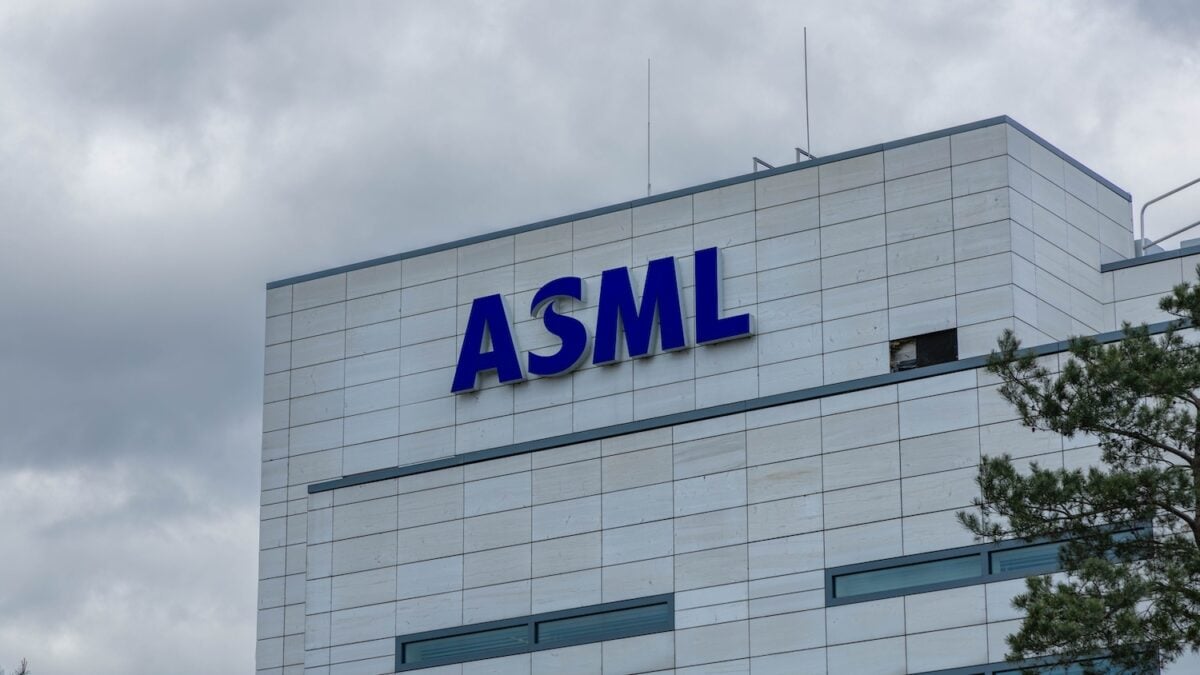
As a new Bloomberg profile of the Dutch lithography giant ASML points out, the global economy is counting on one monopoly’s ability to shoot lasers at tin droplets again, but do it even better this time.
To be clear, the legal theory on monopolies doesn’t say everyone who corners a market is a villain. If a firm simply makes a far superior product, and runs the table economically on that basis alone, antitrust law isn’t supposed to kick in and break that company up for doing a good job. As previously noted by Gizmodo, ASML does a magic trick that, so far, no one else can.
But monopolies in AI are unsettlingly ubiquitous. Nvidia famously dominates the market for data center GPUs, and it’s been investigated by U.S. antitrust cops. Only 10% of the AI GPU market belongs to other companies.
ASML’s monopoly makes Nvidia’s look almost quaint. Bloomberg frames ASML as the bottleneck that AI flows through, because it is. If you want to make the most advanced AI chips, you need ASML’s lithography machines, and you can literally accept no substitutes because there are none. Bloomberg describes ASML’s chokehold on premium lithography in blunt terms: its market share is “a cool 100%,” and ASML is “still the only company” capable of making the extreme ultraviolet (EUV) systems high-end chips require.
I can’t fully explain how ASML’s absurd technology exists, because I’m not an engineer, but if you’ve heard of it, it’s because you’ve seen news coverage of the company’s enormous $400 million machines, shipped from the source in tact on dedicated plane flights. And maybe you’ve heard that these machines work by shooting lasers at airborne, microscopic droplets of molten tin, turning them into a plasma that generates EUV light brighter than the sun, and then use advanced optics to focus that light in order to print the intricate patterns onto the GPUs used to train and run AI systems.
So for the most part, Nvidia designs them, and TSMC manufactures them with ASML’s machines
But there’s tension in Bloomberg’s profile, because CEO Christophe Fouquet’s “next big test” as Bloomberg writes, is coming up: ASML is transitioning from the EUV process already in place to “high numerical aperture” (High NA) aimed at reaching new levels of intricacy—printing at sub-2-nanometer process nodes. As always, smaller means higher performance at lower heat levels and with less power required.
But it’s unnerving how much economic “heat” and “power” is focused on this one dazzlingly bright potential point of failure.
In some ways, ASML’s products are the global economy right now. A recent New York Times report describes a “two-track economy” where “everything tied to artificial intelligence is booming” while everything else is stagnant, declining, or at least not exactly vibrant. AI—or more specifically, investors dumping money into AI—is almost the only thing making companies do things like build and hire people.
So ASML and Fouquet’s “High NA” transition is just a company moving onto a new product cycle, sure, but in some sense, ASML feels like the last remaining lug nut holding a loose wheel onto a truck that’s going freeway speeds. And the truck has everyone on Earth’s economic security inside it.