
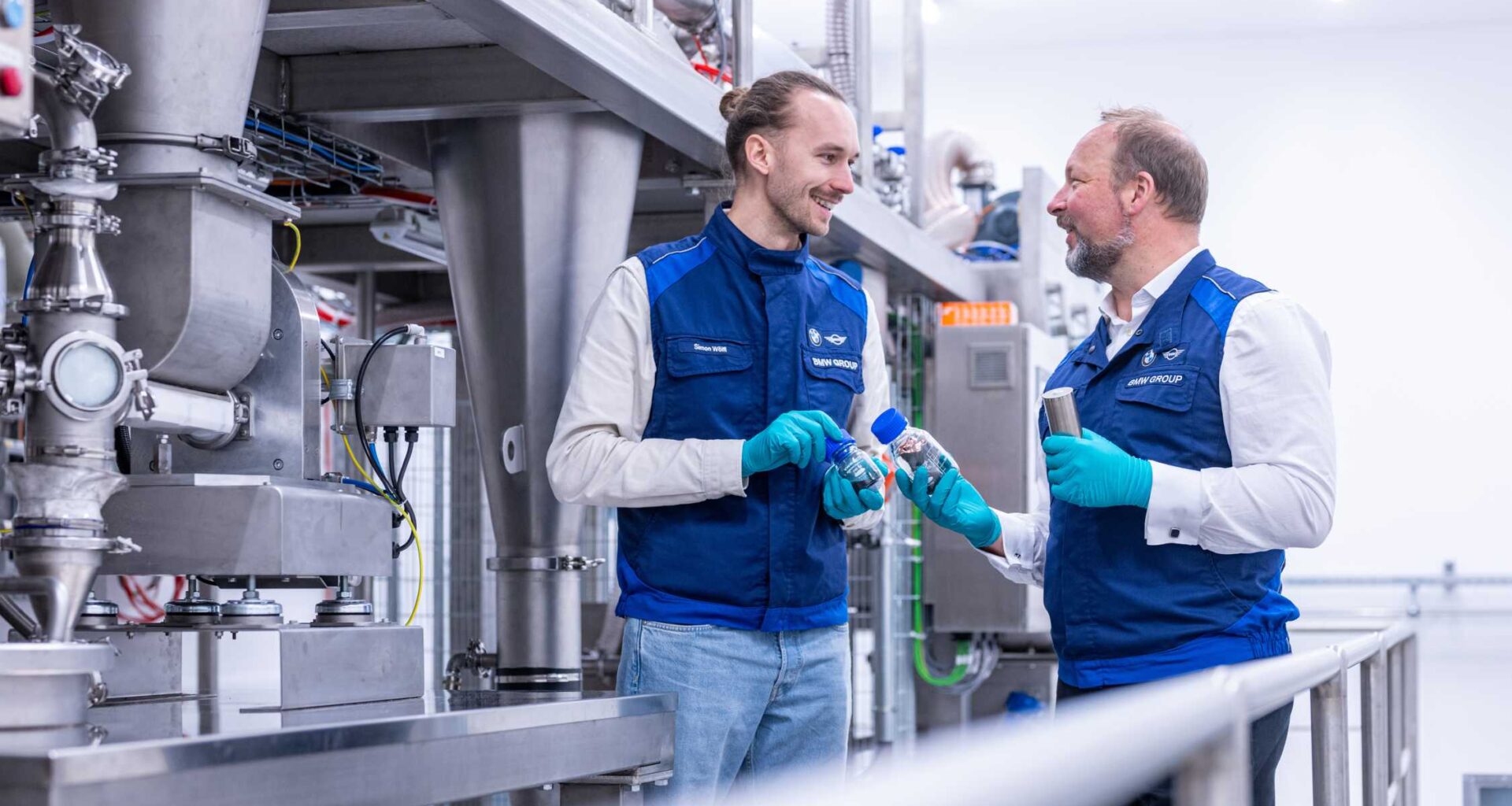
Munich/Salching. The new Cell Recycling Competence
Center (CRCC) in Salching in Lower Bavaria has now been officially
commissioned – marking a major step forward in implementing innovative
direct recycling as a joint project between the BMW Group and Encory
GmbH. For construction and operation of the new Competence Center, the
BMW Group and Encory are relying on regional partners.
Innovative direct recycling enables reuse of battery raw materials
Direct recycling allows residual materials from battery cell
production, including complete battery cells, to be mechanically
dismantled. The raw materials are not entirely reverted to their
original state, but are instead “directly” fed back into the cell
production cycle. This direct recycling methodology, developed by
experts from the BMW Group, therefore eliminates the conventional,
energy-intensive chemical or thermal processing previously required.
At the new CRCC, direct recycling will be scaled up and introduced in
stages until, once fully operational, the annual volume of battery
cell material recycled will be in the mid-double-digit tonne range.
Going forward, the recovered raw materials will be directly reused in
pilot production of battery cells at the company’s own Cell
Manufacturing Competence Center (CMCC) in Parsdorf.
Direct recycling: A process for the future
“Our direct recycling process puts us at the forefront of the
industry,” explains Markus Fallböhmer, SVP of Battery Production at
BMW AG. “This technology has tremendous potential to further optimise
battery cell production.” It is also conceivable that, for the first
time, cell manufacturers could be enabled to use direct recycling in
series production.
Joint venture runs Competence Center – IP remains with BMW Group
An existing hall in Salching in Lower Bavaria (Straubing-Bogen
district) will be used for the new Competence Center. In addition to
the production area and warehouse space of around 2,100 m², the
building also offers just under 350 m² of offices and break rooms, as
well as photovoltaic systems on the roof. While the Competence Center
will be built and operated by Encory GmbH, the intellectual property
for the recycling method is fully owned by the BMW Group. As a joint
venture between the BMW Group and the Interzero Group, Encory will
develop and implement logistics and consulting solutions, including
for recovery, recycling and reconditioning of vehicle components. Both
partners hold a 50-percent stake in the company. The new Competence
Center will employ about 20 people.
Strong partners from the region
With the exception of one Swiss company, only German firms were
contracted for the construction and operation of the Competence
Center. Nearly half of these companies are located within a
100-kilometer radius of Salching.
Optimal location for new Competence Center in Bavaria
The BMW Group consolidates its battery cell expertise at its
Competence Centers in Munich, Parsdorf and Salching. The Battery Cell
Competence Center (BCCC) in the north of Munich offers
state-of-the-art labs and research facilities for developing the
battery cells for next-generation high-voltage batteries and producing
them in small quantities. The best battery cell from the BCCC will be
scaled up for series processes on a pilot line at the Cell
Manufacturing Competence Center (CMCC) in Parsdorf. Recycling of
surplus material from pilot production in Parsdorf will take place at
the new Cell Recycling Competence Center (CRCC) in Salching. The
recovered raw materials will then be reused in cell production,
ensuring short distances between all Competence Centers and preventing
valuable raw materials from being lost. Following on from the BCCC and
CMCC, the CRCC thus represents the next step in the BMW Group’s
battery cell strategy on the road to the circular economy.
Circular economy at the BMW Group
The BMW Group views the circular economy as one of the key issues in
shaping more resource-efficient mobility. Its approach is aimed at
finding the best ways to keep materials in the cycle – ensuring that
resources are not lost, but retain their value for long-term use. The
BMW Group applies the principles of Re:Think, Re:Duce, Re:Use and
Re:Cycle. From vehicle design and production, to recycling and reuse,
everything is geared towards ensuring that vehicles can serve as a
source of raw vehicles at the end of their use phase. The BMW Group is
taking steps to increase the percentage of recycled materials. It
returns selected production residues to the material supplier or
material processor, enabling their recovery and reintroduction into a
new manufacturing process. In this way, recycled and reused materials
are already making their way into BMW Group vehicles today. The
circular economy requires holistic thinking – from product design, all
the way through to vehicle recycling.