
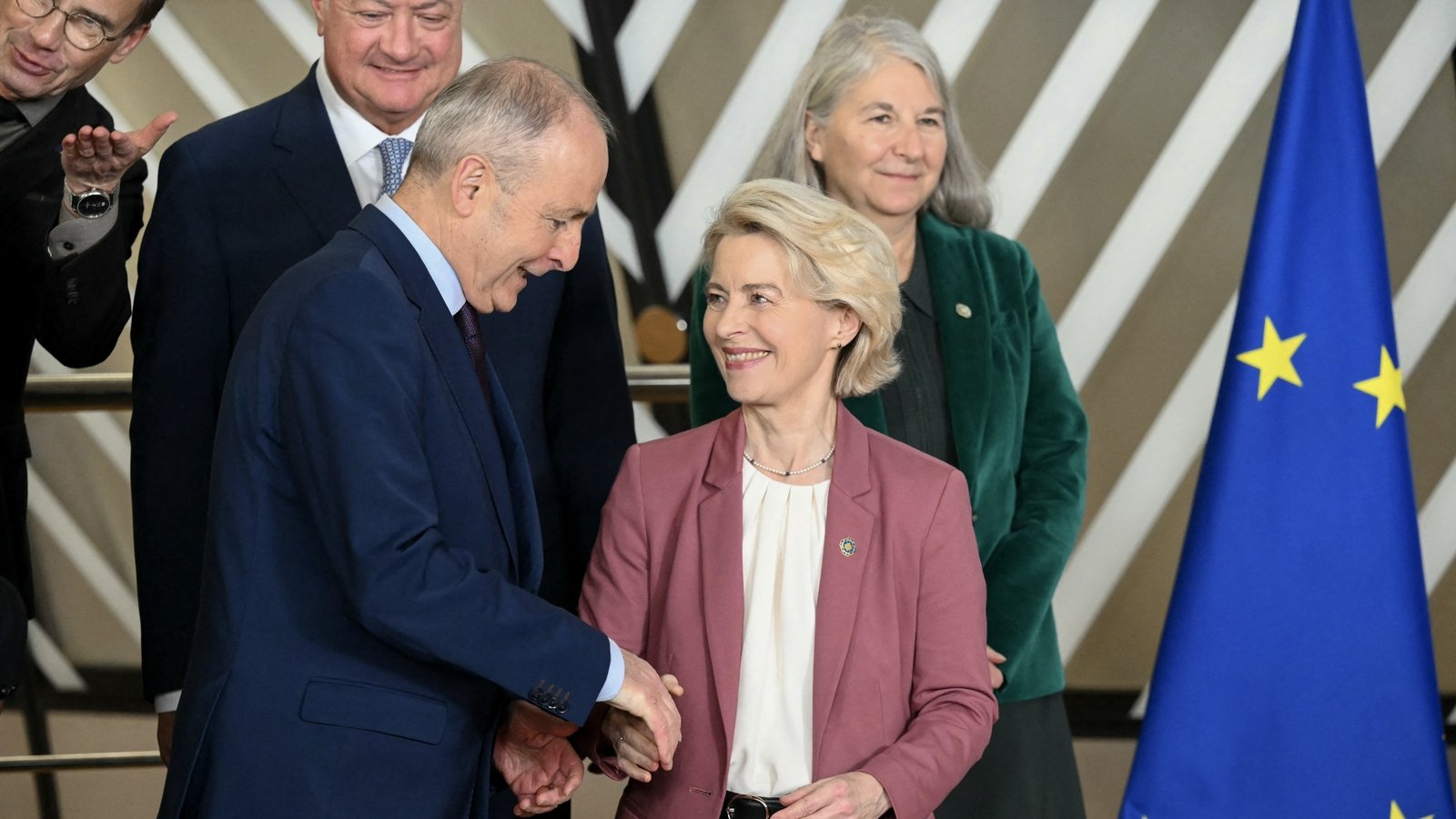
EU leaders are gathering in Brussels for what has been described as one of the most consequential summits in years, with a decision to convert hundreds of billions of euro in immobilised Russian assets into a long term loan for Ukraine hanging in the balance.
Most member states, including Ireland, want to use up to €210 billion in frozen Russian assets to underwrite a loan.
However, Belgium continues to resist the plan, and there are reservations from a small number of other member states.
Officials say it is the best way to provide Ukraine with the military and financial support it needs to both survive and to strengthen its position in any peace negotiations.
Ukraine will run out of money early next year.
In October, EU leaders – with the exception of Hungary – pledged to find ways to fund the country for the next two years, both for its own survival and to show Russia that Europe continues to support the country.
However, since the vast bulk of Russia’s frozen those assets are held in a Belgian company called Euroclear, the Belgian government has objected, fearing a potential legal claim by Russia.
The European Commission has insisted that no Russian or international arbitration court can hold Belgium liable so long as the assets are subject to EU sanctions.
Last week, the EU used emergency powers to ensure those sanctions are locked in until Russia starts to pay reparations, so that Hungary cannot veto them.
Belgium says it wants full mutualisation of the risk. Prime Minister Bart de Wever has also said leaders should consider using so-called headroom in the EU budget against which joint debt could be raised.
However, that appears to be a non-starter, as it would require unanimity, and Hungary would almost certainly block such a move.
Officials say agreement on using Russian assets would send a signal to the Trump administration and Russia that Europe is serious about supporting Ukraine in its hour of need.
The European Council will also discuss the Middle East, as well as EU enlargement, security and defence and combatting antisemitism.
The EU’s next multi-annual budget (2028-2034), competitiveness and migration are also expected to be discussed.
Ahead of the meeting with EU leaders, Taoiseach Micheál Martin said he looked forward to hearing from Ukrainian President Volodymyr Zelensky, who met Mr Martin in Dublin earlier in December.
“I fully support plans to use frozen Russian state assets to support Ukraine, and I hope it will be possible for the meeting to reach an agreement on that,” he said.
“I will also be arguing strongly in favour of accelerating Ukraine’s EU application. Membership of the EU for Ukraine is also important for its future security.
“Our meeting is an opportunity to send a clear message that EU enlargement will happen, and that the reform efforts by countries aspiring to join our union will be matched by our ambition to advance their path towards EU membership.
“There are malign actors, including Russia, who are seeking to destabilise the EU and our neighbours, attacking our shared values and posing a real threat to our security.”
Referencing sightings of drones near Dublin as Mr Zelensky arrived in Ireland, Mr Martin added, “As recent events have shown, Ireland is not immune to these threats and we must continue to work with our EU partners to combat them.”
The Taoiseach also said he would highlight the “critical” humanitarian crisis facing people in Gaza.
“Two months into the ceasefire, aid has still not reached the levels required and as agreed in the peace plan,” he said.
“I will be stressing the need for the EU to do all it can to get this much-needed assistance to the people of Gaza, especially as winter closes in, and to contribute to the next phase of the peace plan, which supports a two-state solution,” he added.
Addressing Sunday’s Bondi Beach attack, he also said he welcomed that the European Council will look to “intensify efforts to rid our societies of the scourge of anti-Semitism”.
“We were all deeply shocked and appalled by the terrorist attack on the Jewish community in Sydney,” he said.
“There can be no place for anti-Semitism and hatred in our societies,” he added.
He said he would argue that the EU should be open to trade and invest in innovation, and said Ireland wanted a “ringfenced and fully funded” CAP and Common Fisheries Policy.
Additional reporting PA